
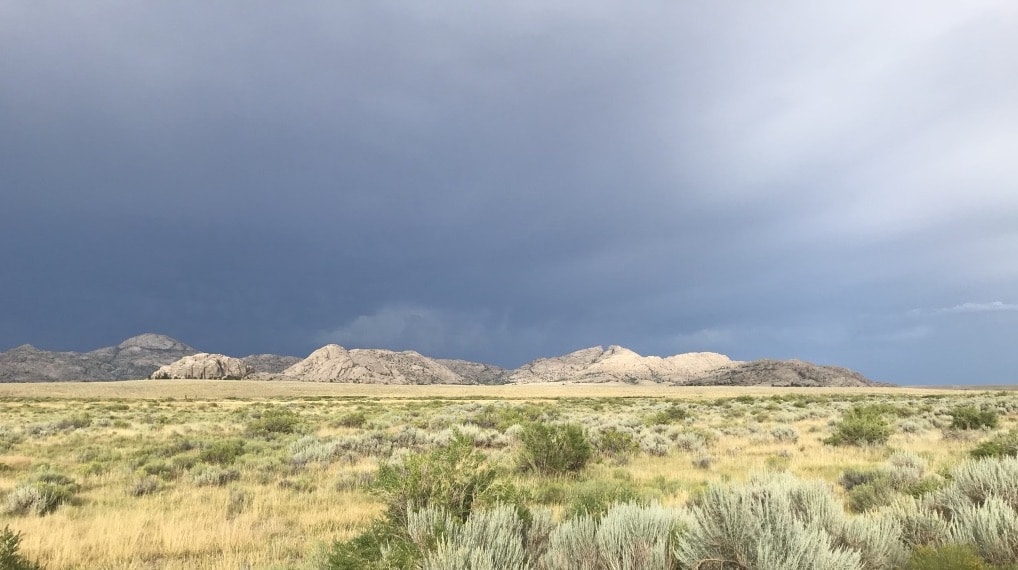
Split Rock was a key landmark for emigrants on the Oregon, Mormon and California Trails. (Katie Klingsporn/WyoFile)

We hear about metaphorical landmarks nearly every day: landmark legal decisions, sports victories, speeches, etc.

But in this era of ubiquitous GPS and navigation applications, fewer and fewer Americans have regular use for the real thing — “An object or feature of a landscape or town that is easily seen and recognized from a distance, especially one that enables someone to establish their location,” according to Oxford Dictionaries online.

That hasn’t always been the case. Hundreds of thousands of emigrants on the Oregon, Mormon and California Trails across Wyoming relied on known landmarks to set their courses through the vast expanses of high desert prairie. Perhaps none was more prominent on the landscape or in the imagination than Split Rock, with its distinctive “gun-site notch” aiming the way to the continental divide at South Pass, some 75 miles distant.

At covered-wagon pace, travelers once kept Split Rock in sight for days. Now, most zip past in minutes on Highway 789/287. But Split Rock didn’t become an icon for no reason. It still grabs the eye, and the imagination, as it did with one modern migrant and her camera last month. 

After all, a landmark’s not much use without staying power.

Support WyoFile with a tax-deductible donation today.

Matthew Copeland is the chief executive & editor of WyoFile. Contact him at matthew@wyofile.com or (307) 287-2839. Follow Matt on Twitter at @WyoCope

Join the Conversation

1 Comment

WyoFile's goal is to provide readers with information and ideas that foster constructive conversations about the issues and opportunities our communities face. One small piece of how we do that is by offering a space below each story for readers to share perspectives, experiences and insights. For this to work, we need your help.

What we're looking for: 

  • Your real name — first and last. 
  • Direct responses to the article. Tell us how your experience relates to the story.
  • The truth. Share factual information that adds context to the reporting.
  • Thoughtful answers to questions raised by the reporting or other commenters.
  • Tips that could advance our reporting on the topic.
  • No more than three comments per story, including replies. 

What we block from our comments section, when we see it:

  • Pseudonyms. WyoFile stands behind everything we publish, and we expect commenters to do the same by using their real name.
  • Comments that are not directly relevant to the article. 
  • Demonstrably false claims, what-about-isms, references to debunked lines of rhetoric, professional political talking points or links to sites trafficking in misinformation.
  • Personal attacks, profanity, discriminatory language or threats.
  • Arguments with other commenters.

Other important things to know: 

  • Appearing in WyoFile’s comments section is a privilege, not a right or entitlement. 
  • We’re a small team and our first priority is reporting. Depending on what’s going on, comments may be moderated 24 to 48 hours from when they’re submitted — or even later. If you comment in the evening or on the weekend, please be patient. We’ll get to it when we’re back in the office.
  • We’re not interested in managing squeaky wheels, and even if we wanted to, we don't have time to address every single commenter’s grievance. 
  • Try as we might, we will make mistakes. We’ll fail to catch aliases, mistakenly allow folks to exceed the comment limit and occasionally miss false statements. If that’s going to upset you, it’s probably best to just stick with our journalism and avoid the comments section.
  • We don’t mediate disputes between commenters. If you have concerns about another commenter, please don’t bring them to us.

The bottom line:

If you repeatedly push the boundaries, make unreasonable demands, get caught lying or generally cause trouble, we will stop approving your comments — maybe forever. Such moderation decisions are not negotiable or subject to explanation. If civil and constructive conversation is not your goal, then our comments section is not for you. 

Your email address will not be published. Required fields are marked *

  1. In the foreword to “Love Song to the Plains”, Mari Sandoz wrote, “When I was seven or eight I liked to climb to the top of Indian Hill overlooking miles of the river and beyond, to where I hoped to see far places in the shimmering mirages, perhaps even Laramie Peak, as old-timers promised.”