

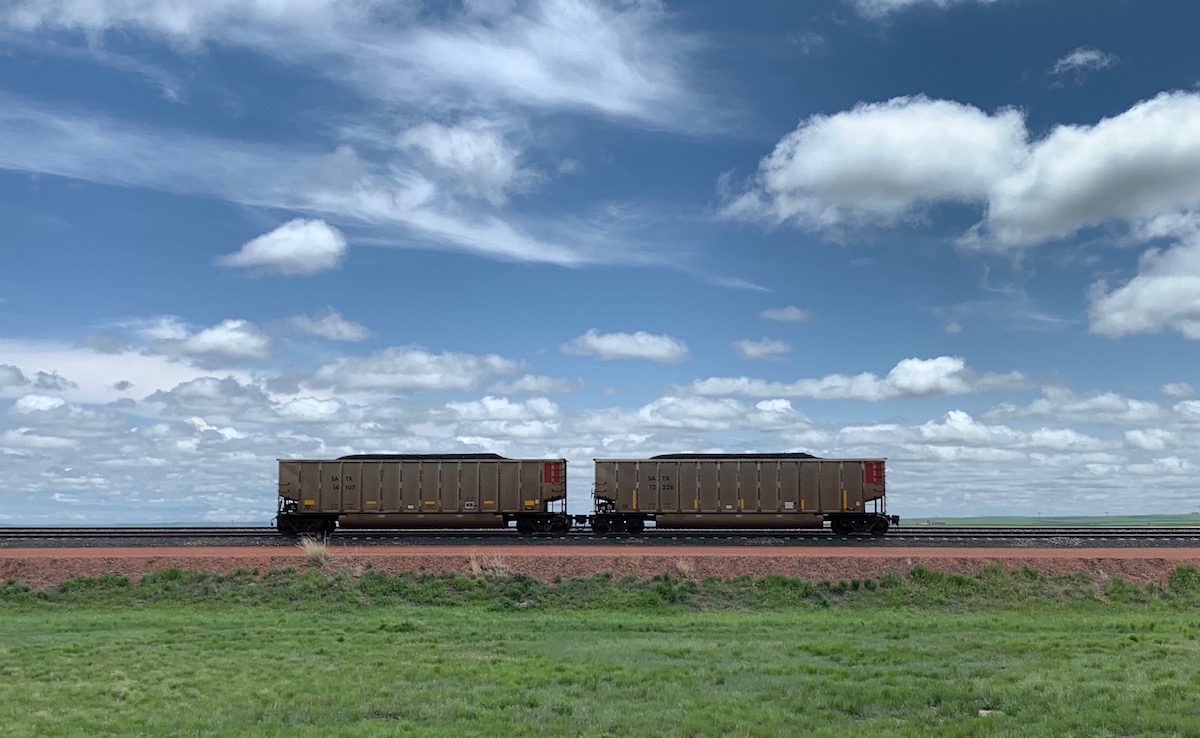
Wyoming’s largest electric utility will move forward with new plans to potentially retrofit one of its coal-fired power plants with carbon-capture technology, following initial estimates of astronomical costs that could further inflate monthly electric bills.
Rocky Mountain Power, a division of Warren Buffet’s PacifiCorp, announced Friday it has signed a memorandum of understanding with North Carolina-based 8 Rivers, which has developed an oxyfuel process that “uses carbon dioxide to drive a turbine to generate power,” according to a Rocky Mountain Power press release. The partnership includes support from South Korea’s SK Group, a conglomerate of global tech innovation companies.
The first order of business will be to determine whether to retrofit the Wyodak coal-fired power plant near Gillette or the Dave Johnston coal plant outside Glenrock. Rocky Mountain Power has not offered a timeline for that decision. Once a site has been selected, according to the company, the partners will “conduct feasibility evaluations, with an expectation of advancing to various phases of engineering and design studies,” according to the company.
After those studies are complete, Rocky Mountain Power and its partners will make a final determination about whether to move forward with construction.
Critically, Rocky Mountain Power ratepayers will be spared from having to cover “upfront” costs for the engineering design and feasibility analysis — costs that could exceed $10 million, according to some estimates.

“Any upfront development capital costs of the project will not be shouldered by Rocky Mountain Power customers but will instead be carried by the 8 Rivers development team,” the utility said.
Gov. Mark Gordon gave credit to himself and lawmakers for what he considers a remarkable step forward in implementing one of his top climate and energy policies.
“This decision to take this action comes as a result of the Wyoming Legislature and me working closely together in both policy and legislation in support of keeping our coal as a base fuel for dependable, dispatchable energy,” Gordon said in a prepared statement on Friday.
State mandate
The plan is a major step forward for Wyoming’s controversial efforts to force utilities to retrofit the state’s coal-fueled power plants with carbon capture technology in hopes of extending the operating life of the plants — and the jobs and revenue they provide to local communities.
The Wyoming Legislature has passed a handful of bills in recent years to mandate carbon capture retrofits at coal plants and to sell the captured greenhouse gas for industrial uses such as enhanced oil recovery.
Lawmakers passed Senate File 42 – Low-carbon reliable energy standards-amendments in March, which not only moved the compliance deadline back from 2030 to 2033, but clarified that Wyoming ratepayers are on the hook for both the cost of analyzing the feasibility of retrofitting coal plants and the cost of construction and operation. Those costs are not insignificant, particularly at a time when electricity customers are already seeing rate hikes.
Cost estimates
Black Hills Energy currently taps its Wyoming customers for a $1.1 million “low carbon” surcharge to cover the costs of state-mandated feasibility studies, while Rocky Mountain Power customers pay an annual $2 million. And that’s the ratepayer burden for just the initial phases of study. The next phases of mandated studies for Black Hill Energy, for example, could exceed $10 million, according to the company’s initial filings with the state.

However, those particular liabilities, at least for Rocky Mountain Power customers, would shift to 8 Rivers as the partnership moves forward, according to the utility.
When is unclear.
Then there’s the cost of actually building and operating a carbon capture facility at an existing coal-fired power plant — a prospect that many critics have said is too costly and technologically challenging compared to non-fossil fuel alternatives. Construction costs alone range from $500 million to beyond $1 billion for each of the four coal-burning units now subject to Wyoming’s mandate, according to preliminary estimates utilities filed with the state in 2023.

Both Rocky Mountain Power and Black Hills Energy are expected to file updated engineering and implementation cost estimates with the state next week. Regardless of the estimated price tag, the utilities’ ratepayers will still be on the hook to cover whatever might ultimately be built.
“A great deal of work remains ahead before we can talk with any certainty about whether this project will be built,” Rocky Mountain Power spokesman David Eskelsen told WyoFile on Friday. “This is an exciting proposal, to be sure, but it must satisfy the regulatory standard of being in the public interest before proceeding to the construction phase. That’s the question the MOU is crafted to address.”
The utility, however, described the application of 8 Rivers’ carbon capture technology at its Wyoming coal plants as economic and “competitively viable.”
“Rocky Mountain Power has been diligently engaged in the process to comply with Wyoming’s desire to implement carbon capture at the company’s coal generating units in Wyoming,” Rocky Mountain Power Vice President for Environmental, Fuels and Mining James Owen said in a prepared statement. “The partnership and collaboration announced today is a major step forward in determining if carbon capture technologies can bring benefits to our customers in Wyoming at a reasonable cost.”


This ignores the experience of all other attempts at coalfired power plants to make it work economically. The ratepayers of Wyoming need to pay attention, and remove the fools who voted for this nonsense.
The supercritical Allam-Fetvedt CO₂ cycle being investigated for aplication will require entirely new equipment to build. If sited at a retiring cola plant, the electrical transmission infrastructure and water supply for cooling probably can be reused. If coal is used, then the coal handling facilities can probably be utilized.
The 50 MW test facility for this cycle, operating in Texas, shows that the cycle can be accommodated with existing engineering knowledge. The real challenge will be using mined coals as the fuel source. The test facility burns natural gas, not coal.
Switching to a coal-based fuel introduces troublesome contaminants into the cycle. The turbine expander (part of a Brandon cycle) will have to “handle” whatever is entrained in the gas stream. Any carryover of ash, chlorides, or sodium will be very troublesome, causing wear, deposition, and corrosion damage of the geometry of the gas path in the turbine.
Operating a Brandon (Simple Gas Turbine) Cycle on pulverized coal has been attempted. It did not work out well after a day or two of operation.
This intended plant can operate at eyebrow-raising thermal efficiency, perhaps about twice as efficient as a supercritical steam (Rankine) cycle! What good is that, if the turbine must be overhauled every 2-3 weeks?
So, the new cycle doesn’t make much use of the existing plant equipment.
Hopefully, the contamination issue can be overcome. Just do that testing and development in Texas, first.
The energy corporations decision to engage Carbon Capture now seems more political to me than geophysical…
… because it will never pencil out to be economical.