

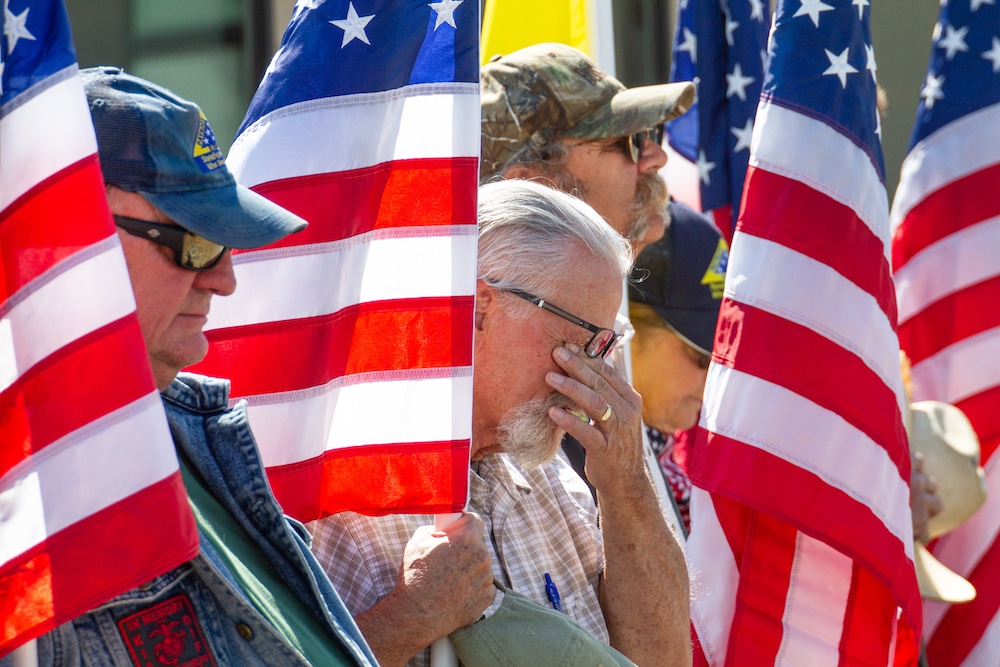
Sometimes veterans give their lives in ways that don’t land them in the cemetery.
Opinion
I’m not a veteran, but as a psychotherapist with nearly a quarter century in practice, I’ve seen the toll trauma takes on those who serve in the U.S. armed forces.
I volunteer most of my work with veterans for two reasons. First, I did not serve and I know I owe a debt to those who did. I am not very good at soldiering, but I think I am good at therapy, so that is what I have to offer. Second, I have learned that my profession, though well-intentioned, has not always served the veteran particularly well, and it can be hard to earn veterans’ trust. I “give” my service, just as veterans have given theirs, in the hopes of opening the door to conversations that could lead to therapeutic relationships.
This Memorial Day I am reflecting on two veterans: one who has passed and one who has not. The one we memorialize passed away last week in our Riverton hospice. He’d lived a full life, was an accomplished psychotherapist, horseman, musician, and at 76 succumbed to cancer.
The other veteran also beams with the light of life and I have come to know him as well-intentioned, optimistic and wishing to do the right thing. But their similarities fall away after that.
Our deceased friend was born in California and served in the Navy Reserves. He was stationed on a submarine off the California coast, and soon his life branched off to Chicago where he attended college and graduate school in psychology. He marched in the civil rights movement of the ‘60s and ‘70s, “doing the right thing” as one would say. He had marriages, family, friends and freedom. He was always proud of his military experience and intended to one day rest in the military burial grounds.
This other veteran was born on the Wind River Indian Reservation. He served in the Marines, post 9/11 and did two infantry combat tours, one in Iraq and one in Afghanistan. He is a gifted artist, but he lost a great deal of himself in his first deployment leading to years in and out of prison.
Today he is in jail once again, awaiting a trial that will likely sentence him to another two to three years in prison. I met him years ago during Thanksgiving time. He had married a woman who had three young children and they had just procured housing but had no furniture. He had found a dining room table at a secondhand shop in Riverton and needed some money to purchase it. This brought him to the veterans’ support organization I’m a part of. We went to the secondhand store and bought the table, and thus our “therapeutic” relationship began. It didn’t take long for me to see how his life had been derailed by post-traumatic stress.
PTS is the result of having been exposed to dangerous, often life-threatening circumstances for periods of time, or levels of intensity that overwhelm our mind’s ability to incorporate the experience. Complex PTS results from traumatic stress that occurs numerous times during different developmental stages in a person’s life. Both are often referred to as PTSD, the “D” denoting the word “disorder,” but here, and in my therapeutic work in general, I prefer to leave off the “D.”
I don’t think post-traumatic stress is a disorder, but rather our brain’s natural way of dealing with inherently overwhelming experiences. The “disorder” is that we seem to continue to place people in these sorts of circumstances. Thus the sickness is societal, not of the individual. This is an important distinction if you want to help the individual, because in my experience telling people they are sick means you have to heal them. Telling people they are having a healthy response to an utterly unhealthy situation means maybe they can transform themselves.
We still have a lot of work to do to shift how we respond to people in crisis. Years ago I heard the startling statistic that veterans were taking their lives at a rate of 21 a day. This was a devastating indication that psychotherapy was failing. The suicide rate is a direct reflection of societal health, and the military segment of our society was killing themselves at twice the overall average.
Let’s think about my Marine friend sitting in a jail cell awaiting sentencing. His intimate relationships consistently fall apart as his anxiety and paranoia eat away at these partnerships. He lives with a level of anxiety that is incomprehensible to most of us. Such that he never relaxes without some kind of chemical aid. He does not sleep well and therefore does not process his daily experiences via dreams and deep sleep. Eventually, he experiences depression, hopelessness and dysphoria. Those feelings often lead to drug and alcohol use and violence.
Two years ago he was shot in the back by a law enforcement officer at the scene of a domestic altercation. He called me that night from the hospital. I visited him. He was scared and confused. He did not feel safe in the hospital. Law enforcement had been visiting him there without an attorney present. Fortunately, an acquaintance interrupted the questioning until a lawyer could be present.
In the days following we attempted to get him transferred to the VA hospital in Sheridan, but that abruptly got shut down. He was discharged from the hospital with a drainage tube coming out of his chest and no place to stay. Days later he returned to the hospital in such bad shape that he was life-flighted to Colorado. There, he was patched up and again discharged, this time to the streets of Denver. He made his way back to Wyoming where ongoing health issues landed him back in the Riverton Hospital. There, the police showed up to take him into custody for a past violation of his sex offender registration that landed him in prison for the next two years on a plea deal.
I’m not suggesting we dismiss the harm he’s caused but I don’t believe it’s his burden to bear alone. We should all feel called to address the consequences of veterans’ trauma by advocating for better systems of care, like Veteran Courts.
Memorials “preserve remembrance,” according to Webster.
So let us remember our sailor who passed last week in the hospice bed with flowers, friends visiting and, as he put it, “an overwhelming sense of love.” But let’s also remember the Marine who sits in jail, with his PTS, a never-ending fight. Remember him as the cost of wars — the ones he fought and those suffered by his Indigenous ancestors whose land was invaded and colonized. Remember him also as the cost of failing to acknowledge and treat trauma, and as the cost of investing in incarceration not transformation. This Marine is being forgotten.
I have no real problem with flags and wreaths for veterans in the cemeteries. They are lovely and worthy gestures. But I have chosen to work with the living veterans. I think we need to do a better job at keeping them out of the cemeteries, and at understanding their experiences and deep, deep struggles. We need to adjust our expectations to accommodate who they have become following their sacrifice for us, and we need to do everything possible to bring them all back home into this great society that they have enabled.

Thank you for this wakeup call of how we fail those who fall victim to alcohol and the failure of our government to care about those who served our country. I spent my life in the medical profession and know of nothing that promises so much and destroys so much as alcohol use.
Well said. We can do more, do better for vets, and for our other citizens, to reduce suicide and the wreckage which leads to and follows the attempts and deaths.
I know one of these vets and have good memories of working and playing some tunes together. I regret not staying in touch. My copout; Although I knew he was ill, I didn’t realize how close he was to his end. I too readily accepted his remoteness as a decision, but didn’t see it for the sign it was.
Reach out, from the side facing death, reach out from the side about to mourn. Friendship and connection can be a lot to offer. We can offer more as well, all easier than only grief.
Thanks Madeline and Charley.
Thank you, Charlie, for this generous, compassionate, wise, loving and eloquent piece.
Thanks Charlie, great read.
This article made me have more respect and compassion for living veterans with PTS. Thank you for sharing your knowledge and compassion.
therapist Charlie Wilson with a depth of understanding, compassion and proper action gives me hope that there can be positive change.
The best solution is to make sure we don’t get entangled in foreign wars.
I applaud your work. Thank you for expanding my awareness with this article.