


Despite representing disparate interests, the 11 members of a governor-appointed task force reached consensus on more than 100 recommendations for the Bureau of Land Management’s controversial draft plan for managing some 3.6 million acres in southwestern Wyoming.
The guidance, released in a report late Wednesday, represents a cool-headed note in a public process defined by furor at the federal agency. Many of the packed meetings convened last fall to discuss the plan unfolded with anger and misinformation — including misinformation the BLM itself disseminated by mistake.
Gov. Mark Gordon held the recommendations up as an example of how Wyoming knowledge can inform a better Rock Springs land management plan.
“This particular effort was initiated out of necessity,” he said in a statement. “It was critical we amplified the public’s involvement in this important BLM planning document, and shared with BLM how Wyoming, through collaboration, creates durable and quality land management policy.”
The final recommendations include conserving landscapes around the prized hunting grounds of the Greater Little Mountain Area, protecting development of the trona assets contained within the Known Sodium Leasing Area as well as proposals for managing the “checkerboard” area of the field office that recognize access needs and wildlife migration. They support continued motorized use and continued grazing. They also urge protections for key cultural features and natural resources, but advise special designations in just a few limited areas.
BLM Director Tracy Stone-Manning, who met with the task force in a closed-door gathering Friday, told WyoFile in an emailed statement she appreciated the input.

Stone-Manning’s agency has worked hard to communicate to the public what’s actually in the proposal, she said.
“Many of the concerns we have seen raised appear to be rooted in misinformation,” Stone-Manning said. “The BLM is working to ensure that conversations are focused on the substance of what is in the draft RMP, sharing that with the public and stakeholders and supporting constructive, grounded dialogue.”
Though many Wyoming denizens came out forcefully against the agency’s preferred alternative, which prioritizes conservation and gives large zones new designations of “areas of critical environmental concern,” Stone-Manning stands by the draft.
“The BLM believes there are a lot of shared values and goals in this plan that strike a balance with conservation and multiple uses,” Stone-Manning said.
Still, just because it was preferred in the draft doesn’t mean it will stand in the final document. With the extended comment period closing on Wednesday, the agency will begin considering what is expected to be an enormous volume of public feedback before drafting a final environmental impact statement.
“We look forward to carefully considering [the task force’s] thoughts and the public’s comments as we finalize the plan,” Stone-Manning said.
Years in the making
The hullabaloo around the draft plan spawned from an action that normally prompts more yawns than protests. In August, the agency released its draft plan and environmental impact statement for its revised Rock Springs Field Office Resource Management Plan. The document, which is designed to guide management of the field office’s vast resources into the future, was 12 years in the making; scoping meetings had last taken place in 2011.
The 1,300-page, acronym-heavy document includes four alternatives for steering management of 3.6 million acres across Lincoln, Sweetwater, Uinta, Sublette and Fremont counties. The planning area encompasses everything from sand dunes to sagebrush ecosystems, badlands and wrinkled mountains. It’s home to the Northern Red Desert’s petroglyphs and major wildlife corridors. People utilize it for economic activities like trona mining and livestock grazing.

Alternatives address everything from mineral development to renewable energy, outdoor recreation, wild horses and special designations.
In the simplest terms:
- Alternative A is the “no action” alternative, which would be a continuation of the existing 1997 Green River Resource Management Plan — the current guiding document. That plan balances protection of resource values with the use and development of resources.
- Alternative B emphasizes resource conservation with constraints on resource uses and is the “Agency Preferred Alternative.”
- Alternative C emphasizes resource use and of the four, proposes the least restrictive management actions for energy and commodity development.
- Alternative D sits somewhere in the middle of B and C — it’s less restrictive on resource use than Alternative B while also having a greater conservation focus than Alternative C.
The agency’s preferred alternative “conserves the most land area for physical, biological, and cultural resources,” according to the BLM’s draft document. “Alternative B emphasizes the improvement and protection of habitat for wildlife and sensitive plant and animal species, improvement of riparian areas, and implementation of management actions that improve water quality and enhance protection of cultural resources.”
The selection of the conservation-focused preferred alternative caused an uproar among Wyoming politicians and residents of towns like Rock Springs, with critics saying it ignores years of local input and will have devastating impacts on the region’s economy and ways of life.


Critics decried the closure of large acreage to energy leasing, the roughly 2.5 million acres that would be excluded for new right-of-way consideration and the transference of lands into “areas of critical environmental concern,” a designation used to protect important historic, cultural and scenic values. Designated ACECs would swell from current acreage of 286,000 to more than 1.5 million acres under B.
Conservationists, however, have championed the vision outlined in the preferred alternative, saying the area is ecologically valuable enough to warrant a conservation-forward approach.
Fallout
A few weeks after the BLM released its draft, what started as wariness of the plan snowballed into bitter dissent.
State lawmakers warned it would lock out hunters and strip the livelihoods of area residents, and congressional members said it would bar all access to public lands. County commissioners excoriated the BLM. Gov. Gordon, among others, blasted the plan while calling for its withdrawal. Crowds of displeased residents showed up at tense BLM meetings.
One major source of consternation spawned from a typo. The BLM mistakenly left in a provision saying it would close 4,505 miles of routes and eliminate another 10,006 miles of undesignated, illegal routes under Alternative B. BLM officials assured that mistake would be fixed.
But claims of the agency shutting down traditional activities like hunting, camping and recreating were unfounded, agency officials maintain.
“For whatever reason, people latched on very quickly that any ACEC designation was going to automatically restrict public use,” Rock Springs Field Office Manager Kimberlee Foster told WyoFile during a September open house. “And none of that is true.”
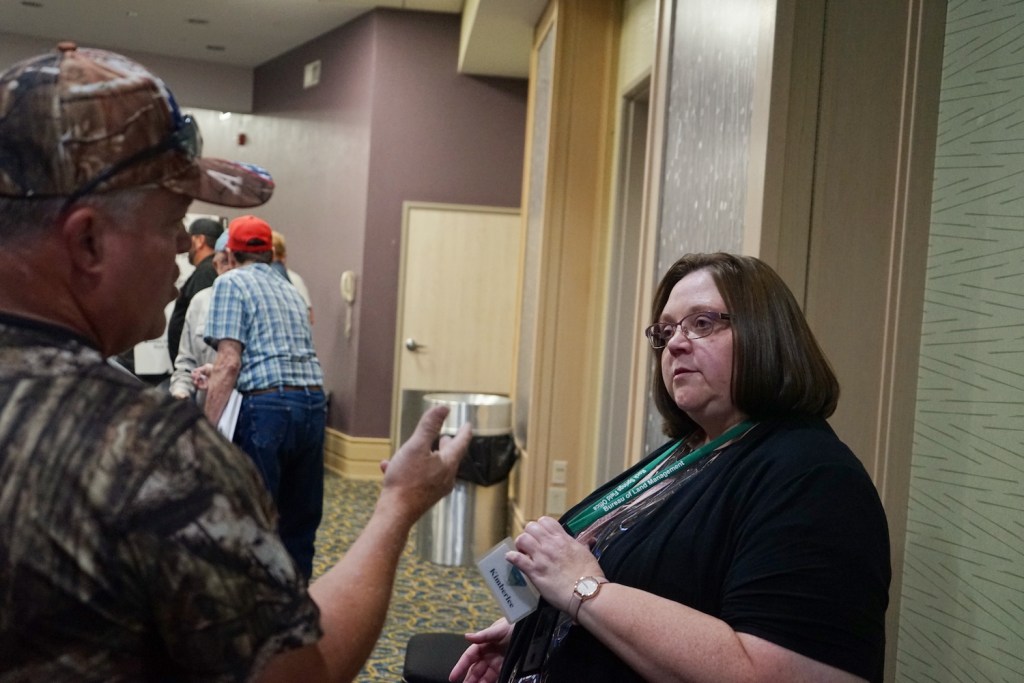
The agency has battled misinformation through the process, Stone-Manning said. “One significant area of misinformation has revolved around access to our public lands,” she said in the email. “For example, there have been rumors about no longer being able to walk your dog on public lands, roads closing, and hunting no longer being allowed. None of this is true and we are taking every opportunity to separate fact from fiction. Public lands are open to the public and there are no decisions to open or close roads being made as part of updating this resource management plan.”
In October, the BLM extended the comment deadline by 60 days and agreed to work with the state. In November, Gordon announced the formation of his task force, tapping the University of Wyoming’s Ruckelshaus Institute to facilitate stakeholder conversations. The idea was to hammer out recommendations supported by all of the interests represented — everything from trona mining to oil and gas, conservation and hunting.
During three public workshops that followed, task force members heard from dozens of local residents who complained the federal direction was misguided and damaging.
The meetings did not necessarily soften the stance of task force participants, either.
Though he is pleased with the task force process, participant John Hay III, president of the Rock Springs Grazing Association, still opposes the plan, he said in a Jan. 2 episode of Gov. Gordon’s podcast. “What this plan calls for would truly be devastating to the economy of southwest Wyoming,” he said.
What’s next
“I think there are lessons that will be learned through this process that are going to be particularly critical,” Gordon said on that podcast episode. That could include feedback to the BLM on how to improve its land management planning to better reflect local concerns.
Public lands advocate Steff Kessler, Gordon’s other episode guest, said she’s not a great fan of the BLM process, citing a lack of communication from the federal agency over the 12 years the plan dragged on. But she said the state’s effort of getting together local folks who are trying to forge a more balanced vision is a good approach.

In Wyoming, she said, “we’re learning to work with each other even though we don’t always agree, but I think we have the interests of Wyoming at heart.”
The BLM’s approach to defusing the hot situation, Stone-Manning said, is to start with what’s universally important about the land. “One starting place for us is always that clean water, abundant wildlife and the sustainable use of natural resources on our public lands is something that everyone cares about,” Stone-Manning said. “From this place, we are working to engage in grounded conversations and dialogue on how alternatives and details in the plan support and balance that.”
Read the draft plan and comment on it through the BLM’s Rock Springs RMP Revision page. Public comment closes Wednesday.

Thanks to the participants for doing what they could in a short period of time. Unfortunately, some of the most controversial aspects of each alternative were not considered because, apparently, it was decided that a consensus could not be reached in the time available (as defined in the report). I think consensus was reached on some good recommendations, but the report should not be thought of as a replacement for submitting individual comments before next Wednesday. Supporters of Alternative B should identify what they like most about it. The features of the four alternatives are summarized briefly in the executive summary of the RMP draft that is available online.
I hope that our BLM Director is serious about habitat efforts. They need to more than triple anything they have been doing and make habitat projects easier to get done. One way is to simplify NEPA for those things that are positive for wildlife, such as providing a resource area wide EA for structures such as Zeedyke structures and all efforts that are directed at improving diversity in the plant communities.
Also, if the area known as the Golden Triangle has any less attention than Little Mountain, it’s because of who was on the Governors task force. That also pertains to the migration corridors.
All areas are not created equal and those areas most important to wildlife, indigenous people’s needs and our historical places of significance need protection so we don’t “love them to death.”
Do what is right scientifically and take care of our resources which, as I recall is your mandate.
It is unfortunate that so much uproar over bad information probably swamped real, logical concerns. On the plus side, if this mistake gets more people to actually read the Plan, maybe future discussions will be more productive.
I am concerned that the Governor’s task force recommendations will give an outsized voice to local interests. Understandably, those local interests are heavily focused on personal economic impacts. But rampant misinformation exaggerated those impacts.
At the same time the public, which is more likely to prioritize wildlife and conservation, was shut out of the task force meetings. The public couldn’t attend, nor were the meetings broadcast via Zoom.
While the recommendations of the task force may represent local interests, they likely don’t represent nationwide interests. BLM officials should keep this in mind when reviewing the task force recommendations. BLM has a responsibility to manage their public lands for all Americans.
This is a tremendously important point and one that should really be ringing alarm bells for the broader public, but seems to be flying under the radar because of the sound and fury about the RMP itself. Leaning only on Task Force groups to provide feedback is moving us away from the very deliberately democratic and more transparent public input processes of federal land managing agencies have been using for decades. Is NEPA fast or perfect? No. But it does give more members of the various publics agencies serve a more equitable microphone to speak into when identifying issues and developing workable solutions. Task Force groups tend to amplify the squeaky wheels and those with strong arms.
Exactly, even as a Wyoming resident I understand that its not Wyoming Public Land, its United States Public Land, for all to enjoy.
Here are some key takeaways from the report for the TLDR crew. The cow is sacred and whatever Wyoming says has precedence over land owned by all Americans. Alternative B is the right answer no matter the subterfuge injected by this report.
“Recognizing the historical and current importance of livestock in the region, support for management actions that ensure continued grazing, predator management, and invasive species control.”
“This is the highest form of the BLM’s responsibility to defer to state policies.”