


A severe winter has boosted snowpack to above-average levels across most basins in the state and at some high elevations. Although the combination of cold and snow hints at a summer of healthy river flows and fuller reservoirs, much of the benefit of that water depends on how quickly the snow melts, according to weather and water watchers.
Low temperatures have broken records in places like Cheyenne, Laramie and Rawlins this season as they’ve dipped well below zero degrees Fahrenheit. Cool conditions should continue into the first part of April, according to the National Weather Service in Riverton, easing flooding concerns — at least in the short term.
“If we get some warm days followed by cool days, and [the snow melts] in chunks, it may not pose a huge concern,” NWS Riverton meteorologist Chris Jones said.
Among Wyoming’s long-trend seasonal changes, however, springtime is warming the fastest — increasing by 2.9 degrees Fahrenheit, on average, from 1920 to 2021, according to National Oceanic and Atmospheric Administration data. But for now, it’s too early to know what spring will bring.
“We are aware that snowpack could be a challenge this year for possible flooding,” said Big Horn County Emergency Management Coordinator LaRae Dobbs, speaking on behalf of a coalition of Wyoming emergency managers. “We are all hoping for a slow warmup and no rain on ripe snow.”

Statewide, low-elevation snowpack averaged about 118% of normal during the first week of March, outpacing the winters of 2022 (86%) and 2021 (90%), according to the federal Natural Resources Conservation Service in Wyoming. The deepest low-elevation snowpack was measured in the Little Snake River Basin at 150%, while the southeastern corner of the state only clocked 78% of average.
Most mountains across the state also have a healthy cap of snow, ranging from 105% to 115%. Two small mountain regions in south-central Wyoming stand out, however.
The Old Battle snow monitoring station in the Sierra Madre Range, where winter snowpack can be fickle, measured nearly 10 feet of snow during the first week of March, according to the NRCS.
A bit further north, the Sage Creek monitoring station, also in the Sierra Madre Range, measured nearly 9 feet of snow. That’s 179% of average for the area and surpasses snowpack measurements going back more than 30 years. The heavy snowpack sits at a relatively low mountain elevation, making it particularly susceptible to warm spring temperatures and a fast melt.
“That would be one of the sites that would melt sooner rather than later,” Jones said.
Water and drought forecast
Wyoming’s cold and wet winter has improved streamflow forecasts for the water season — from spring to late fall when irrigators, recreationalists and wildlife most depend on flows — compared to 2022 and 2021.
The median streamflow forecast for the state is about 118% of average for April through September, according to the latest Wyoming Water Supply Outlook report compiled by the Wyoming NRCS office.
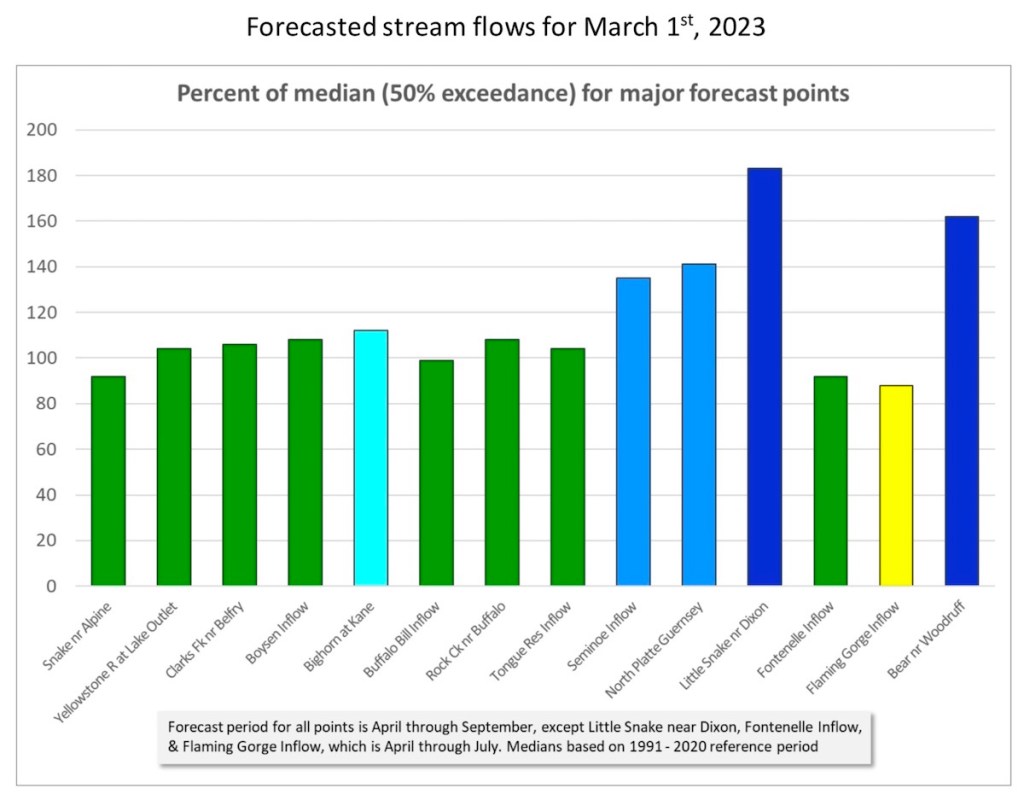
That should be welcome news, particularly for water users along the North Platte and Tongue rivers. Some irrigators with junior water rights in those drainages saw temporary orders in April 2022 to curtail critical early springtime diversions due to low runoff concerns. Both orders were suspended the following month.
This year, the median streamflow forecasts for the Upper North Platte and Lower North Platte are 138% and 141% respectively. The Tongue River Basin forecast has improved to 103% of normal.
Reservoirs are already beginning to fill, too, measuring an average of 88% during the first week of March. Reservoirs in the Snake River Basin, however, remain extremely low — an average of 31%. One such reservoir, Jackson Lake, reached a record low in 2021 and again in 2022, severely diminishing tourism at the popular recreation area.
Drought conditions across the state should inch toward improvement, said Jeff Goats of the NRCS office in Wyoming. Notably, most of central Wyoming has seen relief from varying drought categories of the past two years. That can change quickly, however, depending on spring precipitation and whether high temperatures and winds sap soil moisture this summer.

“How fast can [drought conditions] come back? Well, the answer is, really quickly,” Goats said. “Thirty to 60 days of below-normal precipitation and your soils are back to being dry again.”
Disastrous and ‘weird’ winter
Gov. Mark Gordon filed a request for a federal disaster designation for the state’s agriculture industry this month, noting in a statement that the “culminating impacts of sustained cold, wind and snowfall have caused significant distress to the livestock industry across the state.
“Access to traditional winter grazing resources has become dire, as well,” the statement continued, “because many ranch, county, and [Bureau of Land Management] roads are drifting shut and, even when cleared, continue to re-drift because of high winds.”
The combination of snow and wind has also wreaked havoc on Wyoming roadways, forcing days-long closures along Interstate 80 and in places like the Shirley Basin between Casper and Medicine Bow and Highway 287 between Rawlins and Lander, according to the Wyoming Department of Transportation.
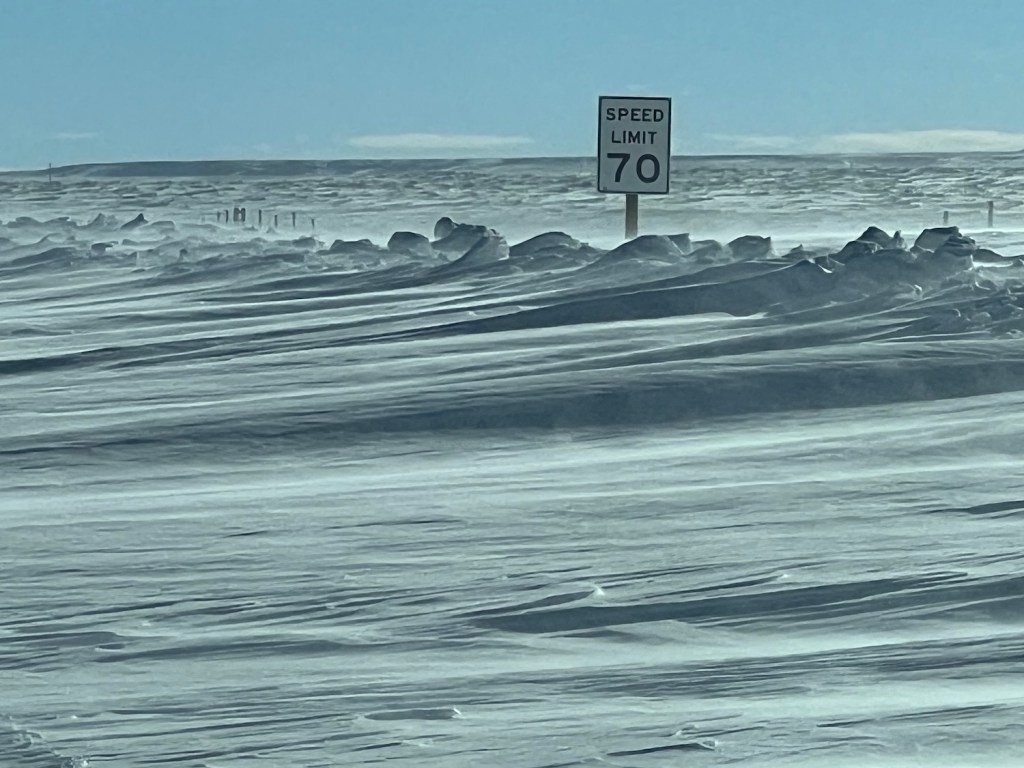
“This year’s been strange and weird,” WyDOT public relations specialist Jeff Goetz said. “We’ve had areas that were filled in with snow that we haven’t had issues with traditionally.”
Highway 487 at Shirley Rim — an area that normally doesn’t see a lot of snow — has been hammered with drifting all winter, Goetz said. The same applies to South Pass south of Lander and Beaver Rim west of Jeffrey City. Highway 287 at Beaver Rim, “That’s just been horrendous this year,” Goetz said. “And that’s not a place where we’ve had issues every year.”
Typically, it’s not the snow that creates headaches for travels and road crews, it’s the wind blowing that snow around, Goetz said.
“It’s been a challenge this year for everybody,” he said. “And when you’re short-staffed, we’re moving resources around — the blowers and the big rotary snow blowers and things like that — we’ve been moving those all over the state just to try to help out.”
All things considered, though, the harsh conditions remind him of Wyoming winters decades ago.
“To me, this is a return to normal,” Goetz said.


Hopefully it will alleviate some pressure off the Colorado river . We need more dams in wyoming let’s let the beavers do it . Keep the aquifers full instead of sending it down stream.