

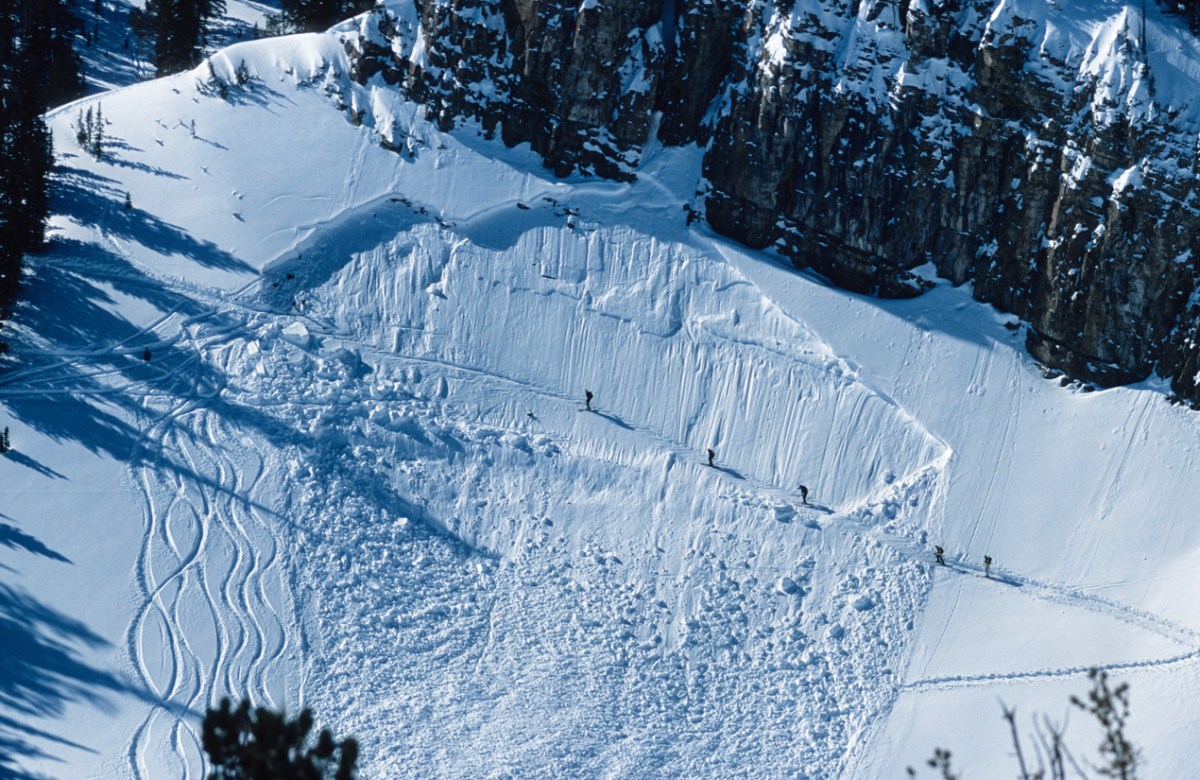
Six people have died in avalanches in the United States since the snow started to fly this fall. Every year, an average of 27 people — skiers, snowboarders, snowmobilers, snowshoers — die this way.
Opinion
For people who don’t venture into the backcountry in winter, the thought of potentially dying in an avalanche seems crazy. Why put your life on the line for a few minutes of fun? But most of us who ride fresh powder don’t look at it that way: We don’t consider backcountry skiing a death-defying activity.
A couple of years ago, my friend Jenna Malone, who is an avalanche educator and physician assistant in Salt Lake City, told me, “I don’t know anyone who’s stood on the top of a slope and thought, ‘Well, this is going to kill me, but it’s going to be epic powder skiing.’
“We believe that with training, planning, good decision-making and a solid ski partner who calls us on our blind spots, we can make it safer,” she added.
In 2009, Bruce Jamieson, a professor of civil engineering at the University of Calgary in Alberta, Canada, took accident data collected in North America and Switzerland to come up with a risk-comparison chart. The data was presented in “millimorts,” or one death per million. One millimort is the chance an average 20-year-old male has of dying from any cause on any day.
Himalayan climbing turned out to be the riskiest activity Jamieson considered, with a one in 40 chance of dying on an 8,000-meter peak, or 12,000 millimorts. Riding a motorcycle eight hours a day earned 605 millimorts, while backcountry skiing in Canada, using usual risk-reduction practices, came in at four.
Of course, not all skiers try to minimize risk. Recently, I saw a group of five riders swooping down a steep gully, hooting and hollering as they flew by. The avalanche hazard that day was moderate. Still, five people skiing a slope en masse like that — rather than one at a time — is outside normal risk-reduction practices and could have easily ended in tragedy.
Jamieson’s data is now more than a decade old, but the likelihood of being killed in an avalanche probably hasn’t changed much. It may have even lessened, considering the growing number of backcountry users in avalanche terrain that are sharing the risk.
When I started skiing in the backcountry decades ago, we would see only a handful of other people. Today, SnowSports Industries America estimates that there are more than 6 million backcountry riders in the United States, which puts the American avalanche death rate at less than 0.5 per 100,000. Your risk of dying in an automobile accident is one in 107.
These statistics may be why we don’t feel like we are gambling with our lives every time we head out to ski. And in general, backcountry users consider themselves responsible risk takers.
We take avalanche courses to learn how to identify dangerous snow conditions. Most of us carry safety equipment: avalanche transceivers, shovels, probes and in some cases airbags to help improve our odds of survival in a slide. We consult the daily avalanche forecast for our area. We choose our partners carefully.
Still, people die. You can argue that statistically the odds are in our favor, but that doesn’t lessen the tragedy that occurs when a glorious day of powder skiing turns into a nightmare.
Two of this year’s fatalities involved fathers triggering slides that buried and killed their sons. It’s hard to imagine anything more painful for a family.
Avalanches have been called “wicked-learning environments,” a label popularized by psychologist Robin Hogarth in 2015. A wicked-learning environment is one where the rules are unclear and feedback is often inaccurate or nonexistent. That means you can’t learn, or may learn the wrong thing from your experiences. Mistakes in a wicked-learning environment can be fatal.
Venturing into winter backcountry is a classic wicked-learning environment. You can arm yourself with all the appropriate safety gear, do lots of prep work on snow conditions and terrain, and keep your eyes open for clues. Ultimately, though, most of the information about snow stability is hidden.
Every time you ski a slope without it avalanching, you are likely to believe you made a smart decision, when in reality you may have just been lucky. Most of us have been lucky.
This piece was originally published by Writers on the Range, a nonprofit dedicated to spurring lively conversation about Western issues, and reprinted here with permission.

I agree with this article & have also skied the backcountry of the Rockies for decades. The author hints at the biggest risk factor & I’d like to amplify it: hubris. Unfortunately that is the risk that is often missed by, well, the best & most confident backcountry enthusiasts. Yes, you strong young men, it’s you getting lost in the stoke.
I strongly recommend watching the documentary “A Dozen More Turns” that shows how it can be the best & most expert member of a group that can trigger disasters.
Very good essay!