

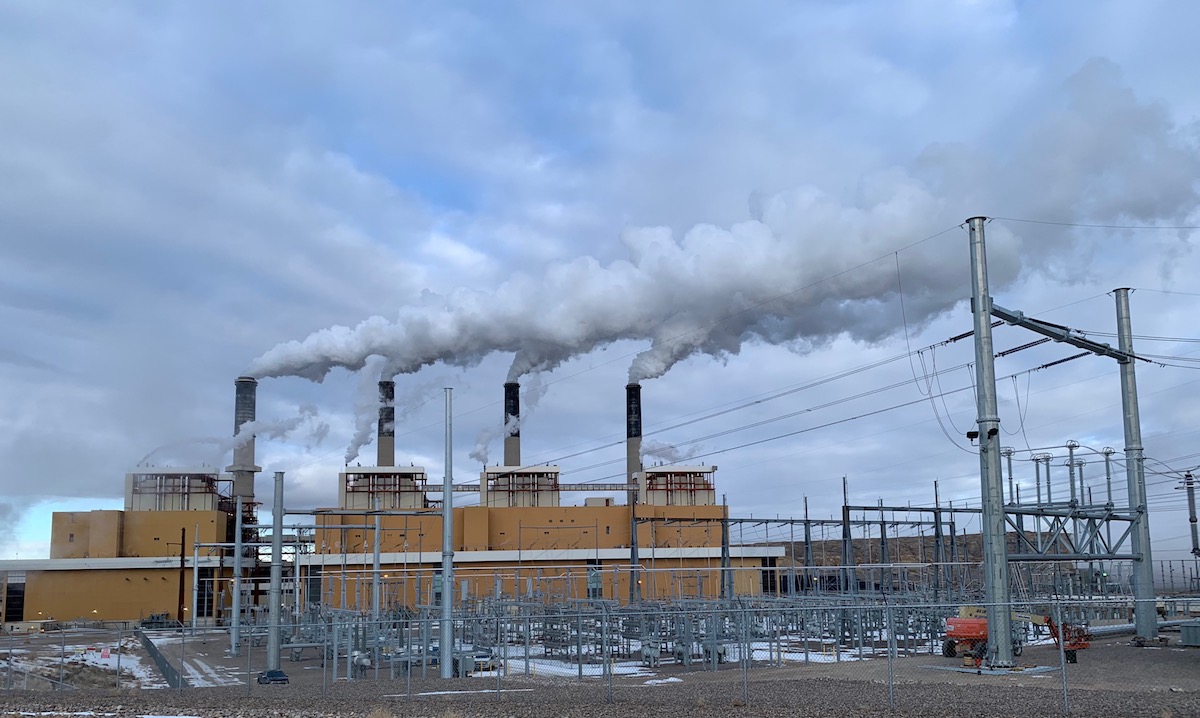
Wyoming lawmakers hope to expand the state’s legal and regulatory framework for advancing permanent underground carbon storage and encouraging carbon capture at existing coal-fired power plants with two new bills.
Senate File 47 – Carbon storage and sequestration-liability establishes a process for the state to assume ownership of, and liability for, CO2 that’s injected into geologic structures. That transfer of responsibility from the operator to the state is contingent upon a 10-year monitoring period following the end of injection operations.
Senate File 64 – Carbon capture and sequestration builds on past legislation to discourage regulated utilities from retiring coal-fired power plants. It would force a utility to either retrofit the plant with carbon capture utilization and storage technology or sell the facility to a new owner that would install CCUS. The original owner would then be required to purchase power from the retrofitted power plant.
This year’s package of proposed legislation builds on past measures, such as 2019’s Senate File 159 – New opportunities for Wyoming coal fired generation, which forces utilities wishing to speed up retirement of a coal plant to first offer the facility for sale.
Both SF 47 and SF 64 must gain at least a two-thirds vote in the Senate to be introduced to the floor during the budget session.
CO2 storage liability
More than a decade ago, Wyoming became the first state in the nation to define ownership, legal liability and regulatory processes for the geologic storage of anthropogenic CO2, the main greenhouse gas contributing to climate change. Senate File 47 attempts to address investors’ concerns by providing a method for CO2 injection operators to get off the hook for indefinite liability for those CO2 reservoirs and related facilities.
The draft bill is similar to a measure in North Dakota which, like Wyoming, wants to advance carbon storage as a way to extend the life of coal and oil production while curbing CO2 emissions to help address climate change.

Under the bill, a CO2 injection operator must ensure the reservoir is stable and that injection wells are sealed and maintained to prevent leaks before the state assumes liability.
“The underground place or pore space where the carbon dioxide was injected or stored is expected to no longer expand vertically or horizontally and poses no threat to human health, human safety, the environment or underground sources of drinking water,” according to the bill draft.
The bill allows the Wyoming Department of Environmental Quality to issue a certificate of completion subject to public comment if it determines all environmental and remediation standards have been met. Then the CO2 reservoir becomes the state’s property and liability.
Retrofitting coal plants
Senate File 64 is likely to face opposition from environmental groups as well as some regulated utilities hoping to retire aging coal-fired power plants in the state.
The measure would give the Wyoming Public Service Commission authority to require the installation of CCUS if a utility cannot make a satisfactory case that doing so is cost-prohibitive and would increase rates for Wyoming customers. Rather than retire a coal plant without first installing CCUS, a utility would be required to offer it for sale to a third party willing to retrofit the plant with the technology.
In making a determination between allowing retirement or forcing a sale and installation of CCUS, the Public Service Commission must consider “the effect on the economy in Wyoming, potential tax revenue to be generated from the proposed installation, including severance and ad valorem taxes from minerals likely to be produced through use of captured carbon dioxide, and any other factor deemed relevant by the commission,” according to the bill draft.
“We believe there is uncertainty and unresolved questions regarding how Senate File 64 might conflict with current law.”
Tiffany Erickson, PacifiCorp
The Wyoming PSC is already modifying its rules and regulations to comply with House Bill 200 – Reliable and dispatchable low-carbon energy standards. That 2020 law also seeks to encourage CCUS at existing coal plants. The commission in November established that a utility that installs the technology may increase customer rates by a maximum 2% to cover the cost.
Opponents regard SF 64 as economically unworkable and potentially unconstitutional for the powers it would give the Wyoming PSC in prioritizing power-generation technologies.
“The constitutionality question is: ‘Can we tell companies what to do with their property?'” Powder River Basin Resource Council attorney Shannon Anderson said. “Certainly, there are laws and regulations related to public utilities. But it’s private property. It’s owned by PacifiCorp and paid for by ratepayers.”
PacifiCorp, the state’s largest regulated electric utility, has repeatedly determined that adding CCUS to its aging coal-fired power fleet would be cost prohibitive, including in its 2021 integrated resource plan. However, it has not completely ruled out a potential CCUS retrofit.
“PacifiCorp continues to actively explore the most technically and economically feasible options for CCUS technologies,” PacifiCorp spokesperson Tiffany Erickson told WyoFile via email. “We believe there is uncertainty and unresolved questions regarding how Senate File 64 might conflict with current law, as well as concerns with how the bill may adversely impact our ability to realize incentives and enter into productive partnerships.”
Meantime, Gov. Mark Gordon said he sees both carbon storage and CCUS as viable technologies that can help extend the life of coal-fired power plants while moving Wyoming toward net-zero or net-negative carbon emissions.
“Wyoming is dedicated across the board to new technologies,” Gordon said in his address to the Wyoming Press Association Feb. 4. “I’m not going to necessarily call them green, but I think they are cleaner in a lot of ways. We’re also going to not give up on any of our legacy assets because quite frankly, we have the best chance of addressing climate change by doing something with carbon capture and sequestration.”


Why should Wyoming citizens accept any risks from this program?
Considering the thermodynamic penalty that Carbon Capture imposes on a coal-fired generating unit, it will place that unit’s price WAY out of the market for a HUGE part of the year (without further government “incentives”).
Then, the past owner of the plant is REQUIRED to purchase the power? THIS? From a RED state??
Wow!
Report on recent carbon capture efforts:
https://www.cbsnews.com/news/clean-coal-projects-carbon-capture-government-accountability-office/
Spoiler alert: Its butt ugly.
CO2 injection is fraught with dangers. It is worse that wastewater injection because gas can travel more easily than liquid in the subsurface. Wyoming strata is highly faulted and fractured so predicting where the CO2 will go is unpredictable. Add the risk of not knowing where the gas will end up with the cost of the process itself and it is uneconomic when trying to keep a coal fired power plant operating. Taking the risk of the injection and storage off the operator and putting it on the taxpayers of Wyoming is an injustice to Wyoming residents. Are our politicians working for us Wyoming residents, or for the power industry? It seems obvious to me with proposals like this!