


Freedom Caucus candidates took a beating in Wyoming’s primary election. But MAGA Republicans found success in races for federal office. Plus, Democrats envision a new direction; details TBD.
Download the podcast episode.
Maggie Mullen: This is the Cheyenne Roundup: Decision 2026, a look at the candidates vying for Wyoming’s top elected positions, from Wyoming Public Radio and WyoFile.
Jordan Uplinger: I’m Jordan Uplinger with Wyoming Public Radio.
MM: And I’m Maggie Mullen with WyoFile.
JU: The primary was on Tuesday. We’re recording this on Thursday afternoon, Aug. 20.
MM: We finally got to hear from voters about the tug-of-war happening within the Republican Party. More than a dozen incumbent Freedom Caucus members and allies lost to challengers, stripping the bloc of its majority in the state House and failing in its goal to grow its members in the Senate.
JU: In the governor’s race, Eric Barlow beat out Trump-endorsed Megan Degenfelder and Brent Bien, who was backed by the Wyoming Republican Party in its first-ever round of endorsements.
MM: Voters swung the other way when we look at the federal races, where a founding member of the state Freedom Caucus took the GOP nomination for Congress, and Trump-backed Harriet Hageman found success in her bid to move from the House to the Senate.
JU: Let’s swan dive right into it.
MM: So, did the Freedom Caucus grow its power? Nope — much the opposite. It looks like the caucus will have about 10 reliable votes in the House. Some notable oustings include former caucus chairman John Bear of Gillette, founding member and Majority Floor Leader Scott Heiner of Green River, Ann Lucas of Cheyenne and Ocean Andrew of Laramie. Plus, Jeanette Ward of Casper and Mark Jennings of Sheridan, who previously served in the Legislature and were part of the caucus, also lost their bids to return to the House.
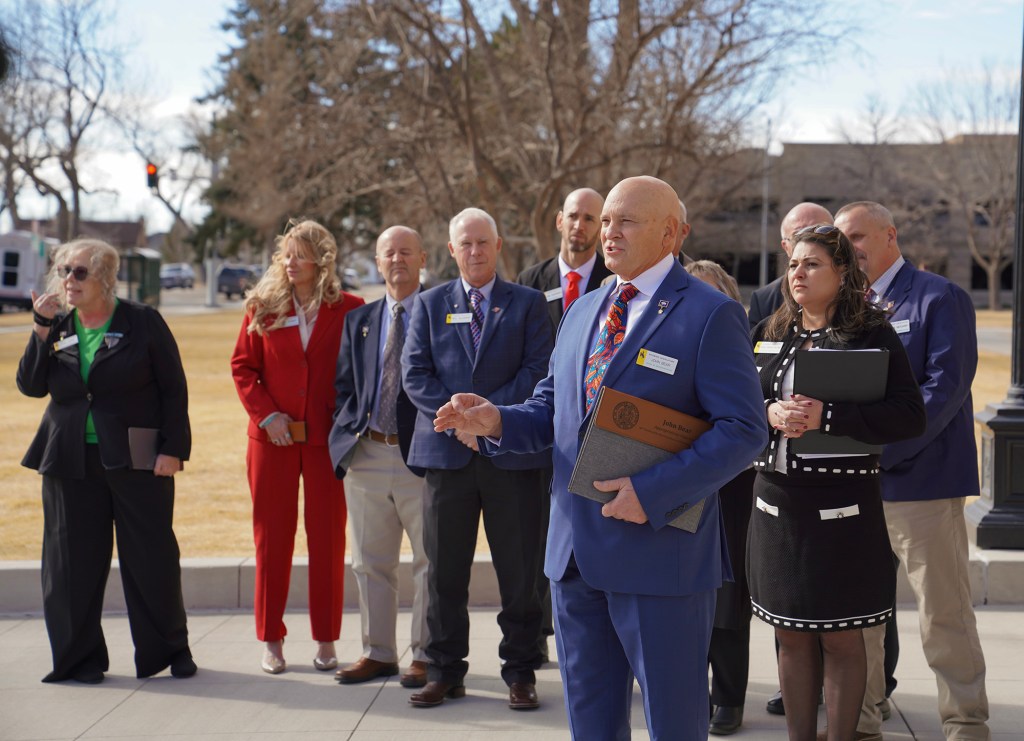
JU: The caucus also failed to pick up any new seats in the House, and nine newcomers that would’ve likely carried the torch of their Freedom Caucus predecessors came up short.
MM: Bottom line is the caucus voting bloc is no longer big enough to thwart bills on introduction during budget sessions. That’s a tactic we’ve seen various voting blocs use to block legislation.
JU: As a little bit of framing, Tuesday’s results come after the Freedom Caucus held a press conference in the Capitol rotunda toward the end of this year’s legislative budget session. They made a call for reinforcements to adopt a statewide library book policy, prohibit touchscreen voting machines, strengthen legal recourse if parents feel their rights have been violated and better public access to court documents.
MM: Which all failed, even with the caucus’ majority.
JU: Looking at the state Senate, voters rejected several prominent Freedom Caucus members’ attempts to move up from the House. Chip Neiman, current House speaker, came up short against Sen. Ogden Driskill in a closely watched race in Northeast Wyoming. Ken Pendergraft and Paul Hoeft also failed to move up. And Sen. Bob Ide lost his reelection bid.
MM: This leaves five reliable Freedom Caucus votes in the upper chamber, well below the 16 needed for a majority. My colleague, Maya Shimizu Harris, talked to Gail Symons, a long-time Wyoming politico and Freedom Caucus critic. She likened this year’s results to the flip in the opposite direction that happened in 2024. But she said this is a way larger scale than that.
Gail Symons: I think what happened is they weren’t paying attention to whose ox was being gored.
JU: The team at Wyoming Public Radio and KHOL in Jackson were talking to voters all day and we kind of heard inklings of that from the polls.
Jeanene Esterholt: I’m not sure I completely agree with the Freedom Caucus. I’m glad they’re conservative. On the other hand, I don’t like the fact that there’s out-of-state places that are swaying our state officials to vote one way or another.
Bob Woodall: In name only, that’s all they are, that they’re an out-of-state group that is trying to usurp Wyoming and bring their outside influence into our state. In the state Legislature, they’re changing all the rules. That’s why I had to vote, change my affiliation and make myself a RINO [Republican in name only] for the day.
Kendra Cross: We’re losing young people. We are losing people having the ability to pay their bills, to have services. We absolutely need strong, stable, reasonable leadership and no more extremism.
JU: I was also bopping around a few watch parties in Cheyenne, and after some races were called, I made some calls myself. Jessica Crowder is a political newcomer with a career in ag. She beat out Freedom Caucus Rep. Ann Lucas with roughly 63% of the vote. Crowder told me a common question she heard on the campaign trail was, “Are you part of the Freedom Caucus?”
Jessica Crowder: So it’s certainly on everyone’s mind, and it looks like there’s a shift across the state just based on the results of the night.
MM: For Wyoming’s top five statewide offices, again voters chose traditional Republicans.
JU: In the secretary of state’s race, current Freedom Caucus Chair Rep. Rachel Williams lost by more than 10 points to Converse County Commissioner Robert Short. Where Williams campaigned as a successor to the current secretary’s approach to managing elections and business filings, Short said he wanted to “make the office boring again.”
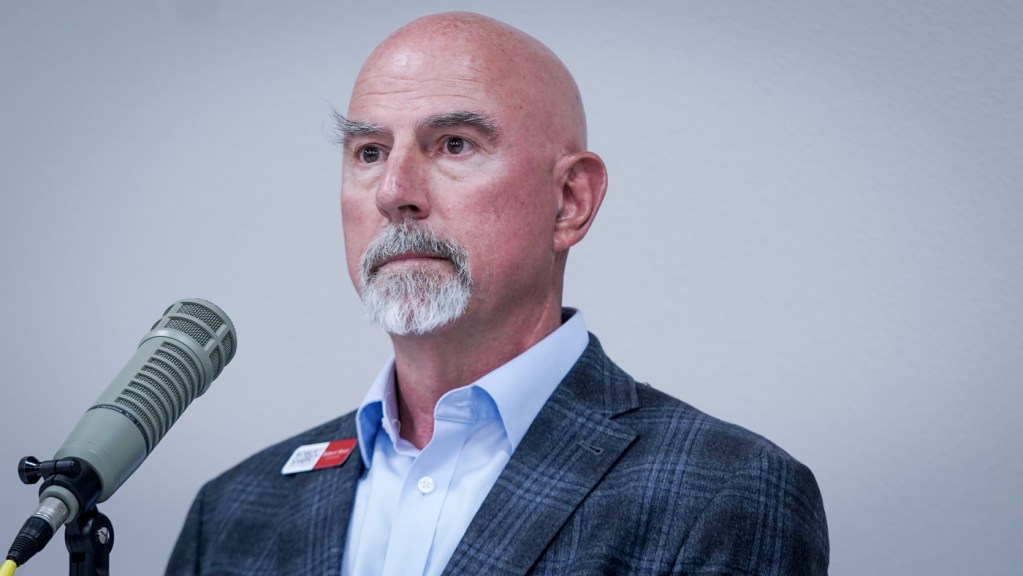
MM: Rep. Steve Harshman took the Republican nomination for superintendent of public instruction. He had about 60% of the vote over caucus ally Rep. Tom Kelly’s 31%. Chad Auer, who previously worked as Gov. Mark Gordon’s senior policy advisor, came in third place.
JU: Worth mentioning: This race also saw a Democratic primary between political newcomer Ana Cordova and former Northern Arapaho Tribal Education Director Sergio Maldonado. Cordova took it with about 63%.
MM: For state treasurer, Curt Meier will have a third term after staving off a challenge from Lingle Rep. Scott Smith, who is listed as a member of the Wyoming Freedom Caucus and who earned the state GOP’s endorsement.
JU: The governor’s race was an interesting one. You may remember from the many political ads flooding our TV, phones and YouTube, President Trump backed current Superintendent of Public Instruction Megan Degenfelder. While the state Republican Party put its weight behind retired civil engineer and military officer Brent Bien.
MM: They both garnered about a quarter of the vote, well behind rancher-slash-state Senator Barlow’s 45%. Barlow campaigned on protecting public lands, funding education and solving Wyoming’s healthcare access and affordability issues.
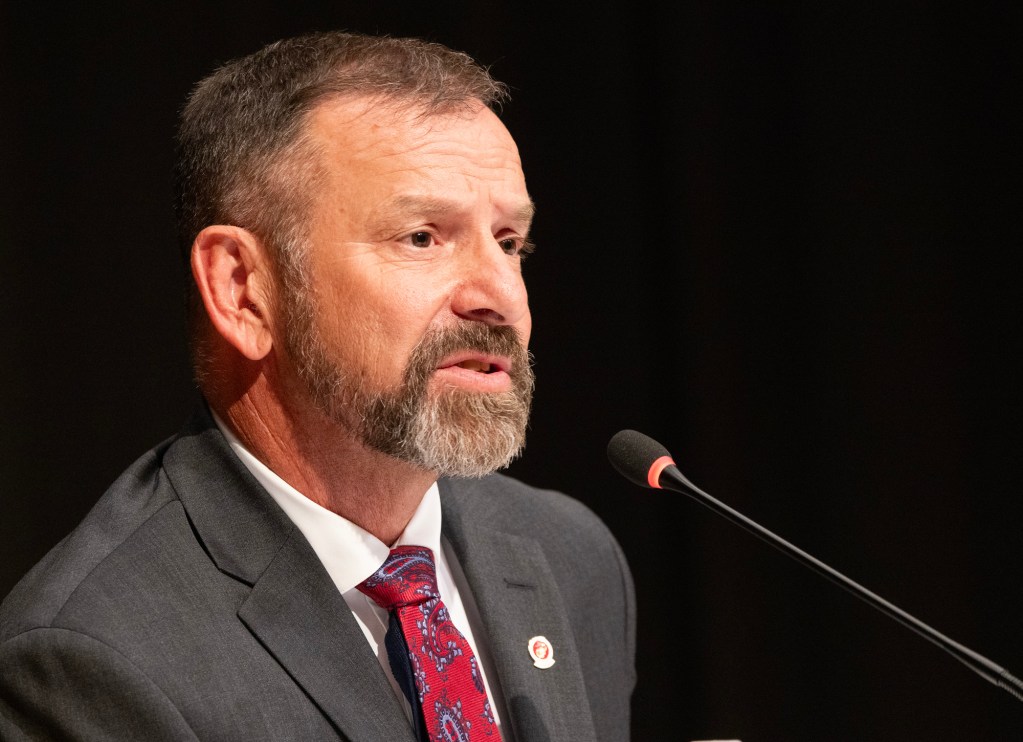
JU: The last two times the governor’s seat was open in Wyoming, the Republican nominee handily won the general election. But Barlow will have competition in November.
MM: That comes from Democrat Kenneth Casner of Casper and Constitution Party candidate Rebecca Bextel of Jackson. You may remember earlier this year, Bextel hand-delivered campaign donation checks to lawmakers on the House floor after they’d adjourned for the day.
JU: Ah yes, I think that was called “Checkgate.”
MM: That’s right. To close that loop: Nine out of the 10 lawmakers who received the $1,500 checks from Teton County donor Don Grasso lost their seats.
JU: Moving on up to the federal races, where Wyomingites had a lot of choices, especially in the congressional race.
MM: Current Secretary of State Chuck Gray carried the day over eight Republican competitors by a slim margin.
JU: Didn’t we guess this race could be won with something like 25% of the vote?
MM: We sure did, and that’s exactly what happened.
JU: Gray was closely followed by Jackson conservative activist Steve Friess with 20%, Army vet Kevin Christensen with 17% and former Superintendent of Public Instruction Jillian Balow with 10%.
MM: This race really showcased the “big tent” of the Republican Party. Several candidates tried to position themselves as Trump acolytes, though the president did not make an endorsement in the race. Others ran more middle-of-the-road campaigns while a couple voiced opposition to some Trump administration policies, like Trump’s latest funding request for the war in Iran.
JU: Despite that, after the race was called, candidates were quick to get voters to rally behind Gray.
MM: This was a spendy race, boosted by the candidates’ own money. Four loaned themselves over a million dollars. Gray said that he, like Trump, had to make that kind of investment to take on “the insiders and the media.”
JU: On the Senate side of things, Republican Harriet Hageman and Democrat James Byrd both won by landslides.
MM: Voters first elected Hageman to Congress in 2022 over Liz Cheney and again in 2024. This year she ran a $2 million MAGA campaign eight times larger than her closest competitor, Sam Mead. Mead is the nephew and great-grandson of two former Wyoming governors. He campaigned under the banner of protecting public lands. That struck a contrast with his opponent, who signed onto a Utah lawsuit that claimed the U.S. government’s ownership of land in Wyoming amounted to a justification for war.
JU: I was at a watch party with Democrat James Byrd, a former state lawmaker and son of the first Black woman elected to the Wyoming Legislature. With MSNBC on a big TV and LED lights flashing, Byrd gave a speech to a small but energetic crowd, talking about a new Democratic Party approach, but I didn’t hear specifics on that idea.
MM: Byrd easily won over his opponent, Billy Benavidez, a greenskeeper from Sheridan.
JU: If history tells us anything, Byrd has an uphill fight in the general election. The last time this seat was open in 2020, current U.S. Sen. Republican Cynthia Lummis handily won with about 73% of the vote over Democrat Merav Ben-David. But Byrd is undeterred.
MM: A quick programming and process note: We’ve been talking about unofficial results. The state canvassing board still needs to meet on Aug. 26 to certify the results.
Jordan: It’s unlikely we’ll see any changes in the winners. This is really the process that counties and the state use to cross their Ts and dot their Is. It also gives counties time to run post-election audits.
MM: For recounts, any race where the winner won by less than 1% will have an automatic recount. Candidates can also request a recount for their race by Aug. 24.
JU: I want to go back to audits, just for a second. This year’s primary and general elections also have a hand-count audit requirement. Clerks will assemble teams to count, by hand, about 5% of ballots cast in certain races. Election clerks we’ve talked to said they think this will be a good chance to show the machine tabulators that counties use are accurate.
MM: So, where does this leave us for the general election?
JU: Republicans are still likely to have a supermajority in the state House, as only 20 Democrats are running out of the 62 House Districts.
MM: We might see some Independent candidates file to run, too. There could also be minor and provisional party candidates, but that list hadn’t been posted by the time we recorded.
JU: A couple seats could see exciting contests come November.
MM: I’m really curious to see whether this rebuke of the Freedom Caucus and its cut-and-slash budget approach carries over into November’s general election when voters will decide whether to approve a 50% property tax cut.
JU: Thinking in the long term, I’m interested in the direction of the Democratic Party. James Byrd talked a lot about being a “new Democrat” [and] the state party has gone through some leadership changes. Even if they win all their races in the state Legislature, I don’t think they’re going to be driving policy anytime soon, but it will be interesting to see how they operate without the Wyoming Freedom Caucus majority in the Capitol.
MM: Another thing I’ll be looking out for: The 69th Wyoming Legislature is gonna have a lot of freshman lawmakers, especially in the House. And there can be a steep learning curve to lawmaking, so they’ll have their work cut out for them when the next legislative session kicks off in January.
JU: I’ll also be watching to see if the Freedom Caucus will keep up its tradition of wearing red jackets, their way of bringing attention to a potential budget deficit down the line, which was also the justification for the large quote “Spending Reductions” they wanted to make to the governor’s proposed budget earlier this year.
MM: I’ll also want to point out that our current lawmakers — a lot of whom are losing their seats — are the ones currently working on committee bills that’ll be voted on in next year’s legislative session. They’re the ones shaping policy, so it’ll be interesting to see how the next few months go and how that legislation comes together.
JU: And I also want to point out: Ballpark, 150,000 Wyomingites voted in the primary. That’s about 55% of registered voters, but somewhere like 33% of voting-age Wyomingites.

MM: The raw turnout numbers were second only to the 2022 midterms, the last time Wyoming’s top five elected positions were on the ballot and when Harriet Hageman successfully challenged Liz Cheney for Wyoming’s U.S. House seat.
JU: We’re expecting to see more people at the polls for the general election on Nov. 3.
MM: We’ll be back with more Cheyenne Roundup before that, so check our feed.
MM: Thanks, as always, for listening to the Cheyenne Roundup: Decision 2026, a preview of Wyoming’s primary election races, from Wyoming Public Radio and WyoFile.
JU: Make sure to like this episode and subscribe wherever you get your podcasts.
MM: Editing and producing by Nicky Ouellet and Tennessee Watson.
JU: Keep following our politics and state government reporting at wyomingpublicmedia.org and wyofile.com. Thanks for listening.
A vote for Hageman is like knifing yourself in the back. I’m heartened by the destruction of the unfreedom caucus, but Hageman and Gray do not represent the people of Wyoming, they represent the goofball in the oval office.
Great recap