


After the Legislature axed $1.7 million in University of Wyoming funding and prohibited state spending on the school’s Office of Diversity, Equity and Inclusion, a university working group is proposing possible steps forward.
While Gov. Mark Gordon vetoed a portion of the Legislature’s budget that would have also barred state funding for “any diversity, equity and inclusion program, activity or function,” the UW working group examined a wide swath of DEI-related programming.
“The message from lawmakers, regardless of the welcomed line-item veto from the Governor, is that our DEI efforts must change, and discussions are underway to determine the best path forward,” University President Ed Seidel wrote in a letter charting a course of action in response to the cuts.
In a report released Wednesday, the group of faculty, staff, students and administrators offered five possible ways to deal specifically with the office:
- Fund the office with private support.
- Continue to fund the office with state funds under a new name.
- Reorganize or consolidate the office under another re-named university “unit.”
- Close the office, terminate employees and redirect some of its duties elsewhere.
- Close the office, terminate employees and redirect only federally required duties elsewhere.
The university says it welcomes public feedback on this working group report, including a section that suggests how to avoid any preferential treatment or exclusion at UW.
In a statement, Seidel said people can share that feedback via this form through Sunday, April 21.
How we got here
Much of the Legislature’s far-right faction was resolute this year in its denunciation of DEI programming at the state’s only public university, echoing similar “anti-wokeness” campaigns around the U.S.
After contentious negotiations, lawmakers passed a budget that included the cut in university funding and a ban on using state funds, endowments or matching funds for the DEI office or “any diversity, equity and inclusion program, activity or function.”
University trustees signaled support for their programs in March while acknowledging possible challenges meeting these legislative directives. Still, they noted the ambiguity of the budget language and misunderstandings about what the office does and what DEI stands for at UW.
“I think we’re a victim of labels, and we’re a victim of misunderstandings and we’re a victim of broad brush, generalistic statements,” Vice Chair Kermit Brown said at the time.
“Academic freedom will continue to be protected and celebrated at this institution. We will not diminish our exceptional faculty’s ability to decide what to teach or research.”
UW President Ed Seidel
Gordon cited concerns about jeopardizing about $120 million per year in federal research dollars when explaining his decision to leave state funds for DEI programming intact, along with UW’s authority to use private funds for the DEI office.
After Gordon’s partial veto, Seidel directed a working group “with providing suggestions (not formal recommendations) on how essential diversity, equity, and inclusion (DEI) programs, activities, and functions could be organized and funded within the university to make them most effective.”
That mix of faculty, staff, students and administrators met six times, stating in their report that the group, “was not a binary of supporting DEI versus opposing it, but rather the prudent use of state dollars in a financially constrained context and the examination of practices that might inadvertently perpetuate perceptions of preferential treatment or exclusion.”
Concern on both sides
The report acknowledges the subcommittee’s work on a topic that “may elicit strong emotions from constituents.” It also notes potential pitfalls of its own suggestions.
When it comes to suggesting UW fully fund the office — using either private dollars or state money while renaming the office — the group notes it may not be following the “spirit” of the Legislature’s direction or intent.
If the DEI office was funded privately, the working group found it would need around $500,000 annually to maintain staff levels and create a “modest” operating budget. That would also translate into a $12.5 million endowment that produces enough interest to fund the office into the future.
Previously, the office of DEI was estimated to cost about $865,000 for fiscal year 2024, resulting in the Legislature cutting $1.73 million from the university’s biennial block grant.
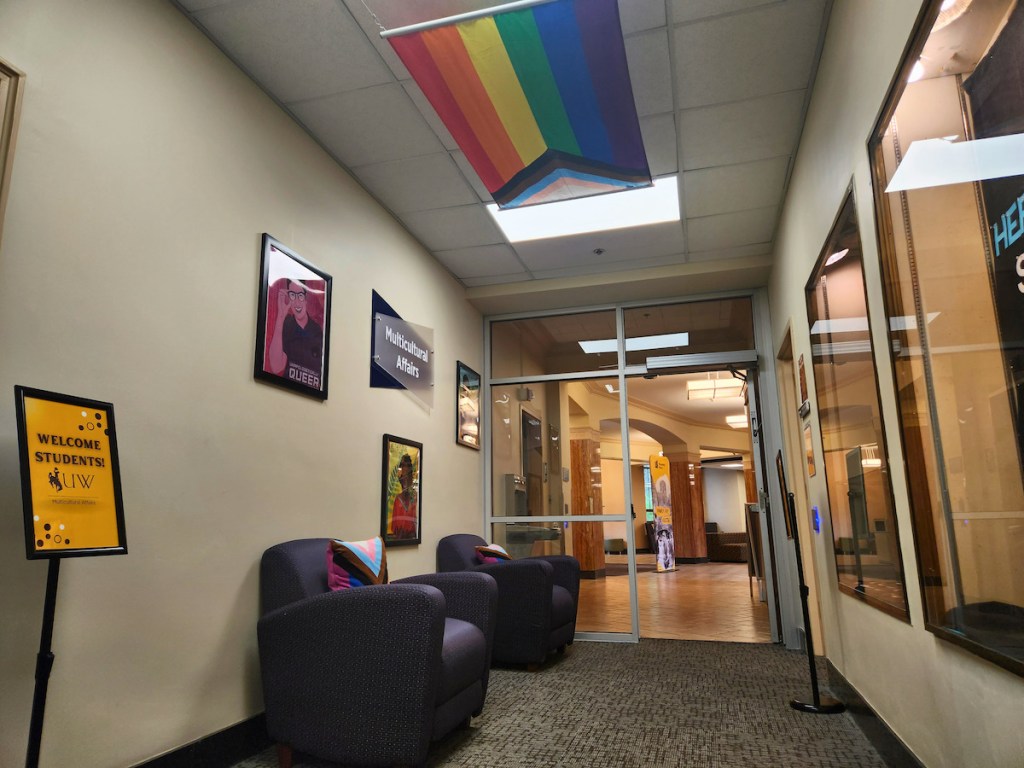
Meanwhile, closing the office and sending some duties elsewhere “would likely diminish support for a welcoming environment for all and remove critical central oversight of any DEI-related functions that remain to ensure they are not preferential or exclusionary,” the working group wrote.
The report also highlights the narrow line UW has to walk, listing all the state and federal statutes that require the university to uphold certain types of DEI programming.
What may be just as contentious as the report’s five suggestions, though, was a list of items the group suggested UW consider changing to ensure no preferential treatment or exclusion occurs.
That list includes reviewing things like graduate admissions practices, DEI advisory groups, rules regarding university speakers, recruitment and retention practices, scholarship awards, and support for student organizations.
“[M]any of the DEI-related programs, activities, and functions across the University — not directly managed by the office — do not align with the issues making national headlines,” the report states. “However, some modification might be considered to ensure that there is no preferential treatment or exclusion of groups based on specific identities.”
There were also suggestions to eliminate some practices, like the ability to hire someone based on a protected class without a competitive process and requests for “diversity or loyalty statements from candidates.”
The working group also mentioned the Black 14 Social Justice Summer Institute, which made headlines in recent weeks resulting in confusion about whether or not the program will go on this summer. This report outlines possible ways to continue supporting it — and other, similar programs — including working with the UW Foundation, fundraising private support or possibly transferring it to one of the colleges or schools.
What’s next?
President Seidel stated he will “make my official recommendations” at the May 8-10 trustees meeting.
Responding to questions that have already been raised, he stated Wednesday that “Academic freedom will continue to be protected and celebrated at this institution. We will not diminish our exceptional faculty’s ability to decide what to teach or research. Similarly, our freedom of expression initiative will continue to support and respect the perspectives of all and promote ways for everyone to engage productively.”
To view the trustees’ schedule or look at previous meeting materials, go here.


Nanny state repubs, making sure that everything is their business.
I am appalled at the overreach of the legislators. Just because they think we need to be in the dark ages, doesn’t mean we need to accept that. Anyone who thinks we don’t need to address diversity of ALL kinds, is in the dark ages, and determined to keep Wyoming there. Not everyone is an old white male straight Christian. My heart breaks for the diverse people who now feel even more unwelcome in WY and at UW. Keep chasing them off, WY! And you can stay old white straight Christian! And die in the world a it truly is.
Trash all DEI programs, they are
Not worthwhile for anything but
Corruption. Tax dollars are needed
For standard subjects & sports.
Please Wyoming cut out wokeness
Like the liberal cancer that it is.!!!!
Let’s get rid of sports – because I don’t like it.
My daughter is a graduate of UW in computer science. She benefited from going to the Rocky Mountain Women in Engineering Symposium which I’m sure was supported by the Office of DEI. She also benefited from seminars related to women in computer science. She was one of less than a handful of women in the college. To be able to see and talk to other women in the field was invaluable when she began her career. It gave her confidence and mentorship in how to navigate this male dominated field.
Today she works at a company where she is treated equally, but she still jokes with me that the women can each have their own bathroom stall.
People will say that the University “separated” people into groups, but what you don’t realize is for a lot of these kids, all they’ve known is being in a white, heterosexual, Christian community. So they know how to get along in that community. When they get to college, for many, it’s the first time they are around others that look like them, have the same religion or are the same sexual orientation…so of course they are going to want to hang out with them! My niece and nephews that are half Korean never got to know anyone else Korean till they went to UW!
If you are not a minority with by race, gender or sexual orientation etc, you will never understand how important the office of DEI is and that it doesn’t give you an advantage, it just to tries to give you and even playing field.
I do not agree with what the legislature is doing. The legislature doesn’t like federal over reach into Wyoming, yet they are doing the exact same thing to UW. They should not threaten UW funding or demand these changes. DEI programs are necessary and should not be eliminated. It is legislation like this that makes our children and want to move out of state and not reside in Wyoming. The legislature needs to change its ways or quit calling WY the equality state.
I’m not sure I take Ed Seiedel’s word about the risk of losing federal grant dollars if they eliminate the DEI office. I would reckon that the university cannot discriminate against various classifications of people or groups in return for the money. I doubt there is a stipulation that proclaims yee shall have an Office of Diversity, equity and inclusion. Public universities in Florida and Oklahoma have dropped DEI offices and the University of Florida on their own website claims to be a top ten public university for research. I think the University of Wyoming is being overly dramatic about the risks involved. There is most likely a bloated administrative staff at the U of Wyo that doesn’t participate or help facilitate the instruction of students, same as every other college.
Yes and no. Many research funding opportunities are geared toward institutions that have programs in place that specifically support underrepresented communities. Especially funding that is geared toward student-centered research and training. If your institution doesn’t meet the agency’s DEI criteria, you are not eligible to apply. UW does have faculty who take advantage of these funding mechanisms. UW would (will) be leaving that money on the table, affecting research progress and our reputation going forward.
The other thing no one is talking about is the very real potential of this to affect tuition revenue. The university has invested millions in recruiting students from out of state and internationally, because enrollment (even of WY residents) continues to drop. DEI helps to recruit students from outside of Wyoming, who might otherwise feel uncomfortable coming to what is a very a homogeneous community. Stopping the DEI programs will definitely make us less attractive to many students at a point in time when it is already proving difficult to keep enrollment up. I have a hard time thinking the legislature actually wants that, but this is almost certainly going to happen. If WY residents are looking for exposure to new experiences and people at a relatively affordable school close to home, we’re not their only option in the region.