


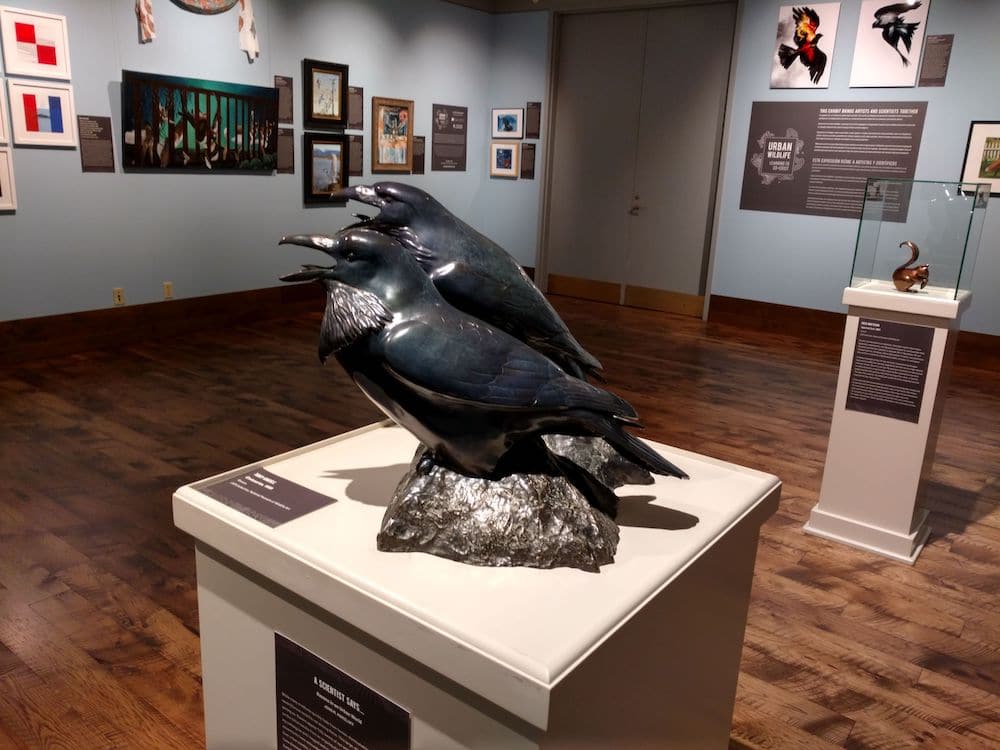
The cliché “a picture is worth a thousand words” seems spot-on for “Urban Wildlife: Learning To Co+Exist,” a new exhibit at the National Museum of Wildlife Art (NMWA) in Jackson.
 The exhibit, which is up through late January, demonstrates how visual art can translate science in a way that grabs us emotionally.
“How do we get people to pay attention?” the museum’s Chief Education Curator Jane Lavino asked. This question animates both this show, and much of the work of the museum and its partner, Creature Conserve.
“Urban Wildlife” asks us humans to consider how well we coexist with animals. Sometimes that means looking in our own backyard, as Jackson native Emily Poole does in “Trout Friendly Lawns.” Or pulling back the curtains on a street lit up at night, where a cougar stalks a deer, as Bozeman artist Nathan Udd has done in his acrylic painting, “While You Were Sleeping.”
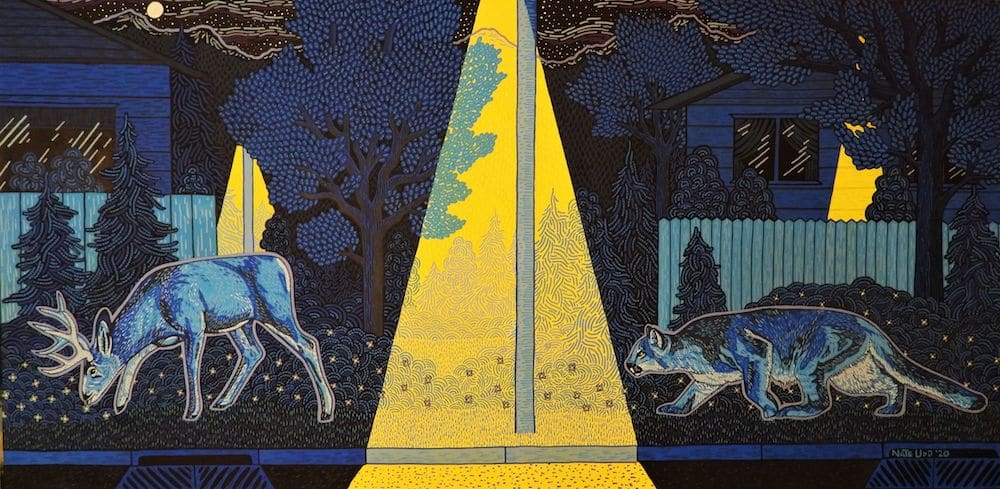
The second partnership between the museum and Rhode Island-based Creature Conserve, “Urban Wildlife” features 32 artists from around the world, including several from the Greater Yellowstone area.
Creature Conserve founder Dr. Lucy Spelman, who teaches art and design at Rhode Island School of Design (RISD), is an internationally recognized big animal vet who has worked with giant pandas and mountain gorillas. Her group fosters collaborations between artists and scientists to tell stories about human and wildlife interactions, the resulting problems and possible solutions. Through workshops and a mentorship program, Creature Conserve offers opportunities for artists and scientists to collaborate.
“Art is what inspires us to feel differently. Artists have always led change,” Spelman said. “I freely admit that animals are a hook.”
While art for art’s sake is great, education and animal conservation underpins both organization’s missions.
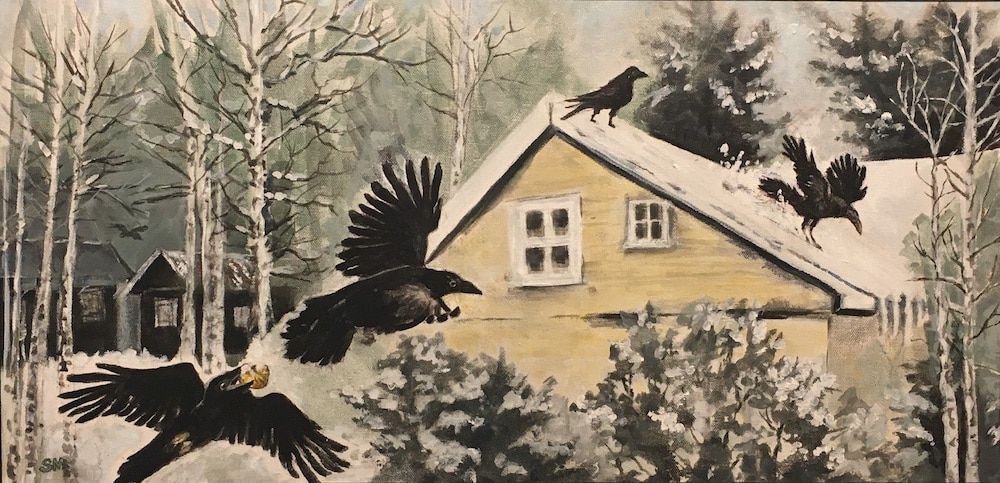
For people in Wyoming, “urban wildlife” are our neighbors. For animals, the urban environment can mean survival or death. In her acrylic painting, “The Wild Bunch,” Jackson artist/naturalist Susan Marsh captures the familiar antics of ravens that scavenge restaurant dumpsters and domestic trash cans. In “Opportunistic Predator,” Oregon-based artist Andrew Myers uses mixed media to show how coyotes augment their diet of insects and mice with human trash and pet food.
The landscapes in the exhibit vary, as do the animals. Some are intimate portrayals, such as Ele Willougby’s collage “Redbud and the Bees,” where three different species of wild bees feed on one flowering branch. On the other hand, Jordan K. Walker’s oil painting, “Broken Corridors,” presents an omniscient view of a highly urbanized city stretching toward distant mountains and overlaid with “floating islands” of wild country cut off to migrating elk.
“We really wanted the artists to decide for themselves what was urban,” Spelman said. Creature Conserve encouraged artists to select wild animals about which they felt passionate. Spelman’s group then linked an artist with a scientist with knowledge of how that animal navigates a particular urban landscape.
It is not often one sees art exhibits that portray ants and bees, snakes and bats, rock pigeons and fish. Of the 50 works exhibited, it is remarkable that bees appear in four pieces, ants in Matt Zigler’s seven digital prints entitled “Carpe Diem, Formicidae,” and bats in three paintings and digital artwork. These works speak to the beneficial work these animals do in the world, such as pollinating and controlling harmful diseases. Lisa Azzoli’s clock sculpture, “Bee On Time,” celebrates bees as artists who create works of art themselves, their hives, but for whom time may run out.
The museum’s own collection does not include representations of insects, and Lavino was excited “Urban Wildlife” artists considered them. To see bees and ants framed larger than life is to understand their importance to a healthy planet.
One of the artists Spelman met at RISD is Emily Poole, who has two pieces in “Urban Wildlife.” Poole, who now works in Oregon, takes a playful approach to what has gone wrong in the relationship between two different species of fish and people.
In “Trout Friendly Lawns” and “Coho-Fragmented,” she uses the solid warm colors of gouache and the transparency of watercolor paints to balance the urgency evident in the science and the hope she wants to evoke in the viewer. Both works illustrate the hidden pathways and mostly unknown journeys these animals take to reproduce and survive.
Obstacles, such as herbicides and fertilizers for the trout and dams for the salmon, endanger their survival. Both works render science’s message: Without humans learning to co-exist, these animals’ journeys, as species and individuals, are doomed.

Jocelyn Slack’s “Fractured Landscapes” also speaks to the human-caused challenges to wildlife survival. This elegiac landscape is ghosted by pronghorn antelope who have died on migration, tangled in wire, skeletons haunting the distant cities. The way the Wyoming artist has used graphite pencil and watercolor conveys her emotional intent to “show the layers of reality and conflict” between wildlife and the human-built world.
In counterpoint to the backdrop of the mirage-like caravan of semis and the cul de sacs, Slack’s vibrant pronghorn take center stage, although they have to move quickly through the gilded hills and desert lands, drawn, even as we are, to the channels of blue water, as if it were hope.
“Urban Wildlife” repeatedly poses an urgent question: “What can we do to ensure that birds of prey continue to nest in skyscrapers, brilliantly colored trout swim in backyard streams, and bees visit home gardens?”
Elizabeth Mordensky’s “Share The Ancient Road,” challenges us to remember another road lies under the paved highway. In Mordensky’s large oil painting, a lone bison dominates the canvas and walks straight at the viewer, straddling a double-yellow line humans have painted.
The exhibit reminds us that “we all share this space,” Lavino said.
Support Wyoming storytelling with a tax deductible donation today.
“Urban Wildlife” warrants more than one visit. There’s an overwhelming amount of information to digest and the artwork has multiple layers. While the exhibit highlights problems facing the world, it offers solutions and hope, at least for this reviewer.
The show is up through Jan. 21, 2021, in the Wapiti Gallery at the National Museum of Wildlife Art in Jackson. Selected images are available on the museum’s website. Information about Creature Conserve is available on its website.
Studio Wyoming Review is supported in part by generous grants from the Wyoming Cultural Trust Fund, a program of the Wyoming Department of State Parks and Cultural Resources and the Wyoming Arts Council with funding from the Wyoming State Legislature and the National Endowment for the Arts.

I was re-reading the article about “contemplating the coexistence of humans and animals”. Thank you for this thought-provoking exhibit, and the opportunity for our community to address co-existence with our wild neighbors nationwide.
I noticed a missing link in the collection of artwork that was submitted – traps and snares. Every single wild animal in Wyoming is exposed to traps and snares from the day they are born, including pronghorn, mule deer, migratory birds, grizzly cubs and adults, and even trout. There are thousands of animals, domestic and wild, who die needlessly each year from the steel devices that litter our public and private landscapes every day of the year. Hopefully with continued efforts to raise awareness, including these hazards in our conversations, and in our “awareness through art” exhibits.
Lest we forget, humans are animals, too: The most destructive and only SELF-destructive species ever to have existed, to the detriment of all others. And we dare call ourselves Homo SAPIENS (sic). Clever, certainly. “Wise,” not so much.