

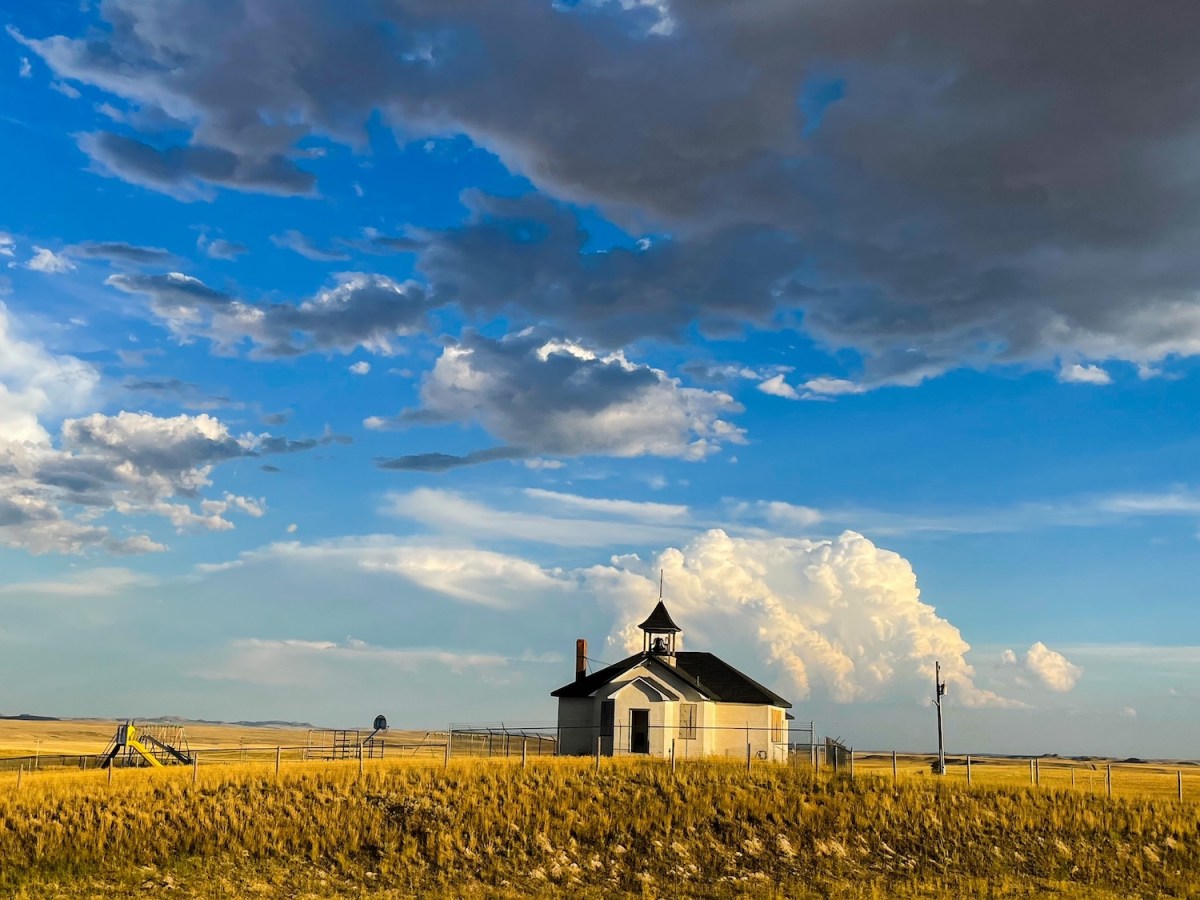
A few blocks southeast of the Wyoming Capitol is a well-functioning parochial school founded in 1892, just two years after statehood. My wife and her siblings attended that school in the 1950s and 60s.
Opinion
Her family couldn’t afford to pay tuition, but all four kids went anyway — funded by contributions from the church’s general membership.
Schools like this one depend on the separation of church and state in order to maintain their respectful distance from government and remain self-reliant. This separation is enshrined for good reason in Wyoming’s constitution.
As a result, for all of Wyoming’s 133-year history as a state, churches with privately funded school facilities and privately funded scholarships for low-income families have thrived.
But now, that separation has been breached, and private and parochial schools in Wyoming will be worse off for it.
This year, the Legislature passed a law creating a new program to fund private and parochial schools with public money. As someone who was raised in the church, I see this as an example of when government “help” actually hurts.
Providing public funding for private education diminishes individual incentives and corporate responsibility of church members, and that hurts.
When schools that have operated successfully for more than a century are faced with accepting government money to remain competitive, that hurts.
When new facilities are built and staff sizes grow, thus assuring the dependence on government, the loss of autonomy will really hurt.
The bill that passed will allow some Wyoming families to receive $6,000 per student so that they can pay tuition at private and parochial schools that have, historically, relied on the faithful giving of members. Who will receive this money? Schools in the most populous parts of the state like Cheyenne and Casper will grab the lion’s share due to the capacity of their existing and planned facilities. It should be noted that the cost of public education will be only marginally lower since funding does not actually “follow a child” but is based primarily on the number of teachers, classroom space, bussing and special education. In short, education savings accounts are an additional cost, not a cost savings as some claim.
When the government pays for both public and private education, it may look like it’s creating competition, but in any organization, there is only one purpose, one philosophy, one direction. In the long term, government, like any business, will not compete against itself. When the government is paying, “competition” will always be subject to the constraints that the government dictates to meet its own objectives.
This new “education savings account” program is being created at a time when church attendance is in decline, and commitment to the church’s mission is waning. In this moment of perceived weakness, some churches are looking to government to solve what is clearly a spiritual problem.
We all know that the winds of government that blow in the church’s favor today can blow you over tomorrow, especially if you’ve made yourself vulnerable. “Education saving accounts” is that vulnerability. These accounts are not a “wall of separation” as proponents suggest, but rather the mechanism to transfer money from the public treasury to the collection plate, the largest church fundraiser ever in Wyoming. Forget about the next church bake sale to support the school.
Today, the church should be fighting hard to defend the wall of separation between church and state, not inviting the state in. Once government money is inside the church walls, the ability of the church to speak independently and critically to the government will be lost.
Years from now, when the people of Wyoming ask when it happened that the state got its foot in the door and started to usurp the authority of family and church, they will look back to 2024. That is when the Wyoming Legislature breached the wall of separation of church and state that had protected the church at large for 133 years.
That is unless Gov. Mark Gordon vetoes the bill. It’s sitting on his desk, and he has until Saturday to take action.

Really great column, Rep. Obermuller, thank you. And a beautiful photo by the way. But please pass along to Alan Nash that that’s an old school building in Shawnee–see the playground equipment, and the bell in the cupola?–and not a church.
Excellent opinion piece. The two “great experiments” the Founding Fathers designed are free public education and the separation of church and state. These two experiments are at serious risk at this time in history. Starting with petty legal battles about prayer in school (no one has ever abridged a child’s individual right to pray during school hours) to this frankly boneheaded legislation created by the Freedom Caucus, separation of church and state is being seriously threatened. Let us pray that Governor Gordon uses his veto pen on this one.
I will call Governor Gordo to urge him to veto this bill. I do NOT want my tax dollars going to religious/private schools! I think it is vital to maintain the separation of church and state in our democracy.
Yes to separation of church and state. Financially and philosophically.
I agree with Representative Obermueller. This bill needs to be vetoed. When legislators have the ear of a few folks at their church and remain deaf to the taxpayers they represent this is the type of legislation that results. I can predict that Wyoming will see pop-up schools to cash in on this bonanza while the students they attract will receive a second class education at best. What a perfect way to attract scam artists and feed the greed of those who don’t need the help. I believe the amount actually spent will far exceed the budget for this ill-advised venture as a result of the fraud and scams. The genie cannot be stuffed back in the bottle. You can’t turn a pickle back into a cucumber.
I agree with Mr. Obermueller, though for different reasons. Yet I can appreciate his point of view and one, like others, I hadn’t considered. I do see this bill creating a money grab with little oversight, that will weaken the public school system and in the end, question if will have any positive outcomes.
Right on
I agree. Separation of church and state are fundamental to the US Constitution. Although the education of children is a universal need, and therefore a public responsibility, paying for education outside of public schools is not. You can argue that the Founders would not have envisioned the multiplicity of beliefs that would have developed in the citizenry, in their wisdom, the Constitution allowed for that. I strongly oppose the use of public funds for the education that incorporates any religious preference in ideology. I f say this recognizing that the US as an ethic was founded on Judeochristian principles. The fundamentals of most religions share similar ethical values, but churches are churches and not public schools. People make a choice when they go to a private school and need to plan and budget for it. It does not absolve their responsibility to provide education for the public good.
Exactly!
I had never thought to look at this issue from Mr. Obermueller’s perspective, but I think he’s right. Thank you for enlightening me!
I’m not often in Rep. Obermueller’s corner, but I am on this issue and partly for the same reason. Add my name to the list of folks who would like Gov. Gordon to veto the “educational savings account” legislation for the sake of both private religious institutions and the public education system.
Need to keep separation of church and state .When you intertwine the two both will soon fail.That is something the far right wing do not understand.
Agreed, we need to maintain separation of church and state. This is an interesting take on this idea, but it makes perfect sense as to why from the perspective of the church.
“Today, the church should be fighting hard to defend the wall of separation between church and state, not inviting the state in.”
Yes, the church should be fighting to keep the separation of church and state. Get religious beliefs out of politics. Freedom of religion also means freedom FROM religion.
In another 20 years, those who don’t identify with a religion, will be a bigger percentage of the population. Hopefully we can finally get past the lunacy of governing by fairy tales.