


The Biden administration in January made regulatory changes designed to make it easier for women to access abortion medication they could take at home. But nearly a year later, it appears the changes have had little or no effect on the drugs’ availability in Wyoming.
Interviews with providers and pharmacists offer a simple explanation for why the rule change hasn’t made a dent in Wyoming: shame and fear.
“There’s this aura of stigma around [abortion], so it’s not just like ‘call your doctor,’ which is what it should be,” Dr. Giovannina Anthony said.
The Food and Drug Administration announced in January that physicians can prescribe mifepristone — half of a common two-drug cocktail used for abortion and to manage early pregnancy loss — through pharmacies, instead of needing to stock and administer the drug themselves, as was previously required. Misoprostol, the second pill, was already available at pharmacies because it’s also used to treat things like stomach ulcers.
In theory, the regulatory change would enable patients to request a prescription from their primary care provider or existing OB-GYN instead of finding a doctor who specializes in abortion care, which is a rarity in the Equality State. But nearly a year after its passage, WyoFile was unable to find a single Wyoming physician or pharmacy taking advantage of the new rules.
“On a lot of levels I blame my profession for not bringing [abortion] out of the dark alley, even when it became legal.”
Dr. Giovannina Anthony
Access to in-person abortion care, in the meantime, has diminished. Wellspring Health Access in Casper or telehealth services like Just the Pill or Aid Access appear to be the only remaining in-state options. A Jackson clinic that performed abortions closed for good on Friday.
Yet, short of calling every physician and pharmacy in Wyoming, it’s difficult to confirm where in-person abortion care is available. The Wellspring clinic declined to be interviewed for this story.
While all abortions in the state must be reported to the Wyoming Department of Health, the agency releases aggregate data but keeps the names of individual physicians and clinics confidential. “We have no official way to be the source of that information,” an agency spokesperson said in response to a question about the number of in-person abortion providers in Wyoming.
Uncertainty stymies access
The sense among Wyoming’s abortion rights advocates is that physicians and pharmacists in the state are approaching the FDA’s new mifepristone rules with caution.
Fear is part of the equation.
“You think, ‘are they going to get a target on their back?’” said Sharon Breitweiser, Pro-Choice Wyoming’s executive director.
That intimidation was made all the more real after an arson attack on the Wellspring clinic in May 2022, which caused $290,000 in damage. Uncertainty about the law is another factor.

“You talk to the physicians in the state and they are acting as if abortion is illegal,” Dr. Rene Hinkle said. They’re worried about facing prosecution even though the practice remains legal, the Cheyenne-based OB-GYN said, and that’s detrimental to the care patients with non-viable pregnancies receive.
“We had a gal who was 17-weeks pregnant and her bag of water was broken,” Hinkle said, “so the baby was not going to survive to term . . . and the doctor here [in Cheyenne] would not do the delivery.”
He wouldn’t induce delivery of the non-viable pregnancy because that’s technically an abortion, Hinkle said. To prevent the risk of infection the patient went to Colorado for the necessary treatment.
Protecting access to that kind of care is why Hinkle said she signed on as a plaintiff in the ongoing lawsuit against Wyoming’s abortion bans. “Those are the types of things where, we as general OB-GYNs, even if we decide not to do routine elective medication abortions, we still do abortions from time to time for other indications,” Hinkle said.
Over the course of her 25-year career, Hinkle said, she opted not to provide elective abortions, because working in Cheyenne, so close to Colorado and its numerous abortion clinics, she didn’t see a need to.
“It’s fairly simple because we can just send them down to Fort Collins,” Hinkle said. “And the fact that they do it more frequently makes it safer for the patient.”
The FDA’s new guidelines have not changed Hinkle’s mind about sending patients across state lines for elective abortions.
“I absolutely am for the normalization of [abortion]. I am fully for every woman having that choice, but as a physician in this climate, I don’t know that it would be worth putting yourself out there for the small number of people that we would treat,” Hinkle said. Yet she acknowledged: “It’s the rest of the state that tends to have less access.”
That’s where telemedicine comes in, Breitweiser said. “It’s the people in the most rural areas that benefit the most from these telemedicine options because those are the areas of the state that are also less likely to have a pharmacy.”
Stigma and shame
While mifepristone and misoprostol might be readily available through the mail, Dr. Anthony — also a plaintiff in the lawsuit against the state’s bans — said she’s frustrated that shame and stigma continue to relegate abortion care to only certain clinics and telemedicine.
“On a lot of levels I blame my profession for not bringing it out of the dark alley, even when it became legal,” Anthony said.
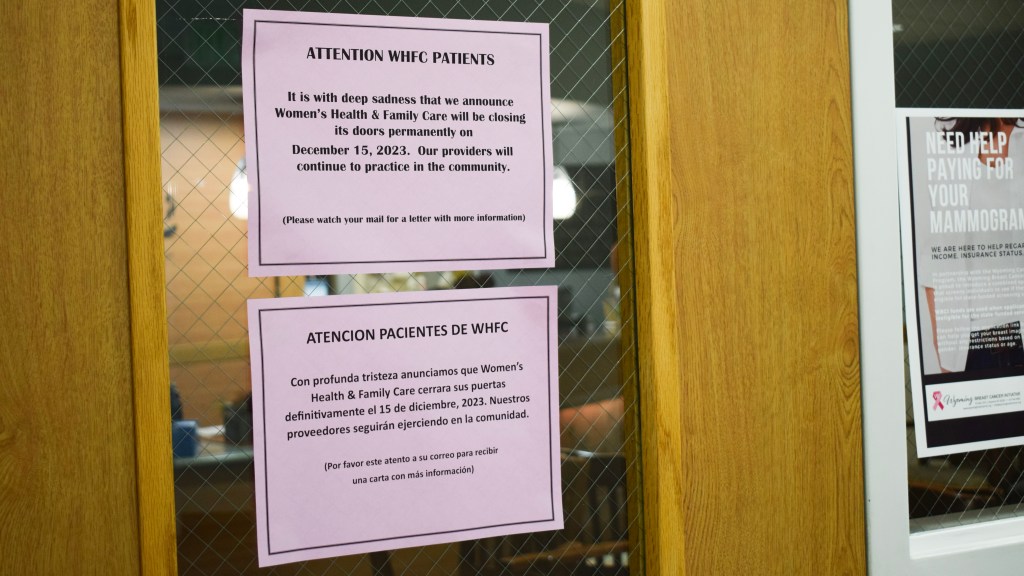
She practiced at the now-closed Women’s Health & Family Care clinic in Jackson and plans to continue providing abortions, but doesn’t know where yet.
The FDA’s new rules are promising, especially for people in rural America, because now “we don’t have to send patients to cinderblock, barbed-wire, high-security abortion centers in Denver or Fort Collins,” Anthony said. “They can just do this in the privacy of their own home,” with a prescription from a doctor that they already have a relationship with, she added.
That being said, Anthony, who has provided abortions in Jackson for the last 18 years, prefers to stock and dispense mifepristone and misoprostol herself to prevent her patients from interacting with pharmacy staff who might judge or harass them.
“At first, when I started providing medication abortion, I would give the patient the mifepristone in the office, and then give them a prescription for the misoprostol,” but Anthony said ran into problems with pharmacists. “They wouldn’t dispense it or they dispensed it and gave the patient a hard time.”
After several patients called her to complain, she decided to take pharmacists out of the equation and dispense both medications herself.
She laments the fact that many of her colleagues, in the face of such challenges, opt not to provide abortions at all.
“It’s just so sad that we’ve allowed fear of protests by a fringe group of citizens to affect providing healthy evidence-based gynecologic care,” Anthony said. “We will deny patients that opportunity because we’re fearful of being attacked, being harmed, being ostracized, being harassed. It’s just so sad.”
Expectations vs. reality
It’s been almost a year since the FDA announced the new certification process for dispensing mifepristone, and just a handful of independent pharmacies have started to dispense the pill across the country. Large chains like Walgreens, which have to navigate the shifting legality of abortion across 50 states, have been slow to get on board.
For independently run pharmacies the process of getting certified is relatively simple and quick, a spokesperson for one mifepristone manufacturer, Danco Laboratories, told WyoFile. All a pharmacy has to do is submit a form to Danco or its competitor GenBioPro to set the process in motion.
Doctors who want to prescribe mifepristone must also fill out a certification form and submit it to a certified pharmacy.
Calls to five different pharmacies in Laramie revealed that none currently stock mifepristone.
Pharmacist Brett Kvenild, with Pole Mountain Pharmacy, said he was aware of the new certification process but hadn’t acted on it because he’s yet to receive a prescription from a provider.
That could be in part because it’s a relatively new process, Kvenild said, but health care providers “certainly are watching the bills that would have outlawed abortion medication. And I don’t want to speak for everybody, but I think when you’re looking at that trying to figure out what’s legal and what you can do, that’s probably largely why we’re just not seeing it available.”
Mifepristone was thrown further into legal limbo last week when the U.S. Supreme Court decided to hear a case in the coming months challenging the drug’s FDA approval.
Even though abortion remains legal in Wyoming, and even though mifepristone is also used in combination with misoprostol to treat early pregnancy loss, and even though information about an individual’s medical treatment is confidential per state and federal law, physicians and pharmacists are still cautious about becoming targets of protests or violence. But that doesn’t preclude patients from having a private conversation with their health care providers about accessing mifepristone.


This issue goes beyond access to Misoprostal, but to the authority of the FDA to approve drugs. If states can ban Misoprostal, then it stands to reason that states can ban any drug they want to within their borders. Look at all of the anti-vaxers in the legislature. Will they ban vaccines next? States should not have this authority. Wyoming’s legislators, driven by extreme religious/political ideology and proven to be the lest intelligent among all hominid species, cannot be allowed to make medical decisions for the state’s citizens.
Another one-sided Wyofile story related to abortion. Ms. Watson’s bias is clear, beginning with the headline and continuing to the end. All her sources are in lockstep on this issue.
The people of Wyoming elected the legislators who overwhelmingly passed the recent abortion-related legislation. Therefore, it would be reasonable to believe that a journalist with an interest in balanced reporting could find at least one source in the state who might see the issue from a different angle. A journalist with Ms. Watson’s experience surely could have done so, had there been any desire to tell the whole story through good journalism.
Excellent comment Mike, and one could add that there should be journalistic interest in the serious and legitimate concerns about these drugs being used at home, especially by young girls who are doing so in secret without parental assistance. Another factor that should be considered is that there are instances when women change their minds midstream of a chemical abortion and that there is the possibility of reversal if done in a timely fashion. Many pro abortion folks fight against this option for women as hard as they fight for chemical abortion. Journalists: please tell the whole story!
It appears from Mike Robert’s’ and Troy Corbett’s comments that neither of these persons have thought much about the need to provide medical care to a woman who is having a spontaneous miscarriage or whose life is endangered by her pregnancy.
It is very curious to me that so called “Pro Life “ people are concerned about the life of a fetus above all other forms of human life.
Put it on the ballot and we’ll find out where the citizens of Wyoming really stand.
Wow. Group think and tribal culture keep ignorance and hate alive and well. How does this backwards climate exist in 2023?
You are so right. The group think of pro abortion advocates is unbelievably tribal. Almost like the ancient people of the Americas who sacrificed thousands of young women to their gods. You are right on the hate too, they seem to really hate little innocent preborn babies especially when they are so inconvenient, or maybe it’s just part of the religion of abortion.
Wyoming always prefers to stay in the dark ages. One of the major reasons many of our young folks leave and never come back.
“and even though information about an individual’s medical treatment is confidential per state and federal law,…..”
I will continue to grind the axe on HIPAA as it was sold to the American people as a protection of privacy when it is really used to protect the medical, pharmaceutical and industrial chemical manufacturers from scrutiny. HIPAA provides an opportunity for State Legislators to pass laws that will present pertinent data to the public about medical issues or drugs that are provided to the public. Wyoming avails itself of the opportunity to provide medical information to the public and while I have been told Wyoming is filled with wonderful, caring and honest people; I find actions speak louder than words.
The Wyoming legislature has not seen fit to provide any data about the medical procedures or drugs distributed in the state, but they do single out vulnerable and pregnant women for punitive reporting and that’s it. The State of Wyoming breaks HIPAA to cow people and not because it cares about its citizens.
Ride for the brand. Love them cows, but cow them people!