


A person convicted of four thefts in Wyoming can now face a felony — and up to a decade in prison — if they steal again.
House Bill 112 – Theft-penalty for fifth or subsequent offense went into effect July 1. It was already a felony to steal something worth over $1,000 in Wyoming — or a “firearm, horse, mule, sheep, cattle, buffalo or swine” of any value — but this new law enables a fifth theft conviction to become a felony, regardless of the stolen good’s price.
Misdemeanor thefts in Wyoming come with penalties of up to six months in county jail and a $750 fine. In contrast, felony thefts carry prison terms and fines of up to $10,000.
Supporters see it as a way to stop serial offenders, but others view it as harmful to communities and fear an increase in prison crowding.
“It’s not like it has all happened within a short period of time,” said Rep. Karlee Provenza (D-Laramie). “It’s throughout the course of your life. It’s just ultimately going to incarcerate more people. And with no solution, it’s not helping anybody.”
Rep. Ember Oakley (R-Riverton) sponsored the legislation this session as a tool to prosecute serial offenders, but said she doesn’t expect it to be used in most cases where it could apply. Oakley is a prosecutor in Fremont County.
“It’s always discretionary,” she said. “That will happen probably more often than not — that you go forward with the misdemeanor, just because you do balance [criminal justice resources].”
The law, however, states that anyone getting a fifth or consecutive theft conviction “shall be guilty of a felony.”
“It really hurts when it gets down to some of our smaller [stores].”
Dale Steenbergen, president and CEO of the Greater Cheyenne Chamber of Commerce
The language is similar to laws for driving under the influence, according to Joshua Case of the law firm Steiner, Fornier, Zook and Case in Cheyenne.
“Prosecutors wouldn’t have discretion to charge this as a misdemeanor,” he stated. “However, the prosecutor could have the discretion to not charge anything if they don’t believe they have enough evidence to convict someone.”
Under the new law, crimes counting toward a person’s five strikes include any theft offense outlined in state or local ordinances, including “shoplifting, larceny, wrongful taking of property, wrongful disposal of property or livestock rustling.”
It states thefts in “another jurisdiction” count, too, which can mean out-of-state convictions.
Small crime, big impact
In her district, Oakley said a lot of the issues came from thefts of choice cuts of meat, cosmetics and electronics from the Walmart in Riverton.
“It’s very rare that we see somebody going in only stealing groceries and probably what they need,” she said.
Prosecutors can already charge low-level thefts as felonies if the case involves a burglary or if the perpetrator has been banned from the store. But this new tool is better, Oakley said in a House Judiciary Meeting this January. There have been concerns about theft-to-resale rings, she added, albeit ones that aren’t as organized in Wyoming as other parts of the country.
That’s increasingly harming retailers across the state, according to Dale Steenbergen, who testified in January on behalf of the Greater Cheyenne Chamber of Commerce, Wyoming Business and Industry Federation, and state retail association.
“It really hurts when it gets down to some of our smaller [stores],” he said. “What they end up doing is raising their prices at a time when we don’t need to raise prices.”
Retailers can recoup many losses via insurance, but some testified that such coverage and surveillance measures cost significant funds that can’t go back into a store.
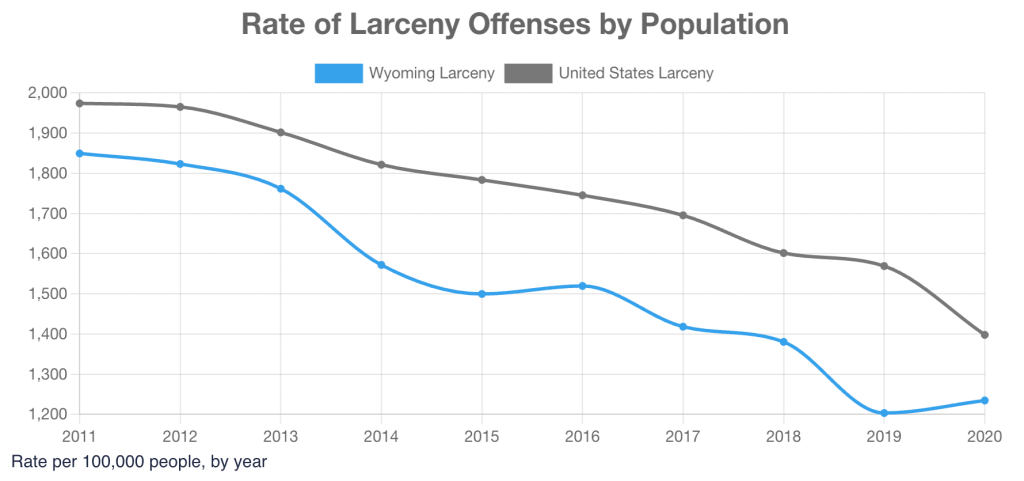
Wyoming’s overall larceny rates have fallen significantly over the last decade, according to FBI data, but there has been an uptick in recent years.
Dissenting opinion
The one lawmaker who voted against the legislation in that House committee was Provenza. She had concerns about a lack of evidence of organized theft rings, she said, and that putting more residents with low incomes and substance use disorders in prison would only hurt Wyoming communities.
“It’s not helping anybody,” Provenza said.
Incarcerating people over non-violent crimes has plenty of critics, given the state’s and nation’s high rates of residents behind bars.
The threat of spending more time in prison is also not an effective deterrent to crime, according to the U.S. Department of Justice. The DOJ found that inmates may even learn “more effective crime strategies from each other, and time spent in prison may desensitize many to the threat of future imprisonment.” Instead, it found the deterrent of swift and certain punishment is more effective, which is a challenge with shoplifters.

Alternately, the public-policy nonprofit Pew Charitable Trusts found in 2017 that increasing the amount someone has to steal to get a felony didn’t mean higher theft rates.
Having a felony conviction is also a barrier to employment, Provenza added.
“We’re talking about crimes of poverty,” she said. “And now, by the way, we’re gonna make sure you get a felony, so you can’t ever get a job.”
Beyond that, she said there are concerns about increasing prison populations.
Wyoming Department of Corrections prisons are fairly full. As of June 30, its five facilities had 1,837 inmates: about 90% of capacity, according to agency Support Services Administrator Paul Martin. Still, the department is not yet using jails or out-of-state prisons to offset crowding, he said — tactics it’s had to use in the past.
Oakley said she doesn’t expect the law to have a major effect on prison capacity. If it does, she said, “then we’d find out we had a much bigger problem on our hands than we even understood.”
Besides, she said, the new law is needed. Oakley pointed to stores leaving areas of California — particularly around San Francisco — over shoplifting.
Stores like Old Navy and Whole Foods reported having issues with shoplifting, safety concerns for staff and reduced foot traffic before leaving San Francisco locations. Walgreens recently walked back claims that shoplifting was a significant reason for its stores’ departure from the same area.
About 37% of physical retail losses in the U.S. were caused by external theft in 2021, according to the National Retail Federation, while 28.5% were caused by internal theft and another 25% were from process/control failures.

Increasing jail time does not deter criminals. They don’t think like that….they don’t ever think they will be caught. The five strikes law makes law abiding citizens think the crime level will go down, but has no effect on the thief.
Does the law apply when, for example, a shoplifter steals five items on one visit to a store and the prosecutor charges those as five offenses?
If so, that seems inappropriate. However charging for shoplifting at five different stores does make sense.
Send the all to prison or establish a penal colony the hire the likes of Yevgeny Prigozhin, then the next time the Masters of War deem it time to smash and grab there will be plenty of felons to take up arms.
As a longtime, independent, retailer here a few thoughts. Retailers can’t just raise the price on goods to make up for loss. The retail price of goods is pretty much set by Amazon and big corporate retailers. If you charge more you won’t get the sale. Independent retailers lose all around. If a person has been caught stealing 5 times, they most likely, have not been caught, countless more times. They are a serial criminal, period. Even if that person is not “rehabilitated” in prison, they are not out in society perpetrating crime, while incarcerated. The idea that employees can be more vigilant to deter theft is fine, except retailers struggle to get enough employees to perform even essential duties and harassing and dogging customers (the vast majority who are honest) around a store hurts sales and makes shoppers uncomfortable. Why are people condoning crime and theft? In all countries and cultures of the world, theft is considered criminal. Lock them up.
This is an unbelievably harsh law. For as long as I can remember $1000 has been the gauge for a felony 50 years ago thousand dollars was a lot of money today $1000 isn’t that much I have always thought that needs to go up as time goes by. This law will ruin so many lives a kid getting caught stealing candy five different times through their life is a felon I guess this is conservatism.
“Oakley pointed to stores leaving areas of California — particularly around San Francisco — over shoplifting.”
The right keeps repeating the same lie until it becomes “true”.
Most of the stores are leaving due to the changing work patterns that occurred during Covid. People worked at home and still do which has resulted in property prices to go up in the west, while retail stores in inner cities struggle. The disruption in the workforce has led to less employment causing increased homelessness.
Using that lie to justify this law was callous but apparently not callous enough for some, but that is seemingly the base of the Wyoming GOP. I watched that January Judiciary meeting and the more interesting testimony was the one given by Michelle Motherway, the 3rd generation owner of Mr. D’s in Lander, Wyoming.
She said she was the most burgled place in Lander and provided a detailed account on how her business had been targeted by gangs stealing food. She claims to have video and police reports to back up these reasons she is supporting putting felony teeth into shoplifting. Why aren’t these videos of gangs of shoplifters being played on TMZ?
Crime goes down but felons go up. “Justice” is a pyramid scheme and they need more customers, not solutions. It’s bad for business.
Prosecutors just want to have as many people in prison for as long as possible, regardless of whether it actually reduces crime. Oakley is no different.
After one has studied “Criminal Justice” and worked inside a “Correctional Facility” for a few years, one becomes familiar with three undeniable tenets: 1. No one is “corrected” in a “correctional facility.” 2. Actual reform only comes from within an individual; it cannot be imposed, i.e., “a person compelled against their will is of the same opinion still!” and 3. As long as crime pays as well as it does, we’ll have plenty of it!
Hopefully this will equally apply to kleptocrat politicians. Next up in the Republican l’aissez faire free enterprise legislative bin is allowing Wyoming’s unoccupied jail and prison cells to be offered on VRBO or AirBnB
Theft is a significant crime that we al pay for, to cover the loss stores simply raise prices of all goods. Store owners could easily train their employees to watch and reduce the cost of theft. Instead of attempting to do their part to prevent loss they simply cut the number of employees and increase their losses. Individuals can play a part, all we have to do is teach and encourage them to act. The science to educate individuals how to help reduce crime is there, all stores need to do is let the store’s management realize that the responsibility is theirs and not rely on the police to do their job of reducing the opportunity for this crime.
I agree that we all pay for theft. But some of your other comments are way off base. You suggest that owners instruct employees to ”watch and reduce theft” Suppose the thief has the build of a NFL linebacker or might be carrying a weapon. I don’t know too many employees who would be potentially willing to get hurt for minimum wage. Besides which police usually say not to interfere but to call them.
You also say to ”not rely on the police to do their job…” Should we all walk around carrying guns then because we can’t rely on the police?
And to some other comments from others. After 5 thefts it should be pretty clear the person is not going to stop unless he is stopped. Instead of jail what do you recommend? A slap on the wrist and a ”Naughty, don’t do it again!”
This is a first step to stopping these woke crime trends I fully support and applaud these law makers, nice work and maybe they should take off a finger on first 4 thefts so they can remember how many times they have broken the law were caught.
Woke crime trends? Is there anything that the gullible right don’t claim as woke?
Only themselves?
It seems to include anything you don’t like or agree with and, apparently, is a negative verdict.
It could help to have all those who use this word in this new meaning could write their definitions down and post them in a central location – online or in public view. We could all learn from that.
” Woke crime trends ” ??? Is there no treatment for the hallucinations and delusions of the more inflamed right wing rabble? There seems to be a pandemic all to their own that conjures up imaginary perpetrations . At least among the 60+ million supporters of one orange-tufted serial white collar criminal who passed his Five Strike quota about 40 years ago…
So Oakley is pushing legislation that gives her job security here in Fremont County?
She’s always had an axe to grind with the reservation, this just makes it apparent.
Thanks for the voice of Rep. Provenza. But we need more who care about making our criminal justice system more just, not more punitive and costly. We could save by investing in prevention instead of costly law enforcement and prisons.
What SPECIFIC prevention are you suggesting? If the propect of being arrested and going to jail isn’t enough to deter people from stealing…then ”prevention” isn’t going to work.