

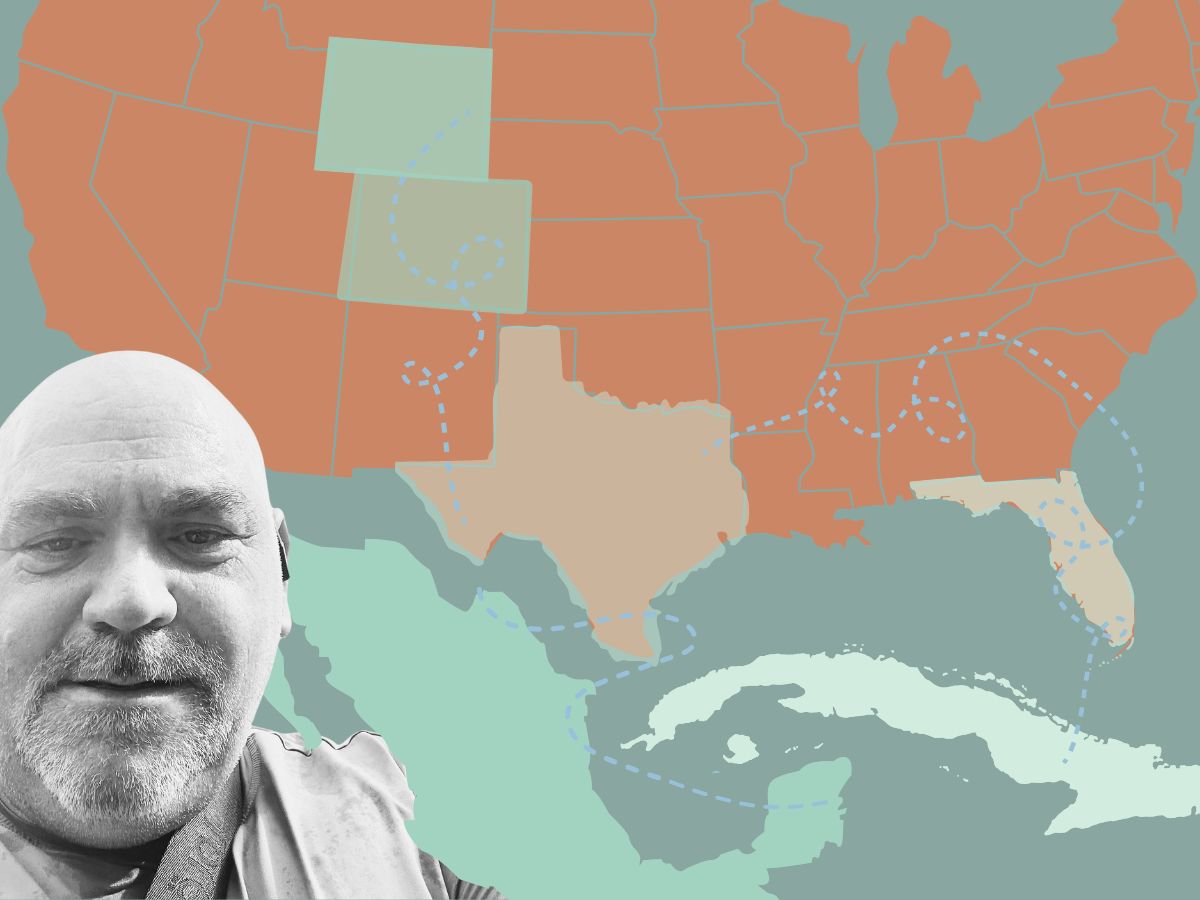
Josue Rodriguez Perez, a Cuban immigrant who spent 40 days in the Natrona County jail during his months-long imprisonment by U.S. Customs and Immigration Enforcement, was deported to Mexico in September.
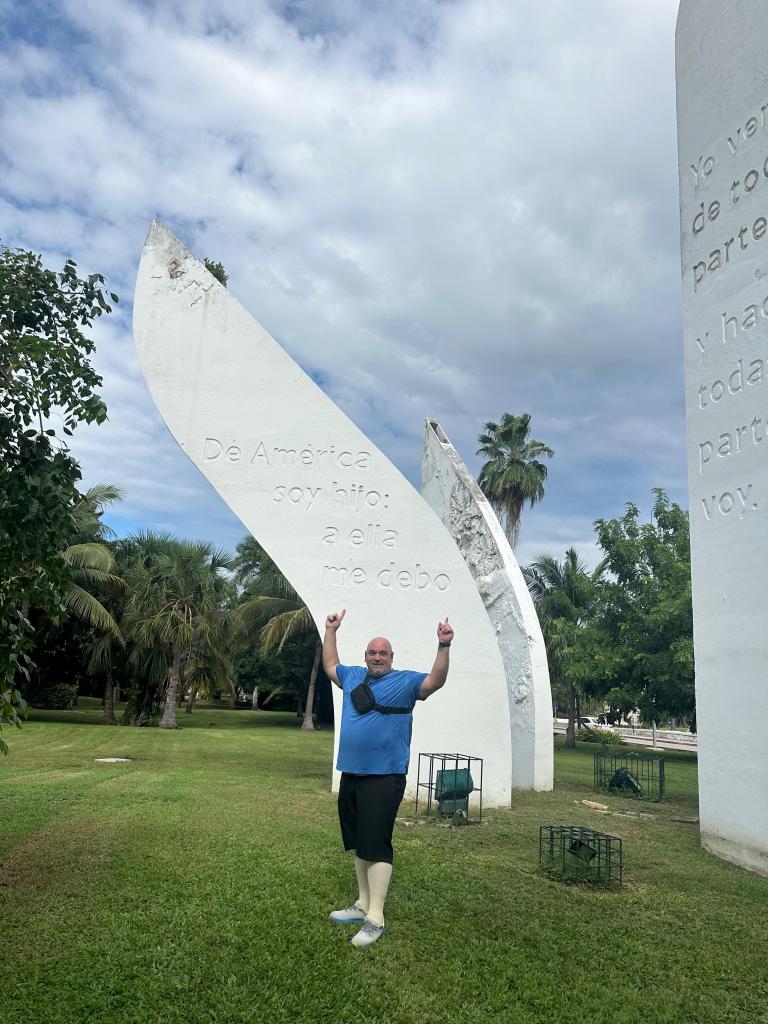
Today, he is sharing an apartment in the seaside vacation destination of Cancun alongside other deported Cubans. But Rodriguez is on no vacation. The federal government cast him into Mexico, a nation to which he had no ties, and he has essentially become a man without a country. His legal status in Mexico is in question, the career he built as a commercial truck driver with a valid U.S. work permit is over and he is separated from his wife and family.
Sharpening that separation is Rodriguez’s inability to enter the United States while his brother fights an aggressive cancer that has spread throughout his body, Rodriguez said during a recent phone interview with WyoFile.
Rodriguez spends much of his days walking around in a foreign land, trying not to let his mind wander, he said. “Every day I feel sad,” he said, “it’s hard to think.”
WyoFile profiled Rodriguez in late August during his time in the Natrona County Detention Center, where ICE deposited him while they tried to find a country that would take the Cuban immigrant.
ICE agents detained Rodriguez at a federal office in Miami when he went to renew a work permit that had allowed him to live and earn in the United States since 2017. Rodriguez and his father fled Cuba, where an authoritarian government squashes independent political activity, tightly controls the press and limits freedom of speech, in 1993 and were granted legal U.S. residency.
But after a tragic car accident upended Rodriguez’s life and led him down a path of addiction, the Cuban man went to a Louisiana state prison in 2012. The felony ruptured his legal residency, but since Cuba won’t accept most deportees from the U.S., a diplomatic antagonist, the federal government allowed Rodriguez to stay.
He served his sentence and emerged from prison reformed. He married and became a truck driver who criss-crossed his adopted country. He has not been charged with any new crimes.
President Donald Trump’s second administration upended that life. Though the Trump administration says it’s targeting undocumented immigrants who are committing crimes and are public safety threats, the federal government has, in reality, been seeking to deport broad swathes of immigrants, including by changing laws and policies to categorize some groups in the country legally as subject to deportation.
Unlike past presidents, Trump wants to deport people to third-party countries like Mexico. When Rodriguez showed up to renew his work permit, he was detained and moved around the country in shackles, in what seemed to him like cruel randomness. He spent time at ICE detention centers in Florida and Texas before landing in Aurora, Colorado, and then Casper’s jail.
He does not remember his long stay there fondly. “That was hell for me,” Rodriguez said.
ICE brought Rodriguez to the Natrona County jail on July 18 as part of a group of more than 40 detained immigrants. As of Friday morning, 12 of those people remained incarcerated there, four months later.
Fearing interminable imprisonment, Rodriguez signed an agreement allowing him to be deported to a third country — but for weeks, the federal government seemed unable to find a place to send him.
He never went before an immigration judge during his detainment, he told WyoFile. In June, the United States Supreme Court overruled a lower federal judge and allowed the Trump administration to pursue third-country deportations. The high court’s decision came via its emergency, or “shadow,” docket, through which the court issues brief, often unexplained orders on requests from the president for legal permission to proceed with a policy despite unresolved legal challenges.
In late August, as WyoFile was preparing to publish a story about Rodriguez’s imprisonment, ICE moved him and other Cuban detainees again, this time to El Paso, Texas. On Sept. 9, he was taken across the Mexican border. Rodriguez described a harrowing journey, including two men on his bus into Mexico who refused to get off in the strange new land and were beaten by a security contractor.
There were kind guards, too, Rodriguez said. He remembered one guard in Aurora, an employee of the private prison company GAO, who told Rodriguez he had already served his time for the crimes he committed in 2012 and did not deserve to be in prison again.
After months in the hands of ICE, Rodriguez described his reception by Mexican authorities as welcoming, and a deep relief. He got a hot meal and a hot shower. Though he stayed in a jail cell, the door was unlocked. But then, he was released into Mexico, without a passport or identification. Instead, he was provided t a piece of paper that gave him 10 days in the country. He still has not been able to secure an identification.
Rodriguez and the other Cubans who made their way to Cancun faced exorbitant prices from locals capitalizing on the influx of confused strangers arriving in their country. Amnesty International has decried third-country deportation as a denial of due process and a human rights abuse that is placing people in unsafe conditions. The human rights organization reported in September that the U.S. has deported more than 5,700 non-Mexicans to that country this year.
At one point, Rodriguez said, he and his now roommates were defrauded out of $2,000, money mostly sent by relatives they had left behind in the United States, as they tried to find housing.
His wife has visited him in Mexico, and they spent four days and nights together, he said. But she is employed in the U.S., and it’s not realistic for her to uproot to Mexico and be with him more permanently.
“It’s hard to think that we’re not going to be together anymore,” he said. The sharper pain today, he said, is the fear that he won’t get a chance to see his brother alive. Rodriguez, for now, is trying to figure out where he can safely stay in the long term and what he will do for work. He is buoyed in part by fellowship with his roommates, the other displaced Cubans. “We take care of each other,” he said, “we respect each other and we love each other.”
He has dim hopes of being able to return to the United States. The big rig truck he sunk tens of thousands of dollars into has been repossessed by the bank he had taken a loan from to start his career, he said.
Perhaps the president who follows Trump will “want to make up for what Trump did,” Rodriguez said. It’s his best hope for a legal pathway back to Florida and his family, he said. “We were good,” he said of himself and other Cubans in his situation. “We were working, we were paying taxes, we were helping.”


I think if he was in the US that long. Why not avoid this by becoming a US citzen…that my friend is not Trumps fault
I find it interesting there was no mention in the article of Mr. Rodriguez’s attempt to become a US citizen. All those years of living here and making a life for himself and he never thought about applying for citizenship? But herein lies the problem with people coming into the country illegally. You want tolerance and compassion from the government? Then make an effort and show you want to become a legal citizen. Until then, roll the dice and hope that you being in the country illegally works out for you.
So he was arrested on felony drug charges and driving a commercial truck? That is Trump’s fault all over.
Andrew,
Great article. It’s eye-opening that these aren’t even criminals. Immigration is considered a civil issue and they’re treated worse than criminals.
cuban exiles have special dispensation that not other immigrant has.
all cubans are granted a green card,without exception,the caveat is commit a feleny & you get deported.
mr rodrigues knew that but committed a felony anyways.