


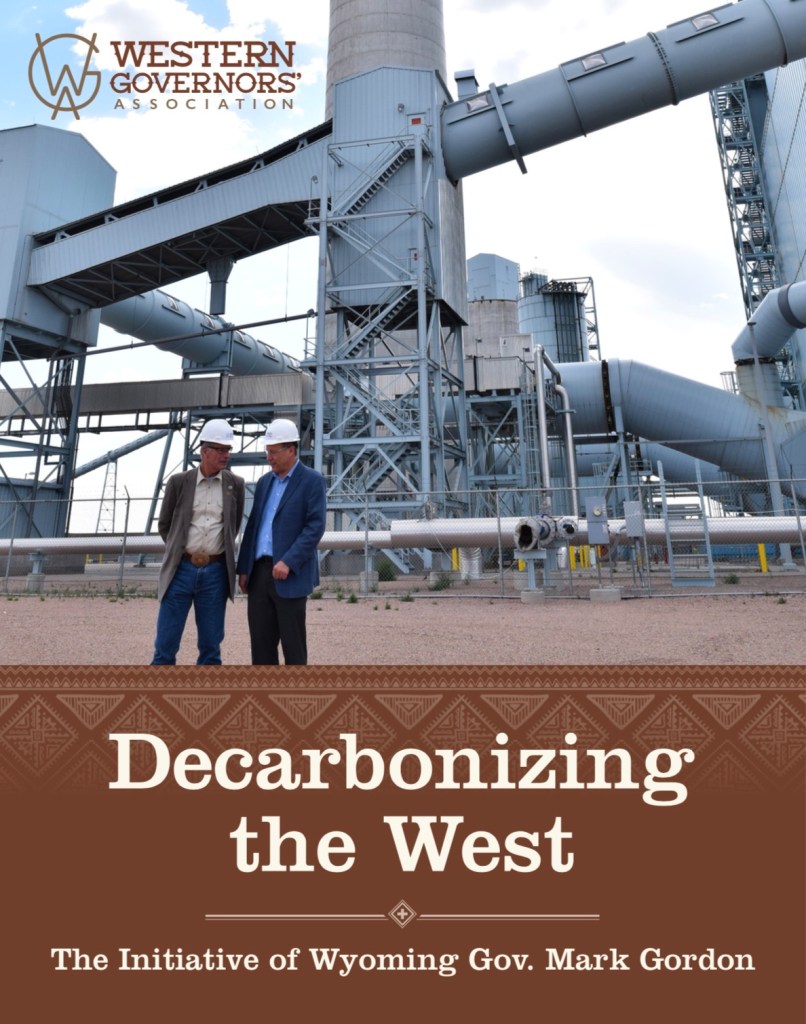
Federal agencies and the Biden administration must be more flexible and encourage technological innovations like carbon capture that can enable low-carbon energy while keeping coal and other fossil fuels in the nation’s energy mix, a new report by the Western Governors’ Association concludes.
The association released its Decarbonizing the West report Tuesday, an initiative spearheaded by Gov. Mark Gordon, who is wrapping up his 2023-34 tenure as the organization’s chairman. Among the report’s recommendations:
- The Department of Energy should fund pilot and commercial-scale industrial carbon capture projects.
- The Environmental Protection Agency should “promote, not impede” deployment of carbon capture technologies at electrical power plants, and streamline permitting for carbon dioxide injection wells.
- Congress should enact “technology neutral” tax policies and provide more research and development funding for carbon capture.
Gordon and his western gubernatorial cohorts found common ground on more than a dozen such strategies for combating climate change in ways that don’t threaten local economies throughout the region.
“It is important that we acknowledge that, if the concern is about CO2 emissions in our atmosphere, then our focus must be on CO2 more broadly, not just curtailing the use of fossil fuels,” Gordon wrote in the introduction of the 32-page document. “This report will show effective efforts to manage carbon in the West are already within our grasp and can proceed without compromising our standard of living or hopes for the future.”
Gordon’s ‘all-of-the-above’ initiative
Western communities both small and large face existential economic challenges, quickly transforming landscapes due to climate change, and market and policy responses that sometimes do more harm than good, according to Gordon.
In Wyoming, the Republican governor has championed an all-of-the-above energy and climate policy that he says encourages technological approaches to curbing greenhouse gas emissions instead of accepting the notion that the nation must jettison fossil fuels.
For example, rather than retiring aging coal plants — a major source of planet-warming greenhouse gas emissions — Gordon, along with the Wyoming Legislature, required western utility giant PacifiCorp to explore adding carbon capture and sequestration to several coal units. At the same time, Gordon is embracing advances in hydrogen energy research as well as a growing wind energy industry, including the TransWest Express high-voltage transmission line connecting Wyoming wind to customers in the southwest.
On Monday, Gordon joined Microsoft billionaire and TerraPower founder Bill Gates in Kemmerer to mark the beginning of construction on the company’s Natrium nuclear power plant — part of a pilot nuclear energy development effort that’s essential to meeting growing demand for low-carbon electricity around the world, he said.
One direct result of the Decarbonizing the West effort is a 2023 memorandum of understanding between Wyoming and Colorado to partner with the Department of Energy and private businesses to establish infrastructure necessary to launch commercial-scale direct air capture facilities.
But Gordon’s efforts to “decarbonize” legacy fossil fuel operations rather than scrap them has often resulted in battles with the federal government. That’s why it’s essential that western states — despite political differences — must band together and convince federal regulators to allow for technology innovations to achieve common goals and address climate change, Gordon maintains.
“This report contains recommendations for Congress and for federal agencies to advance the development and implementation of a suite of carbon removal and reduction strategies across the West,” Gordon said in his opening remarks of the Western Governors’ Association’s annual meeting in Olympic Valley, California, this week. “Importantly, it’s about building, not so much tamping down. This report will serve as a foundation for future Western Governors policy and advocacy efforts.”

North Dakota Republican Gov. Doug Burgum echoed Gordon’s call for technology approaches and federal policies that don’t threaten communities that rely on fossil fuels.
“Innovation, not regulation, is the way we’re going to solve these big problems,” Burgum said during a panel discussion Tuesday.
Conservation perspective
Though western governors have found some common ground on “decarbonizing” strategies, others say portions of the initiative focus too heavily on maintaining the use of fossil fuels. Even if the U.S. manages to capture some carbon dioxide from fossil fuels, those industries will remain a major source of planet-warming greenhouse gas emissions, according to one conservation advocate.
“It’s an improvement over not capturing it, but it’s also an excuse to continue emitting [fossil fuel] carbon when we need to be figuring out how to stop doing that,” Center for Western Priorities Policy Director Rachael Hamby told WyoFile.
Hamby has closely followed the Decarbonizing the West initiative since its inception last June. She commended Gordon and the Western Governors’ Association for taking on the difficult challenges of addressing climate change in the West in ways that benefit the region’s economy. She also noted that the report highlights the “need to protect more public land, so that it can continue to provide carbon capture and storage that it is already providing for free,” she said.

Investing public dollars in landscape preservation, as well as agricultural and forestry management practices that result in natural carbon storage, has the co-benefit of protecting sources of drinking water, maintaining outdoor recreation opportunities and protecting habitat and connectivity for wildlife, according to Hamby.
“So we could get all of those benefits for a lot less money if we prioritized protecting public lands and restoring landscape health so it can continue to help us in capturing and storing carbon,” Hamby said.
Carrot and stick
States, universities and private businesses are benefiting from billions of federal dollars from the Inflation Reduction Act and the bipartisan Infrastructure Investment and Jobs Act, including several grants administered by the Department of Energy here in Wyoming.
But Gordon’s strategy in Wyoming isn’t all about cooperation.

Since 2019, the year Gordon became governor, the Wyoming Legislature has considered at least 14 bills intended to prevent the closure of coal-fired power plants in the state and force utilities to either retrofit the plants with carbon capture, utilization and storage technologies or potentially offload them to another party willing to do so. Seven of the bills have become law.
Coal-burning utilities subject to the state’s carbon capture mandate say the technology is far from economically viable today, despite their promises to continue studying its potential. The Wyoming Office of Consumer Advocate has criticized the policy for what could amount to massive increases for ratepayers.
Lawmakers also gave Gordon a $1.2 million “coal litigation” fund to pay for lawsuits against proposed coal plant closures in other states. The controversial effort aims to buy time for Wyoming to advance its vision for coal carbon capture and demonstrate that Wyoming coal can be an integral part of combating climate change around the globe while maintaining reliable, affordable electricity.
Gordon has also pushed back on several Biden administration programs intended to help finance greenhouse gas emission reductions, including rejecting federal dollars for communities and for the oil and gas industry.
He has also railed against the administration and launched several lawsuits over environmental policies, including the Environmental Protection Agency’s coal pollution rules, the Bureau of Land Management’s “methane rule” and its proposal to end federal coal leasing in the Powder River Basin.
“This report will serve as a foundation for future Western Governors policy and advocacy efforts.”
Gov. Mark Gordon
Gordon said such federal policy battles are one reason it’s important for western states to form a unified front — at least where they find common ground — on technology and policy strategies at home and in Washington D.C.
“Western governors have a longstanding tradition of addressing complicated issues in thoughtful and bipartisan ways that often lead to national policy reform,” Gordon said in a prepared statement this week. “This topic is not simple. I chose it because it’s important to gain a comprehensive understanding of strategies and technologies that can be utilized in managing carbon.”


So confused. Suddenly need big government energy department to fund carbon capture. Forget the free hand of capitalism. Let’s force power companies to keep burning non-economic heat producing fossil fuels. High nighttime temperatures are definitely contributing to the mudslide and catastrophic failure of the road between Idaho and Wyoming but all of our anti government folks in DC are begging for federal government funding. No new taxes, carbon capture seems to be uneconomically workable, keep government out of my life until I need you to put out fires, solve fossil fuel problems and rebuild roads. What exactly is the stance of your party?
While capturing some of the CO₂ emmitted from coal-fired steam generators is a noble goal, the thermodynamics of current (amine-based) processes will require using a significant amount of energy from the generating unit. This is on the order of 10% of the unit’s output, making the unit it’s “own best customer”, and ruining the economics of that unit’s market position.
Not to mention the capital costs associated with installing such CCS systems, and it’s ongoing O&M.
Just what we need, another “muffler” for flue gas treatment, and higher costs of generation.