

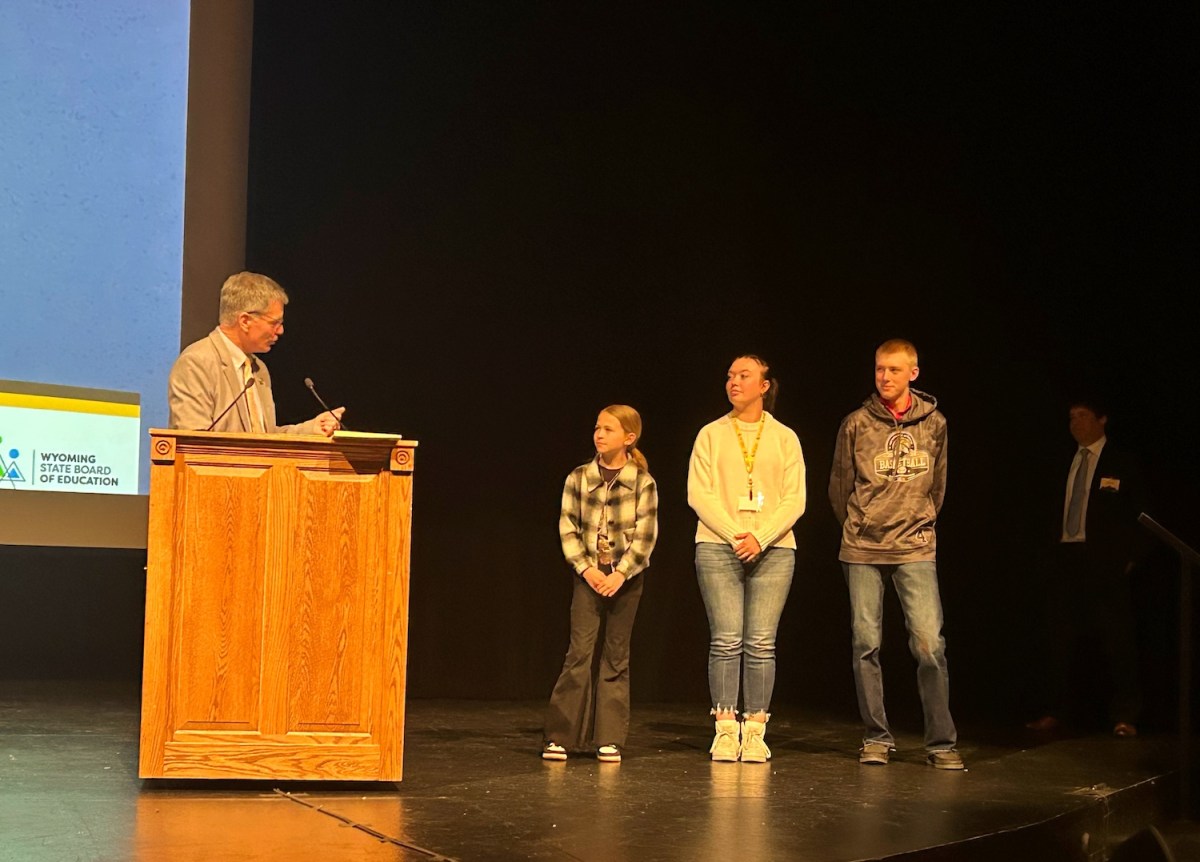
RIVERTON—At Cheyenne Central High School, one of the schools participating in a pilot initiative aimed at rethinking education in Wyoming, Liz Edington taught her psychology students about mental illness by having them study speculated diagnoses of great American leaders.
When it was time to test her students, Edington asked students to produce their own diagnoses in what are known as performance assessments, she recounted Friday from a stage in Central Wyoming College. Unlike traditional tests where students hunch over papers scratching in silence, these assessments require students to demonstrate what they know by working through open-ended tasks. Students construct answers, produce projects or perform an activity — live.
It’s a far cry from what many educators are used to, Edington told an audience of teachers, students and education professionals. But, students “want to figure it out, they want to be creative.”
The testing method forces students to rely on their own resources rather than answers they’ve simply memorized, she said. “It is some of the best work I have done in my entire career,” she said of the class.
One of Edington’s students, sophomore Sirma Orahovats, vouched for her teacher. The course felt like what Orahovats imagines working in a psychology office with real patients would entail, she said.
“I think this experience was so authentic,” said Orahovats, who noted that she didn’t initially have a particular interest in the subject. “I feel like this is the class I’ve probably been most engaged with all year.”
This story was one of several shared at an all-day event that helped give definition to the contours of Wyoming’s new education initiative. The governor-led program, RIDE, stands for Reimagine and Innovate the Delivery of Education, but what that actually looks like has been tough to pin down.
As pilot districts wrap up year one of the program and a second cohort prepares to embark on it, more details emerged Friday from schools that used RIDE to experiment with things like internships for credit, teaching tax filing and student attendance at the Legislative session.
Areas of need
Gov. Mark Gordon established the RIDE advisory group in May 2021 to study and develop recommendations for elevating Wyoming’s K-12 education system.
The group surveyed more than 7,000 stakeholders and held 17 listening sessions to gather feedback from around the state. Most survey respondents identified themselves as parents or guardians. Nearly 60% of respondents said they do not believe children are being adequately prepared for the future, and the most commonly identified areas of needed improvement included “learning outcomes and expectations” and “class content and structure.”
Based on the information gathered, the committee proffered two top-line recommendations: First, students should be able to progress through academic content as soon as they are ready; advancement should be a product of mastery, not seat time. Second, students should have more opportunities for career and technical education.
Other key priorities included improving mental health support and increasing kindergarten readiness.

The pilot program that followed has been a bit of an experiment. That’s because the RIDE initiative rethinks some facets of Wyoming’s educational status quo — like traditional assessments or classroom time — and incorporates concepts like competency-based learning and credits for learning outside the classroom.
The nine school districts selected for the pilot include Albany 1, Converse 1, Laramie 1, Lincoln 1, Park 6, Park 16, Sweetwater 2, Teton 1 and Weston 7.
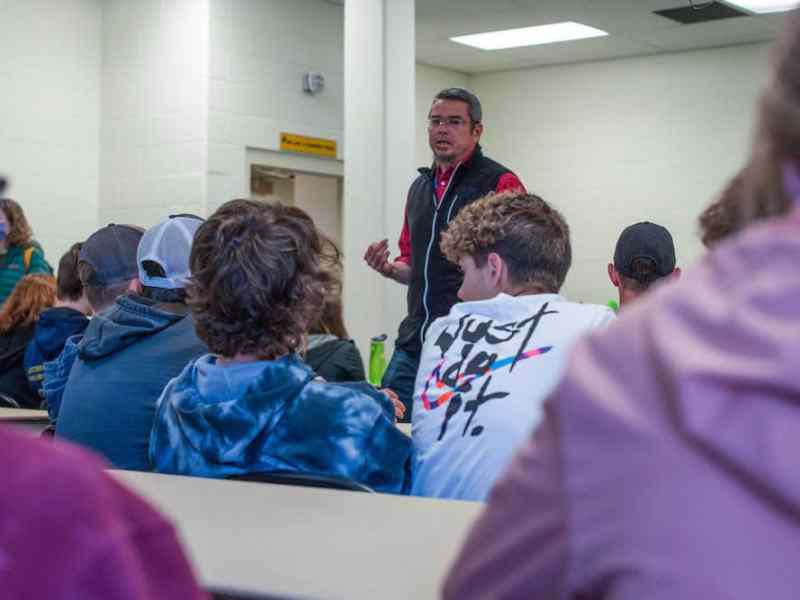
District representatives convened on the CWC campus Friday to share their successes and struggles. Teachers, parents and education professionals from across the state were there. RIDE encouraged all districts to send teams to learn about the opportunities.
A second cohort will begin the program in the fall. It includes Platte Districts 1 and 2, Park District 1, Sweetwater District 1, Weston District 1 and Fremont District 25.
The 15 pilot districts now teach some 43% of Wyoming’s K-12 students, Gov. Gordon noted at the Riverton event.
For them to take the leap, he said, “it is a feat of courage.”
Examples, challenges
Firing off rockets and using range finders. Honing the art of meaningful conversations in an era dominated by cellphones. Sending students to gain clinical experience by working hospital shifts. Having students build their resumes and go through job applications. Walking them through that most adult of tasks: filing taxes. Using code to build electronic birthday cards. Arranging for a student who is interested in politics to attend the Legislative session. Arranging for another to work in a veterinary facility.
These are some of the activities that animated education for the pilot schools.
“We’ve got to bring these [life] skills back into the classrooms,” Park County District 16 Superintendent Shane Ogden said. “We’ve got to provide opportunities for kids to make mistakes in those critical life activities in a safe environment.”
It stretches kids to realize that “they can do so much more than they think they can,” Ogden continued. Doing well on a WY-TOPP standardized assessment test, he said, “really isn’t a skill that they are going to take anywhere else.”

The RIDE effort represents a step back from rigid, arbitrary standards of learning, Gordon said, and saying “maybe we ought to refocus on what’s really important to our communities.”
The type of learning it strives for gives teachers more creativity, allows school systems to better enable learning and “most importantly, we’re engaging students where they want to be engaged,” Gordon said.
It hasn’t all been smooth, and participants also shared challenges. These include how rigid schedules with 60-minute class increments don’t necessarily support innovative teaching, concerns with how this education style conforms with assessment and accountability requirements and battling a misconception that “butts in seats” is the same as learning. Fear and resistance to change, parent apathy, funding challenges caused by early graduation and inflexibilities with crediting were also shared.
These are pain points, 2Revolutions Cofounder Adam Rubin, who is working with Wyoming on the initiative, said during a break-out session.
“What do we do about the pain points?” he asked before posing guidance based on participant discussion. “What can we do with existing rule and regulation to clarify what is misunderstood? Where are there priorities at the state level to change statute in ways that will enhance this work? And is Wyoming interested and ready to go to the feds on an assessment front?”
CORRECTION: This story has been updated to reflect that Shane Ogden is superintendent of Park County District 16. -Ed.

It was a great experience for those that were there. I was a presenter and everyone’s enthusiasm for the RIDE Project was contagious!
One part about the article that I want to clarify: while she was pictured, Superintendent Degenfelder and the rest of WDE were not there! This was an overwhelmingly positive event, it was great for educators to see Governor Gordon having positive comments for all students, educators, and administrators involved, but I can’t imagine what was so pressing that Degenfelder could not attend.
One hundred years ago, Alfred North Whitehead and John Dewey were saying the same thing about education. I started teaching math in 1973. I retired in 2013. I loved it and I think I might have done some good work, but my first and last department meetings were depressingly similar. Imagine that in computer science or genetics. I have come to the conclusion that schools simply reflect the strengths and weaknesses of the community in which they are embedded. If we want schools to become active agents in supporting the full development of a child’s potential, then the entire community must become fully engaged in that project. We have to be what we want to see replicated. That is a big ask.
“The Halls of Congress would Benefit Enormously from the RIDE Initiative” ~ Sorta Woody Guthrie…
How did Woody know everything would be Plastic and there would be Atomic Bedrooms before the Manhattan Project? Talking Columbia ~ Woody G.
“And atomic bedrooms and plastic —
Everything’s gonna be plastic.” ….. Woody Talk’n Columbia ……….Listen!!!!!!!!
“Life is Just a RIDE!?” ~ Bill Hicks
“School’s In!!!!” ~ MC Hammer – “You Can’t Touch This!!”
My Favorite!….. “Taking “IT?” to the Streets!” ~ Doobie Brothers!!!
Throw the Rattan Away!!!!!