

CHEYENNE—After the Wyoming Supreme Court ruled last month that the state’s two abortion bans are unconstitutional, Republican lawmakers did not hesitate to cast aspersions at the judiciary branch.
The Wyoming Freedom Caucus, for example, called the high court’s bench “weak judges” and “woke attorneys,” and without evidence, accused the court of making an “engineered” decision.
Some lawmakers, including members and allies of the caucus, held a closed-door meeting to discuss shrinking the court from five justices to three. Sources told WyoFile the private meeting was in direct response to some members’ disapproval of the court’s ruling.
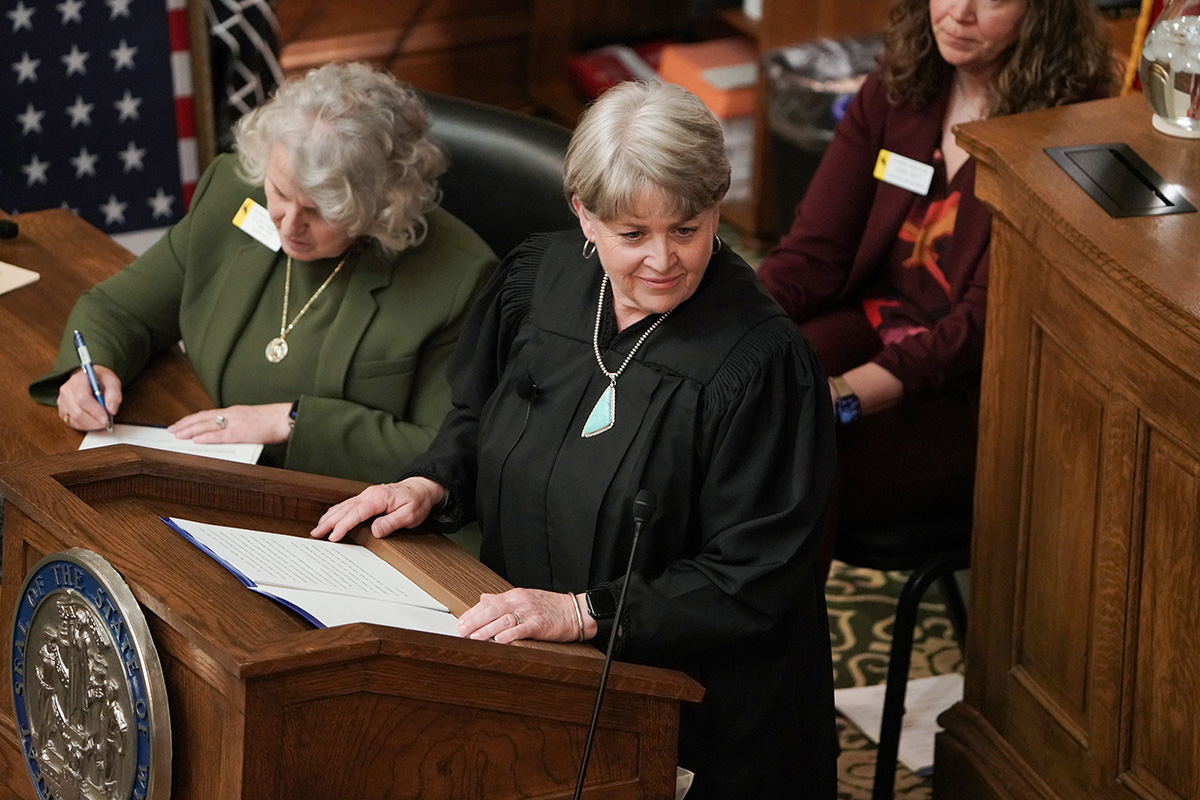
The Supreme Court, meanwhile, has stayed quiet, letting its legal decision speak for itself. Chief Justice Lynne Boomgaarden explained that silence as she gave the State of the Judiciary address Monday at the opening day of the 2026 budget session.
“We decide the issues as they are presented. Issues that are difficult, emotional, fraught with all the failings of human beings. We do our best to consistently apply the law to the facts of each case and to provide well-reasoned decisions,” Boomgaarden said. “But we cannot use television or social media to debate or explain why we decided a case the way we did.”
The Wyoming Code of Judicial Conduct prohibits judges from publicly discussing or defending a ruling. As such, Boomgaarden did not directly name a specific ruling by the high court in her first remarks to the Legislature as chief justice.
She did, however, acknowledge the waters the high court finds itself navigating as the Legislature has increasingly tasked it with weighing in on controversial laws.
“We may not like the outcome the law demands, but whether we like the outcome or not, we can sleep at night because we follow the oath we took to uphold the law, including the United States and Wyoming constitutions,” Boomgarden said. “This is the only way the system can guarantee that every citizen who enters the courtroom will be treated the same and will be subject to the same law as their neighbor, regardless of their politics or the politics in the governor’s office or the Wyoming State Legislature.”
“This is the rule of law,” Boomgaarden said before being interrupted by a hearty applause.
She began again.
“This is the rule of law — a load-bearing wall that supports all three branches of government,” Boomgaarden said.

Wyoming’s three branches of government have historically worked well together, she said, adding that state dollars appropriated by lawmakers have strengthened statewide judicial operations, especially technology.
“I would feel cowardly and complicit if, at this point, I didn’t address an uncomfortable reality,” Boomgaarden said. “Recently, the public has heard rhetoric suggesting retaliation against or defunding of courts because of the outcome in one high-profile case.
“There is no greater threat to a stable system of government than the weakening of the judicial branch for political gain.”
She pointed to the Wyoming Constitution. Article 2, Section 1. The powers of government are divided into three branches, and no branch may exercise the powers of another, it instructs.
“Judges aren’t threatened by efforts to undermine judicial independence, but citizens who rely on fair and impartial courts should be,” Boomgaarden said.
The chief justice also sought to dispel what she called “misinformation” on an unnamed podcast.
“Here’s the correct information: The judicial nominating commission is equal parts citizens and attorneys,” she said.


In Wyoming, members of the state bar apply for open judgeships. The commission, which includes three state bar members and three citizens appointed by the governor, vets those applicants.
Boomgarden is the seventh member and only votes if there’s a tie, “which hasn’t occurred in my short tenure, and I understand rarely occurs,” she said Monday.
There’s also the Commission on Judicial Conduct and Ethics, which Boomgaarden said “describes itself as the quiet guardian of judicial accountability.”
It consists of 12 volunteers — three trial court judges chosen by their colleagues, three state bar-appointed attorneys and six Wyoming citizens appointed by the governor and confirmed by the Senate.
“This commission investigates and decides complaints from citizens, attorneys and judges who report judicial misconduct, criminal wrongdoing or disability,” Boomgaarden said. “The commission then recommends disciplinary action as appropriate and reassures the public that its judges are complying with their very strict ethical rules.”
In her concluding remarks, Boomgaarden urged the state to “listen with open minds, honor the distinct roles of each branch, debate vigorously, yet respectfully, recognize that the people bring cases, issues and evidence to the courts.”
“Judges do not choose them,” she said. “Understand that judicial decisions are not political statements. Avoid demonizing judges for unpopular rulings.”
Lastly, Boomgaarden urged lawmakers to “celebrate that the Legislature has the last word if a court has reached a result that is unpopular.”
“The Legislature can make a new law, amend an existing law, or propose a constitutional amendment for people’s consideration,” she said. “Therein lies the intended checks and balances between coequal branches.”
It was, in fact, a constitutional amendment enacted by the Legislature and passed by voters in 2012 that the court’s abortion ruling hinged on. Voters passed the amendment that protects an individual’s right to make their own health care decisions after Republican lawmakers put it on the ballot due to concerns over the Affordable Care Act, also known as Obamacare.
The day of the abortion ruling, Speaker of the House Chip Neiman, R-Hulett, told WyoFile he was working on language with Torrington Republican Sen. Cheri Steinmetz to modify the Wyoming Constitution. Such a bill from either lawmaker has yet to appear on the docket, though Neiman’s bill banning abortion except in the earliest weeks of pregnancy was posted Sunday to the Legislature’s website
Rep. Elissa Campbell, R-Casper, also told WyoFile in January she planned to bring a bill to let Wyoming voters decide on abortion.

“Wyoming is full of independent-minded people who don’t want their lives governed by a never-ending tug-of-war between politicians and courts,” Campbell said in a Jan. 8 statement. “On an issue this personal, the people of Wyoming deserve a direct say. This is how we bring clarity and a durable answer from the voters.”
Meanwhile, a stated top priority for the Freedom Caucus this session is what the group has dubbed “judicial transparency.” The caucus held a prayer gathering Monday morning outside the Wyoming Supreme Court.
The group says it intends to “codify public access to judicial opinions, orders, and oral arguments so that the people know what our judges are up to.” The Wyoming Supreme Court’s public docket and opinions are already available online. County courthouses around the state have computer terminals where members of the public can look up cases from any of the state’s circuit and district courts.
For more legislative coverage, click here.

For years I pushed for senate confirmation of supreme court justices including sponsorships and co-sponsorships of bills to that effect. Now after seeing the Freedom Caucus’ reaction to the court’s abortion decision I’m rethinking my position. They decided the case based on the state constitution, not on the issue itself.
Thank God for an independent Judiciary.
Amen Ken. They are the only thing that’s holding this country together presently. It’s certainly not the vast majority of cowardly Republicans in Congress.