


The justices on the Wyoming Supreme Court want the state to understand that, unlike their counterparts in Washington, they don’t select the cases that reach their chamber in Cheyenne.
Any case in Wyoming that’s appealed beyond the district court lands in their courtroom, and requires a resolution from the five justices.
“We just take them as they come. We don’t get to pick and choose,” Chief Justice Lynne Boomgaarden told WyoFile on Wednesday.
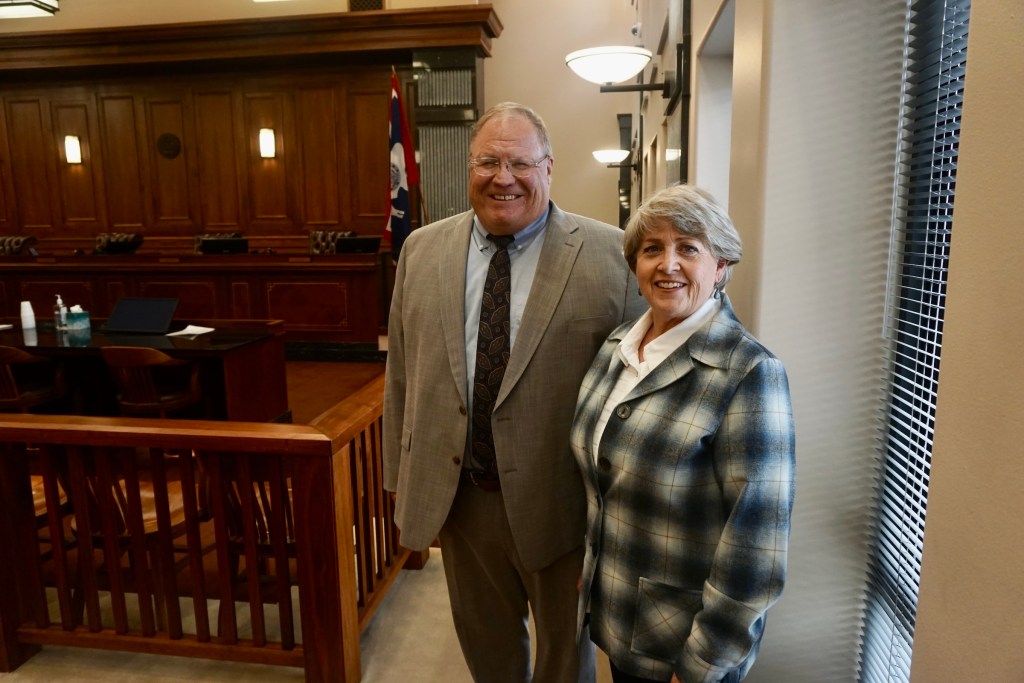
She made the remarks in an hour-long interview, in which she was joined by Justice John Fenn. The rare sit-down between the two justices and a reporter covered topics ranging from the timeline of a highly anticipated ruling on abortion rights to the judicial nominating process to the scrutiny state judges have found themselves under from the Wyoming Freedom Caucus.
That pushback at the state level joined a national rise in criticism against judges that reached such a crescendo earlier this year that more than 100 Wyoming lawyers and retired judges publicly called on the state’s congressional delegation to condemn the attacks.
Over the weekend, President Donald Trump continued his administration’s conflict with the federal judiciary, criticizing a judge he appointed who blocked his sending of Oregon National Guard troops into Portland. Trump has repeatedly sought to send armed troops into American cities, labeling protests as acts of rebellion against the government. In this case, a federal judge ruled the administration failed to provide sufficient evidence of that claim.
In a response that will likely be seen as defying the judiciary, Trump within a day ordered the California National Guard into the neighboring state instead.
Closer to home, Wyoming’s high court is increasingly being asked to rule on controversial laws the Wyoming Legislature has implemented in the realms of school finance and school vouchers and abortion access. Lawmakers have at times passed those bills over outspoken warnings from opponents that lawmakers were crossing the constitution.
Amid those pressures, the justices projected a picture of consummate legal professionals, taking on business as usual.
“Do we have cases in the pipeline now that have a great public interest? I think we do have that,” Fenn said. “But you know, those ebb and flow over time.”
Pushback from the right
The Freedom Caucus put a spotlight on the state’s courts — specifically Wyoming’s process of selecting judges through a nonpartisan panel and gubernatorial appointment — after lower judges ruled against abortion restrictions and the Legislature’s school finance decisions.
“For far too long, the judicial branch has been seen as untouchable, outside the realm of criticism,” an April 30 post to the group’s substack read. The posts are not signed by a particular author.
“As our founders knew well, all human institutions are capable of corruption,” the post continued. “It’s time for judicial reform in Wyoming in a way that gives the people a stake in our bench.”
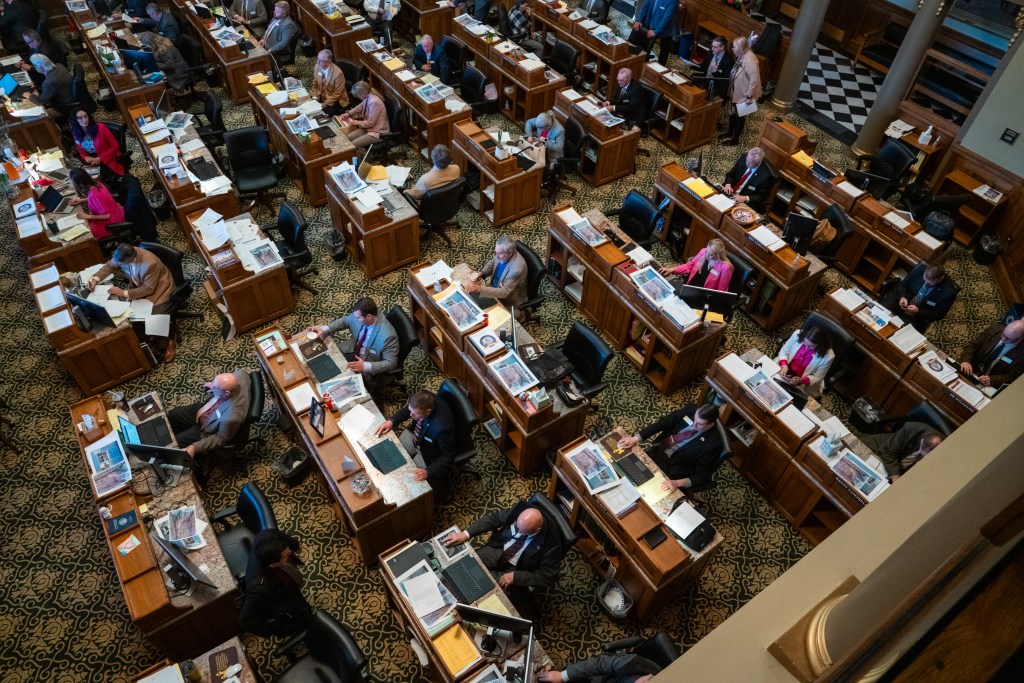
In August, senators on the Joint Judiciary Committee narrowly rejected a proposal to change the state constitution to require lawmaker approval of state supreme court justices. That measure is likely to return and other judicial reform bills may surface, given their popularity in the Freedom Caucus-controlled House.
Any measure to change the Wyoming Constitution would require approval from voters in a statewide election.
The two justices said Wednesday’s interview, which was offered to WyoFile by judicial branch officials, did not come in response to legislative scrutiny. It was, instead, part of a broader effort by the court to educate the public on the state judiciary’s role and processes.
A two-year strategic plan developed by the Wyoming Judicial Council — the courts’ governing body — calls for an increase in public education by the justices. The court has added a new communications director, Jacob Just, to its staff and justices hope to soon begin publishing a public-friendly explainer to accompany the often dense legalese of new court opinions.
“We are very consciously and intentionally not speaking to the media or anybody in the public in response to legislative initiatives,” Boomgaarden said. Boomgaarden, age 65, was appointed to the court by former Gov. Matt Mead, a Republican, and took her oath of office in February 2018.
On the other hand, “some of the legislative effort … maybe it verifies the need for awareness,” Fenn added. The veteran jurist served as a district judge in Sheridan for 14 years before Gov. Mark Gordon appointed him to the Supreme Court in December 2021. Fenn is 63. Wyoming Supreme Court justices are required to retire at age 70.
Voters get the opportunity to remove any judge in the state from office within two years of their appointment. Two supreme court justices, former attorney general Bridget Hill and Robert Jarosh, will be up for retention elections in 2026, according to Just.
The justices pointed to those retention elections as an example of an existing but little-talked-about way to hold judges accountable if they’re believed to be out of line. “The public isn’t cut out of this system,” Boomgaarden said. There is also a council on judicial ethics that fields and investigates complaints about judges. The justices pointed, as well, to the fact that Wyomingites can lobby the governor after the names of three finalists for a supreme court seat are published.
“Our world is changing,” Boomgaarden said. “There is so much misinformation, disinformation, lack of knowledge out there, and that’s why we’re talking in our strategic planning about the need for judges to be more proactive,” in public education.
Considering change to nominating process
In Wyoming, members of the state bar apply for open judgeships. Those applicants are vetted, and some are interviewed, by the judicial nominating commission — a group of three lawyers elected by state bar members and three non-lawyers appointed by the governor. That group of six, with the chief justice serving as a tie-breaking vote, sends three names to the governor for a final decision.
Lawmakers and other critics who say the selection process is dominated by legal industry insiders want to see the names of all applicants made public. Judicial officials, like Boomgaarden’s predecessor, retired Justice Kate Fox, have indicated they’re open to making such a change. They’ve cautioned, however, that making the names public from the beginning might diminish the pool of applicants, because some attorneys won’t want clients, law firm partners or (in the case of an elected district attorney, for example) voters to know that they’re considering a new job.
At Wednesday’s interview, Boomgaarden said members of the nominating commission are split on the issue — and that split isn’t simply between lawyers and non lawyers.
The commission just completed its second discussion on the question, Boomgaarden said, and has chosen to poll bar members on whether publication of their names would impact their decision to apply for judgeships. Boomgaarden did not offer a concrete timeline for when the commission might reach a decision, but said “it was possible” they could do so before the 2026 legislative session begins in February.
And what if, as critics of the Freedom Caucus’ judicial reform initiatives contend, it’s not a lack of knowledge, but dissatisfaction with judges’ rulings, that’s driving the scrutiny?
In that case, Boomgaarden said, there’s a “disconnect” about the role of the independent judiciary and the constitutional separation of powers.
Or even, “a lack of respect, maybe, that we take an oath of office to uphold the rule of law, to apply the law fairly and impartially to any case that comes before us. And if somebody is expecting us or asking us to do anything other than that, we won’t.”
The Legislature always has the opportunity to react to a state supreme court decision by crafting new policy, Boomgaarden and Fenn noted. Attorneys who staff the Legislative Service Office, in fact, each year review the high courts’ opinions and flag for lawmakers decisions they think could merit a statutory review or fix.
That becomes more challenging for politicians when it comes to a constitutional decision — like the question justices are being asked to resolve around abortion access in Wyoming. If the justices uphold the lower court’s finding that the Legislature’s abortion ban violates a provision in the Wyoming State Constitution regarding individuals’ rights to make their own health care decisions, then abortion opponents will have to make their case to voters for a constitutional amendment.
But how lawmakers react to their decisions is neither the justices’ problem nor their concern, Boomgaarden said.
“Our job is to look at the issues that were brought to us, look at the evidence that was presented, and make sure that the law was applied in the correct way,” she said. “When you start talking about what might be important long term or not, or have broader implications, that gets into that policy realm that belongs to the legislative branch.”
