


Hundreds of people marched down a Laramie thoroughfare on multiple nights this week to protest police brutality, joining nationwide protests sparked by the police killing of Minneapolis resident George Floyd and other black citizens around the nation.
Rivers of sign-carrying and fist-raising protesters streamed down both sides of Laramie’s Grand Avenue under summer skies that darkened with rain clouds but never let loose. Marchers stuck to the sidewalks as they passed the University of Wyoming campus before returning to a downtown plaza where they’d started.

Throughout the march and at its end, protesters echoed chants heard in cities and towns all over American in recent weeks. They chanted Floyd’s name and Breonna Taylor’s. Police in Louisville, Kentucky, shot and killed Taylor, an African-American medical worker, in her home while executing a search warrant in March.
Protesters also chanted “justice for Robbie,” a homegrown chant referring to the death of Laramie resident Robbie Ramirez. Derek Colling, an Albany County Sheriff’s Department officer with a history of violence, killed Ramirez during a confrontation following a traffic stop in November 2018.
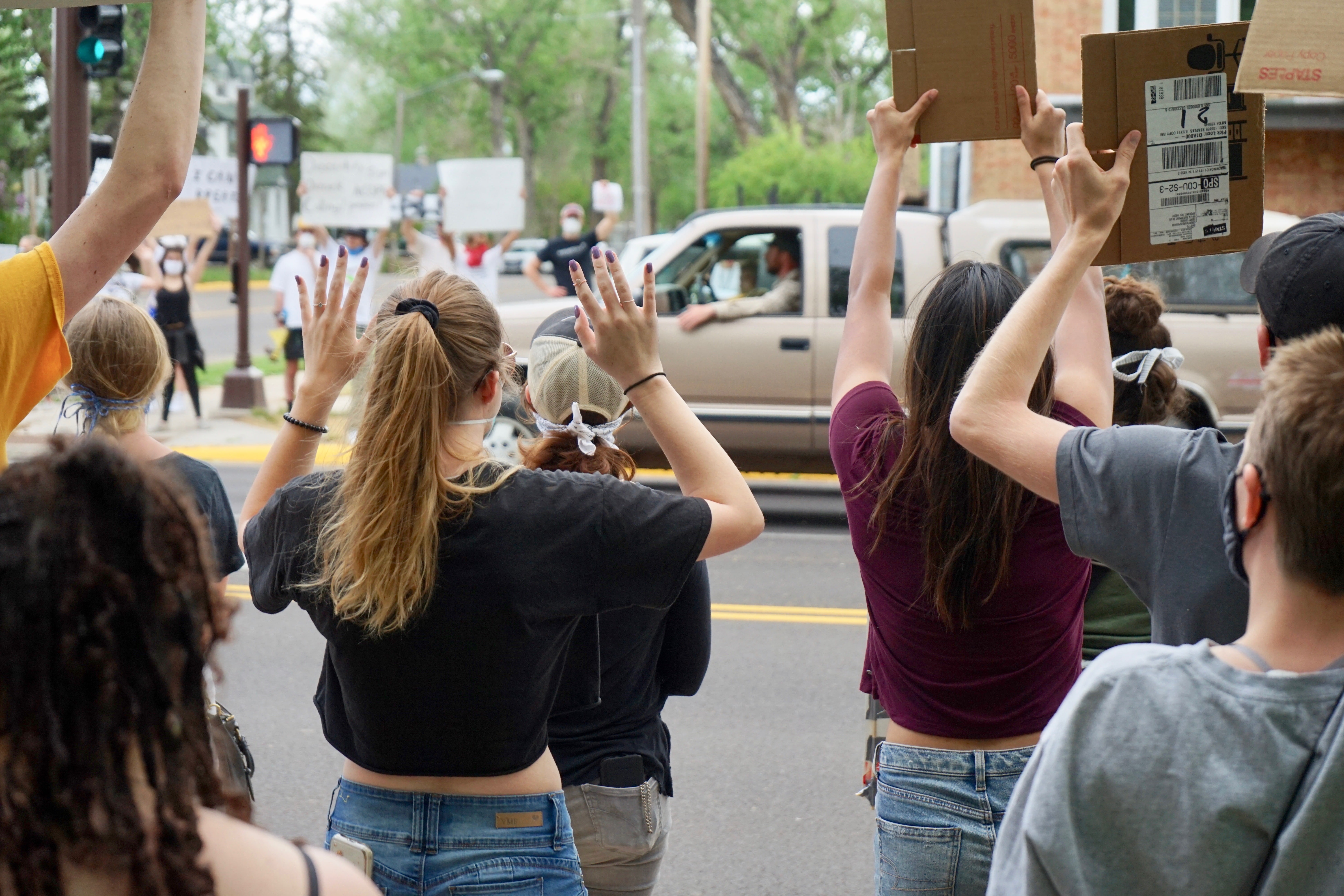
Adrian Hargrow, a black resident of the small town of Rock River who said he marched for police accountability, was struck by the crowd size on June 3.
“I didn’t think there’d be this much support,” Hargrow said, “this being Wyoming.”
The crowd swelled further the next night.
Laramie’s marches have been peaceful. Organizers are urging participants to stick to the sidewalk and off the streets, and to avoid interactions that could incite violence in a group of counter protesters in pickup trucks. A handful of trucks, many flying American flags, sped by protestors on Grand Avenue on both June 3 and 4, and were seen blasting black exhaust smoke into the air, which enveloped marchers.
On June 4, a brief confrontation ensued between protesters, the truck drivers and an associated motorcycle driver at an intersection. Protesters chanted at the drivers and the cyclist, who revved their engines over and over before turning off the march route.

Opinions differed among protesters about whether a more disruptive protest would be more effective, one organizer told WyoFile — protesters in Casper, for example, blocked an intersection. But, ultimately, safety concerns for marchers and those they are marching for win out, Rihanna Kelver said. The organizers don’t want to antagonize the truck drivers, she said.
“We can’t assume their intentions aren’t going to be to initiate violence and especially violence against people of color [in the march],” Kelver said.

Liberal progressives should ask themselves why they only seem to care about Blue on Black violence and ignore the more insidious and deadly Black on Black violence. Ask why they only march when white people commit physically aggressive offenses against people of color.
From the NY Times:
“…whites increasingly have progressive views about race in general, they often still favor public policies that disadvantage African-Americans. For example, they may oppose multi-occupancy housing in their affluent suburbs, reducing affordable housing and perpetuating segregation. Or they may support a broken local funding system for education that results in apartheid schools.”
From “What if There Were No George Floyd Video?” by Nicholas Kristof in the New York Times.
You can get free access to the Times via the Teton County Library’s website: http://wy-tetoncountylibrary.civicplus.com/1341/New-York-Times-Online
Jackson had a similar protest. Showing support for our friends and neighbors in a time of crisis is always good. Not seeing our own hand in racism is not.
The structural racism in Jackson Hole is championed by all white progressives. It is in plain sight when the needs of immigrants are less important than the needs of wildlife. It’s in plain sight when we treat view sheds with more respect than working people of color and call ourselves progressives. It’s in plain sight when we leave their undereducated children grade-levels behind their peers. It’s in plain sight when we promote subsidized housing for the middle class and leave 30% of the population out of the equation. It’s in plain sight when the wealthy fight affordable housing projects. It’s in plain sight when 30% of the population is Latino and not a single one is in a position of power. Its in plain sight when we pay the parents of minority children less than the prevailing wage of their peers. It’s in plain sight when employers are going overseas to find cheap labor instead of hiring and housing unemployed minorities from American cities. It’s in plain sight when we place obstacles to success in the path of the poor, mostly minorities, and open doors for the wealthy, mostly white, via the tax code, land-use regulations, zoning, laws and policies. Structural racism is championed by the Jackson Hole Chamber of Commerce. It is championed by the media which kowtows to its advertisers and people of wealth with whom it wants to curry favor and friendships. It is championed by Conservation Groups. Jackson Hole profits off of economic inequality and suppresses voices from below which questions the status quo. Liberal progressives in Wyoming couldn’t see their own hand in racism if their own hand was pointing to it. Conservatives in Wyoming don’t have an agenda that’s any better but at least they don’t present themselves as ministers of justice for an oppressed minority. Protesters, per se, aren’t the problem, however. It’s people who waited for a video of a man crying “Mama” just before his last breath. It’s people who ignored and continue to ignore the structural racism that benefits them.
“Injustice anywhere is a threat to justice everywhere. We are not satisfied, and we will not be satisfied
until justice rolls down like waters and righteousness like a mighty stream.” MLK
Somebody just hit that nail squarely on the hit a bunch of times.
Thank you, Mr. Graham and WyoFile, for keeping up with this.
Positive as it is to join in solidarity with Black Lives Matter here in Wyoming, I hope we can use the momentum and publicity of this moment to make real change. We still need to prioritize civil rights legislation, including policing and reasonable gun control measures; we should reconsider pushing for a hate crimes bill in Wyoming, finally passing a nondiscrimination law, etc. If not now, when?