

The time has come to again consider opening Wyoming’s doors to a spent nuclear fuel waste repository, some lawmakers proclaim.
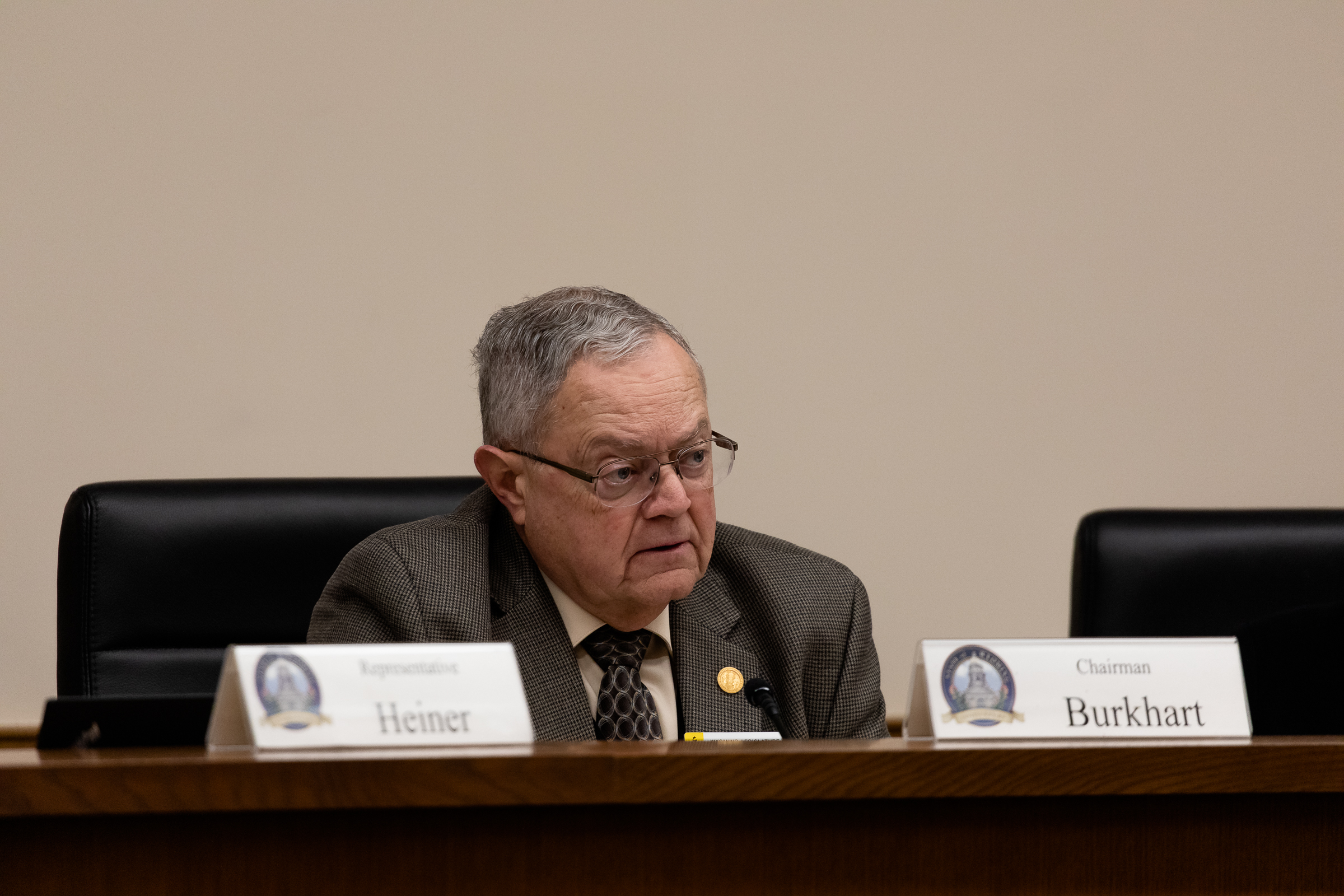
Minerals, Business and Economic Development Committee Co-chairman Rep. Donald Burkhart Jr. (R-Rawlins), a longtime proponent of the idea, said he will bring a draft bill to the committee in October.
The outlook for Wyoming’s fossil fuel-dependent budget is trending downward while the state could reap more than $4 billion a year from nuclear waste storage, “Just to let us keep it here in Wyoming,” he told committee members during the final minutes of a two-day hearing in Casper on Wednesday.
Burkhart said he was asked by the Legislature’s Regulatory Reduction Task Force — which is co-chaired by Sen. Mike Gierau (D-Jackson) and Rep. Bob Nicholas (R-Cheyenne) — to take up the effort. Minerals committee member Sen. Stacy Jones (R-Rock Springs), who also serves on the task force, said, “It was just brought to us as a possible money maker for Wyoming.”
Burkhart shared a rough draft among committee members for potential legislation paving the way to nuclear waste storage, but he has declined to share the document publicly, according to the Legislative Service Office. He did not respond to WyoFile inquiries regarding the working draft document and more details about the proposal.
Jill Morrison, who has lobbied against similar proposals since the 1990s as an advocate for the Sheridan-based Powder River Basin Resource Council and has since retired, said it’s a bad idea that keeps coming back every few years.
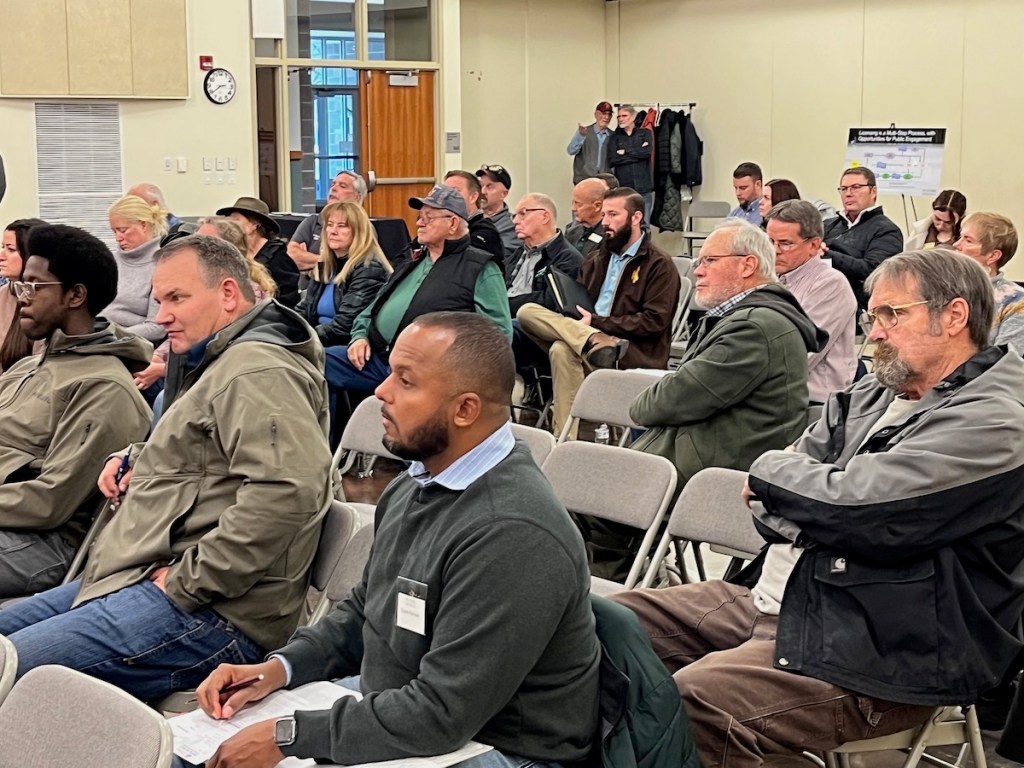
“They want to try to sneak it in and ram it through,” Morrison told WyoFile. “It threatens public safety and it’s really going to wreck Wyoming’s national reputation and image as a destination for tourism and recreation — a beautiful place to visit or live.
“And guess what,” Morrison added. “People don’t want it.”
‘Rough draft’ proposal
Burkhart gave an overview for the concept to committee members on Wednesday.
The facility would accommodate spent nuclear fuel in “dry” form as opposed to “wet,” he said. When nuclear fuel rods are initially removed from a reactor, they must be cooled in water, according to the Department of Energy. Afterwards, the material can be stored in “dry” containers, an arrangement which is considered more stable.
Burkhart said he recently visited with a private landowner in Fremont County who, as in the past, is interested in selling land for the facility. The land purchase would cost an estimated $2 million and it would cost about $400 million to build the facility, “None of which would come from the state,” he said. “It would all come from private enterprise.”
The facility would be operated by a private entity in cooperation with the federal government, which would maintain regulatory control over it, Burkhart added.
Although such a facility would be designated “temporary,” Burkhart said it will most likely become a de facto permanent storage facility because there’s little faith that the federal government will build a permanent one to which “temporary” stockpiles could ultimately be relocated. Many local officials around the country have offered locations for a permanent repository, but communities have ultimately rejected the idea.
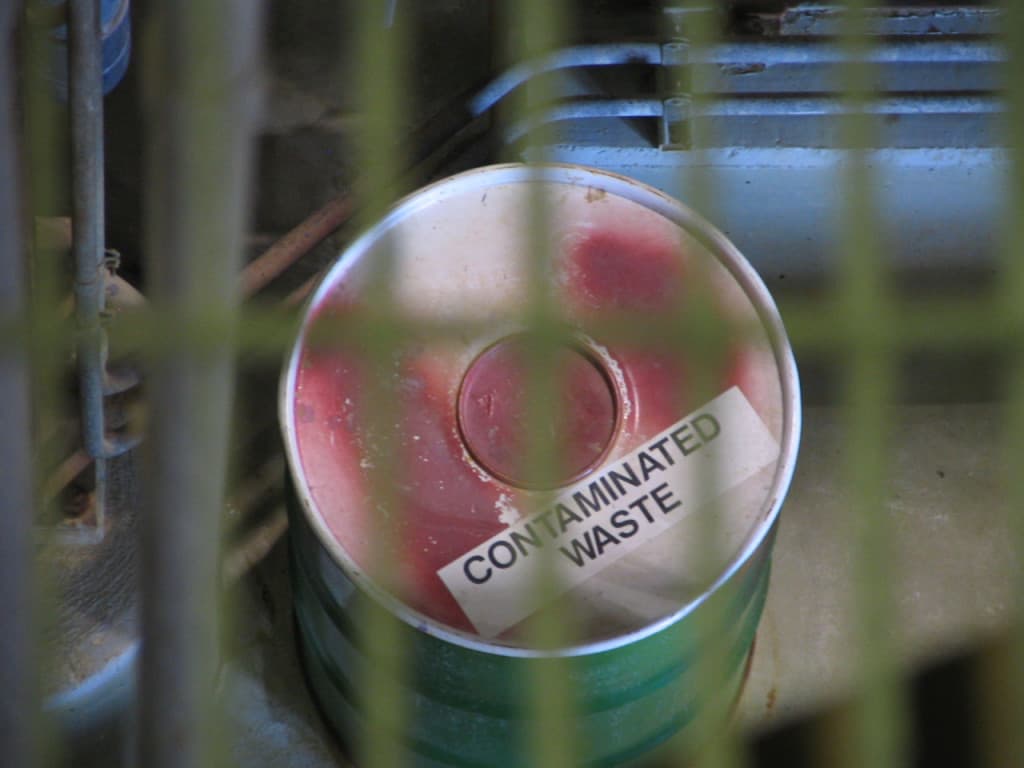
Current state statute prohibits a commercial high-level radioactive waste facility unless the federal government establishes a permanent repository.
Burkhart thinks that will likely be challenging in Wyoming too. “Frankly, my opinion would be the government will never have permanent storage,” he said.
By hosting even a “temporary” nuclear fuel waste storage facility, Wyoming could also push for a reprocessing plant to generate even more revenue, Burkhart said. “Currently, the United States does not reprocess nuclear fuel,” he said. “I feel that within the next five years, that will change, and when it changes, wherever the fuel is stored is where they will do the reprocessing.”
Recurring effort
The idea for a temporary, or intermediate, high-level radioactive waste storage facility has been proposed several times in recent decades, most notably in the 1990s.
In 1992, after several years of contentious debate, then Gov. Mike Sullivan vetoed a similar measure, stating in a letter to Fremont County commissioners, “It makes no sense to me as Governor to put this state or its citizens through the agonizing and divisive study and decision making process of further evaluating the risks and benefits of an MRS [monitored retrievable storage] facility.”
In 2011, Sullivan told a group of geologists, “There was huge fear. This struck a chord like I never seen in my office over anything. I had three boxes of letters, pro and con. They were not check-the-box letters. These were coming from people hand-written because of their love for Wyoming and because of their fear of nuclear.”
“It threatens public safety and it’s really going to wreck Wyoming’s national reputation and image as a destination for tourism and recreation — a beautiful place to visit or live.”
Jill Morrison, retired landowner advocate
In 2019, the Legislature formed the Spent Fuel Rods Subcommittee to reexamine the issue, but did not advance legislation.
Proponents see an opportunity, however. The nuclear energy industry is enjoying a resurgence in support and investment, including in Wyoming where the U.S. Department of Energy and Microsoft billionaire Bill Gates are backing the $4 billion Natrium nuclear power plant, and where BWXT Advanced Technologies is considering setting up a microreactor manufacturing hub.
If the U.S. boosts its nuclear energy capacity, according to proponents, the nation will have to grapple with its decades long failure to finally establish a permanent repository for radioactive waste and potentially consider reprocessing the byproduct.
Federal efforts
Federal efforts to establish a permanent repository for high-level radioactive waste are currently led by the Department of Energy through its consent-based siting program — a process for communities to establish broad local support for hosting such a facility.
In 2021, the U.S. Nuclear Regulatory Commission issued a license for a storage facility in Andrews, Texas. Last year, the agency also issued a license for a storage facility in Lea County, New Mexico. Both efforts have been tied up in legal challenges and “no work has gone forward on the facilities,” NRC spokesman David McIntyre told WyoFile via email. “There is no permanent repository and really no movement towards one.”

I applaud Burkhart for bringing this issue to the table. It’s not so much a revenue issue for me, rather it’s a question of addressing a national challenge: where to store nuclear waste. Why shouldn’t Wyoming play a role in finding a solution? Storing nuclear waste somewhere in the middle of the Great Divide Basin makes more sense to me, than having it scattered at numerous sites near major metropolitan areas around our country. Done right, it can even become a tourist attraction. I’ll visit!
The nuclear fuel rods are currently unsafely stored in thin-wall (1/2″ to 5/8″) stainless steel canisters that are vulnerable to stress corrosion cracking from numerous causes. These canisters cannot be inspected for cracks. Canisters are welded shut so the condition of the fuel rods is unknown. Canisters do not stop gamma or neutron radiation. Canisters are stored in thick-wall concrete overpacks, but these overpacks have air vents for cooling. Radiation continuously streams out of these air vents. There is also no method to detect problems or prevent problems. Each canister holds roughly the amount of radiation released from the 1986 Chernobyl nuclear disaster. There are over 4000 of these canisters in the U.S. The Nuclear Regulatory Commission gives numerous safety exemptions to please the nuclear industry. Other countries use bolted lid thick-wall metal casks (10″ to over 19″ thick) that don’t have these problems, but the NRC refuses to require their iwn safety standards, including ASME N3 safety codes for storing and transporting highly radioactive spent nuclear fuel waste. More info and references at SanOnofreSafety.org
All said and done. Coal is still the cheapest/safest energy source. We can safely reuse the fly ash generated off coal. Simply add it to concrete for durability and strength. O by the way SUN POWER a solar power generator just declared bankruptcy. It simply not economical.
Splendid idea Mr. Burkhart Jr. Why not double down and add an amendment to your bill that would locate this facility on the Kelly Parcel. That way the state can kill a whole flock of birds with one stone.
If ever a real world circumstance fit the premise of the Faustian Bargain , it is this one. The classic German legend fits Wyoming hand in glove. We cut a deal with the Devil in exchange for wealth and/or power.
America and the world definitely have a nuclear waste problem. There are about 450 nuclear reactors across the globe, and the USA has 1/5th of them … 90 fission factories all making radioactive toxic waste . What to do? – the stuff is piling up and Plutonium has a half-life of 27,000 years. It has to go somewhere.
Where if not Wyoming ? Thinly populated semi-arid largely rural not really developed Wyoming. We also have an ace or three up the sleeve. For one we have the Red Desert , completely encircled by the Continental Divide, isolated from the hydrography and contiguous geology of the West . A massive repository-graveyard for nuclear waste will inevitably be situated in the Red Desert of Wyoming or some other desert in nevada. That’s about it for pragmatic locations, like it or not, till you get to Central Asia or interior Australia.
Wyoming has never been one to put morality and its conscience above the potential to make a fortune from the mineral industry. Wyoming prostitutes itself for oil, coal, gas , trona, uranium , bentonite , presious metals, gypsum , iron ore, and soon Rare Earths. Wyoming is always willing to sell itself to industry , if on First World terms and not Third World terms . We aren’t the Congo using child labor to extract cobalt. We’re classy pimps and soiled doves. It’s always been like that around here. Don’t deny it. Wyoming allows greed to win over sensibilities and conscience. The Robber Barons made Wyoming what it is today. The board was set a long time ago. Let’s play a round.
The new nuclear waste Faustian Bargain needs to be done differently this time around. The ordinary citizens and general populace of Wyoming need to be the prime benefactors first and foremost , not the stockholders , investor class, money moguls or lords and ladies. We know there are billions of dollars in new money to be transacted for Wyoming taking on the onus of nuke disposal for all mankind. The purveyors of nuclear materials must be wholly subserviant to one inviolate condition . The money goes to Wyoming people , not Wall Street, the Hamptons, the Cayman Islands, Cyprus, or anywhere else . Totally transparently . No blockchaining or money laundering or hiding of assets on paper in post office boxes in Sheridan. The residents of Wyoming – every man woman and child, their pets and livestock , their unborn heirs – get the money the way Alsaka gives paychecks to its people for North Slope oil. The sovereign wealth to be realized from nuclear mortuary service goes straight into the pockets of us. Regardless of whose land or property the waste ends up sitting on, or which federal state or global agency has physical regulatory oversight. No exceptions ; no ifs ands or buts. If you are going to ask Wyoming to allow this Devil Deal , the compensation must be directly proportional to the gross proceeds without deduction beyond the cost of delivery and warehousing. We also expect the jobs associated with this Reverse Manhattan Project to be exceptionally well paying from lowest to highest position, white or blue collar. QED. All of this would occur on a Red Desert setaside of about 25,000 acres ( 40 square miles ) estimated , to whatever depth necessary.
Do the math: $ 10 billion in nuclear waste stored in Wyoming would yield $ 16 million gross for each and every citizen . I would expect my share after expenses, taxes, maintenance and operating costs , medical centers to be not less than $ 10 million , rounded down and paid semiannually , graciously so.
Let’s see if the argument thus restructured changes the perspective . Thank you Johann Georg Faust of the 15th century for the blueprints to enable Wyoming and it people to become the 21st century sovereign wealth empire it has always yearned to be if only those greedy Robber Barons and multinational corporations would just get out of the way this time around. You’ve never been our friends.
If not Wyoming , where?
Correction: a slip of the decimal point in my napkin math. A $ 10 billion haul for servicing nuke waste would yield only $ 16,000 per Wyoming resident , not sixteen million . My bad.
p.s. Disclaimer – don’t think for a minute that because I write something I also believe it. I quite often put out statements just to enlarge the discourse. So while I fully support nuclear power and always have, it has to be fusion not fission.
Why not? It’s totally safe. And once established it will never be dismantled or relocated. It will only continue to grow. A continuous cash cow. Speaking of cows – how do you like your steak irradiated?
I would rather have a disposal site that’s well regulated, then more of those ugly raptor killing spinning whirly gigs that only employ folks in a control room in another state. If anything has destroyed the viewscapes of our big empty it those ugly wind turbines.
Deja vu all over again
By current design, the current proposed natrium reactor core will be buried under ground. The estimated life span of the reactor is about 7 years. No one has proposed digging up the reactor core for disposal somewhere else. Wyoming will then be an after the fact radioactive waste storage facility. We then build another reactor to replace the first one and so on. Really??
No Wyoming doesn’t need this money. This waste really needs to be stored in State it generated in. If Bill gates/warren buffet involved with a nuke power plant. Than they can store it on their estates. Wyoming will soon cross that bridge with power plant a Kremmling
“Wyoming is open for business.” Remember that? We can not sell our wonderful state with its wild and varied landscapes, habitats and wildlife. Excepting all the visitors who want to see how lucky we are to live here. What are they thinking? Money and some jobs today for a possibly rotten future? Please, think a little harder and look yourself in the mirror.
Just No No No