


Scientists are pointing to “complex ecosystem function problems” — rather than point-source trouble like specific human developments — as the big threat to the troubled West-wide sagebrush landscape and its wildlife.
Wildfire, pinyon-juniper expansion into the sagebrush biome and invasive cheatgrass are among the sweeping threats across the West, a group of federal, state and independent researchers said. They proposed prioritizing conservation efforts on the most-undisturbed and vital areas before restoring more-degraded habitat.
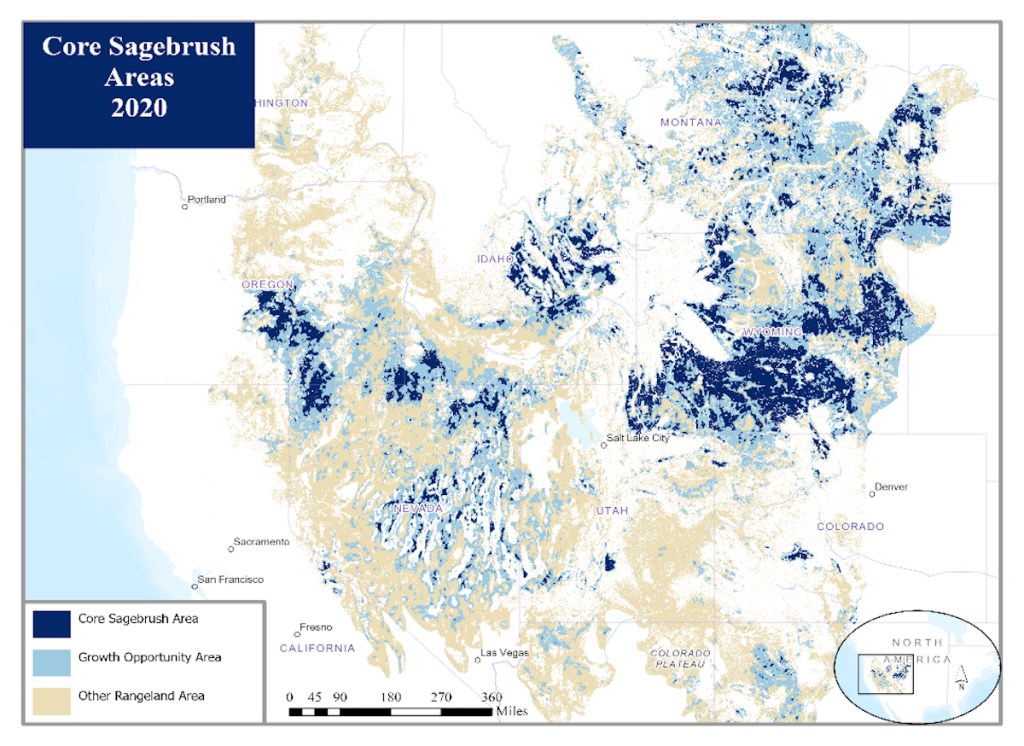
The 50-page Sagebrush Conservation Design published Thursday by the U.S. Geological Survey provides a roadmap to conserve and restore some of the 165 million acres of sagebrush ecosystem across 13 Western states.
The report by a team of 22 scientists from 12 agencies and organizations urges “cooperative conversations that enable stakeholders to work together,” its publishers said.
Saving a substantial part of the sagebrush sea — also under threat from “human modification” — is paramount to avoiding federal protection of greater sage grouse. The species has suffered an estimated 81% population loss in the last 53 years.
But the semi-arid ecosystem that’s the grouse’s only home is disappearing at a rate of 1.3 million acres a year, the report says.
The analysis suggests that climate change is unlikely to be the dominant threat to sagebrush in the next few decades. But the interactions of climate with wildfire and invasive annual grasses may be important, especially in the longer term, the report says.
Unchecked losses that trigger Endangered Species Act protection of greater sage grouse could cost Wyoming between 2% and 6% of its total annual economic output, according to a 2016 paper. That’s because Wyoming is home to an estimated 38% of the species.
“Knowing all of the science in the world is not going to save the sage grouse unless we act on it.”
Greta Anderson, Western Watersheds Project
Top-down restrictive decrees, however, are not the answer, the new report suggests. “Regulatory intervention may not be effective at controlling complex problems that involve disruption of ecosystem processes,” authors wrote.
Several conservationists hailed the “Sagebrush Conservation Design,” calling it an invaluable tool that directs efforts immediately toward top-tier sagebrush habitat. It’s not yet certain how the proposed paradigm might fit with Wyoming’s Core Area Strategy, Wyoming’s Sage Grouse Implementation Team leader Bob Budd said Thursday.
That state plan seeks to limit disturbance in the most valuable sagebrush habitat that’s not leased for energy development by directing development elsewhere.
The new Sagebrush Conservation Design is but one tool, said Greta Anderson, deputy director of Western Watersheds Project, a nonprofit that’s critical of public land grazing. She called the report and attendant data “a gee-whiz map” that lacks a critical overlay — the socio-political challenges to preservation.
“Knowing all of the science in the world is not going to save the sage grouse unless we act on it,” she said.
Launching pad
The report is a launching pad for incorporating local input and knowledge into site-specific management, authors said. The “complex ecosystem function problems” drive 73% of the demonstrated threats within the best half of the sagebrush range, according to the study, which has been years in the making.
The report utilized remotely sensed data to categorize sagebrush and perennial grasses, keys to ecosystem health. Its authors said the plan’s scope is unmatched by previous sagebrush conservation efforts.
Intact core sagebrush areas of “immediate high value” to wildlife provide “anchor points and are most likely to maintain their condition as high-quality habitat,” a summary of the Sagebrush Conservation Design states. From that base, a “defend-and-grow-the-core” approach would reverse attrition of the sagebrush community and benefit more than 350 species in it.
The plan categorizes more degraded habitat as second-priority “growth opportunity areas” where expensive restoration investments may be necessary.
The proposed conservation approach helps managers and landowners focus finite resources, Anne Kinsinger, associate director for ecosystems at the U.S. Geological Survey, said in a statement.
Conservation efforts are not for wildlife alone, Tony Wasley, director of the Nevada Department of Wildlife, said in a statement. They are designed to “help people maintain quality of life and livelihoods,” he said.
That’s especially important in Wyoming, where federal ESA protection of sage grouse and attendant restrictions of industrial, agricultural and recreational activities in its habitat could have severe economic and cultural effects. Sagebrush habitat covers an estimated 68% of the state, a 2016 UW study by Temple Stoellinger and David “Tex” Taylor said. Much of that is on U.S. Bureau of Land Management property.
Stoellinger and Taylor’s contested view holds that ESA listing could cost the state up to $5.4 billion in economic impacts a year, evaporate up to 24,307 jobs annually and decrease yearly state and local government revenue by up to $287 million.
The extent of the sagebrush sea before European settlement of the West “is uncertain,” according to a 364-page USGS report that set the foundation for Thursday’s Sagebrush Conservation Design. Nevertheless, experts calculate it has since been reduced by slightly more than half.
Grazing effects
The new report identified 33 million acres of high-quality sagebrush habitat where preservation should first be concentrated. Eighty-four million acres are growth opportunity zones where rehabilitation might be costly. Another 127 million acres are “other rangeland areas,” according to the report.
Western Watershed’s Anderson found fault in the authors’ failure to link livestock grazing to the sweeping degradation of ecosystem functions from pinyon-juniper and cheatgrass invasion.
“Livestock grazing leads to all kinds of ecosystem conversion — reduction of native perennial bunch grasses [and subsequent] fire,” she said after a preliminary review of the report. “Pinyon-juniper expansion is, in part, due to conditions enabled by a century of livestock grazing.”
“I think this is useful information,” she said. “I hope it gets translated into meaningful policy.”
The paper seems to be consistent with Wyoming’s Core Area Strategy for protecting sagebrush and sage grouse, said Jim Magagna, executive vice president of the Wyoming Stock Growers Association. Ranchers in Wyoming generally support that plan and fight conifer expansion, cheatgrass and wildfire, he said.
“It’s what most of our ranchers are already doing,” he said.
Some historic overgrazing likely contributed to the state of today’s affairs, he said. “The grazing our producers practice today can reverse that,” Magagna said.
The USGS published the report with the cooperation of the U.S. Fish and Wildlife Service and the Western Association of Fish and Wildlife Agencies.

If Magagna says so, it ain’t so. Livestock on the range is a threat to all/any native flora-fauna. Livestock producers in Wyoming are stealing the rest of us blind. Either make them pay for restoration, just like a power plant pays for reclamation, or do not allow livestock of any kind to be baby sat by some dude (dudette?) on a horse who would like to believe it is Wyoming in the1800’s. Wake up Wyoming. It is a new day and age that looms; business as usual can not continue. Herbicide destruction of sagebrush in the Bighorns is just an example. Stop it!!!
“If Magagna says so, it ain’t so”….boy, ain’t that the truth! Not only has the welfare rancher been allowed to run wild and unchecked over public lands, they get to do it for pennies to the acre.
And yet, the plan to kill hundreds of acres of sagebrush & native plants with herbicide goes forward for the southern Bighorn National Forest! (See Mr. Thuermer’s article “Bighorn Forest Plan for Sagebrush”).