

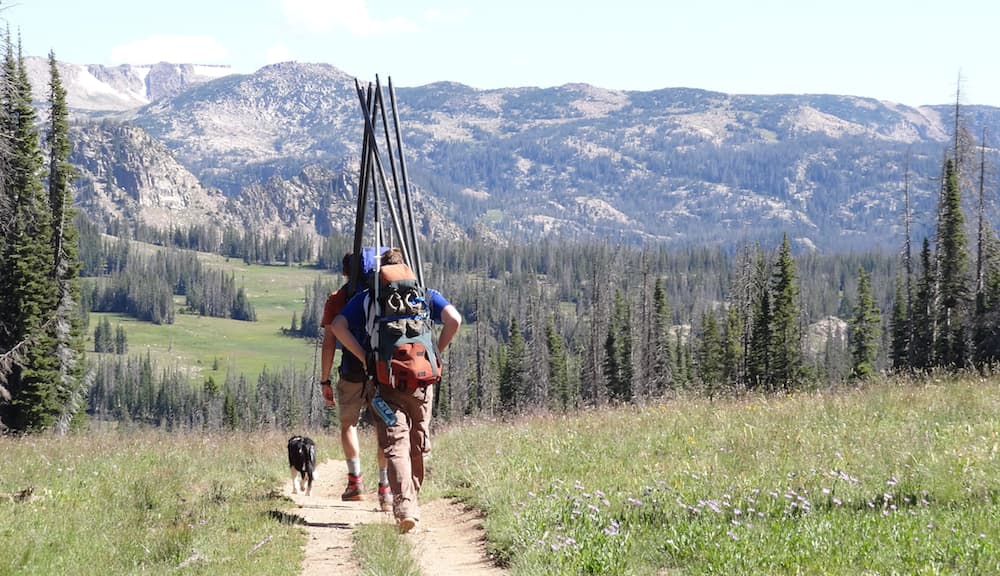
Bad news if you love to hunt, camp or fish in the Rocky Mountains above 7,000 feet: Wildfire will likely burn at least 83 percent of that mountain range during your lifetime.
That is according to a new study led by University of Wyoming doctorate student John Calder. The study, Medieval warming initiated exceptionally large wildfire outbreaks in the Rocky Mountains, shows that even small changes in temperature (an increase of less than 1 degree Fahrenheit) can have major impacts on how often wildfires burn in the Rocky Mountain West.

Calder wrote the paper with fellow University of Wyoming researchers Dusty Parker, Cody Stopka and Bryan Shuman along with Gonzalo Jimenez-Moreno of the University of Granada in Spain.The journal Proceedings of the National Academy of Sciences published the paper Oct. 5.
When major fires burn within a mile of a lake, charcoal is buried in sediment that settles on the lake bottom and remains there, while on land it can blow away. In his study, Calder extracted 2,000-year-old mud samples from the bottom of 12 high-elevation lakes in Colorado and measured spikes in the amount of embedded charcoal. He then cross-referenced the time periods where he found spikes in charcoal with historical temperature data from the National Oceanic and Atmospheric Administration.
The goal was to see whether when there were increases in temperature if there were also spikes in the amount of charcoal in the sediment. If both increased and decreased in unison, that would suggest a correlation between temperature rise and the charcoal deposited — and the fires that made the charcoal. He discovered large wildfires burned more frequently during a 300-year-period known as the Medieval Warm Period.
During that period, from roughly the mid-900s to the mid-1200s, the average temperature increased by almost 1 degree Fahrenheit. That single degree change had implications for the forest landscapes Calder studied. During other periods, wildfire burned an average of 25 to 40 percent of a mountain range in 100 years. When the average temperature increased 1 degree, more than 80 percent burned, he said.
That means the massive fires ravaging the West will likely continue and worsen as the earth warms, Calder said.

The rise in temperatures in the last few decades is similar to the increase during Medieval Warm Period. Since the 1980s, the United States has seen some of the largest wildfires in history, starting with the 1988 fires in Yellowstone National Park. These types of fires used to be incredibly rare, but are becoming the norm, Calder said.
If the warming continues, based on natural history, the West’s massive fires could be just the beginning. The average increase in temperature in the Rocky Mountain region since 2000 has been 1.25 degrees higher than during the 20th Century, he said.
“Climate change will be a big factor,” Calder said. “It will be more than a degree. We’ve already gone past that [1] degree and we’ll go even more. We are already in this warming period.”
If the warming trend continues, it is likely people will see most of their favorite forested spots burn at least once in their lifetimes. Land managers should prepare for the majority of mountain forests to burn.
While Calder studied lakes in Colorado — many of them just south of the Wyoming border — the data is applicable to many landscapes in the Rocky Mountain West, above about 7,000 feet.
Calder would like to next study lakes in other high-elevation mountain ranges to see what patterns emerge during the same time periods. This could help gain a better understanding of the regional response of wildfires and climate change.

kudos to Ms Dayton for writing a story that mentions the Medieval warm period, a natural warming period like the Roman warm period and the Minoan warm period. Droughts come and go, but plants, trees etc. produce more biomass during warming periods which would explain higher charcoal levels due to more biomass within the study area. The natural sine curve of climate seems to be alive and well. Hope everyone enjoyed the great fall weather and don’t let the evangelic or environgelic “doomers” get you down.
Paul Cook
Very interesting article but not surprising conclusions when added to lack of forest management – harvesting, grazing, land uses – those things could help the fire hazard issues.
Mary Flitner
Very interesting and not surprising research. Thanks for the great article.
Susan Marsh