

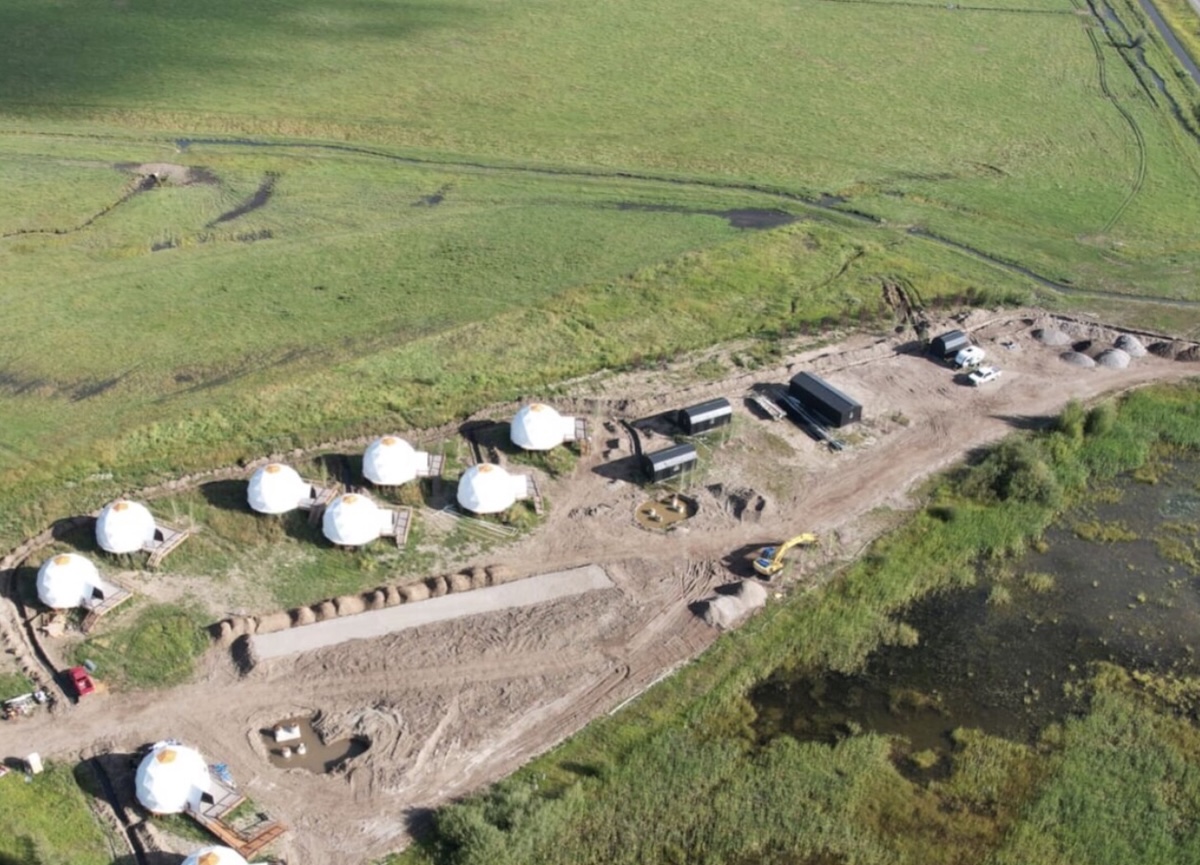
As Wyoming officials defend their approval of an upscale tent hotel on state land near Teton Village, the state’s own regulators allege the glamping resort is polluting groundwater.
Tammah — a hotel of 11 canvas-covered geodesic domes constructed by Utah-based Basecamp Hospitality — must stop using a “sand mound septic system,” the Wyoming Department of Environmental Quality states in a violation notice. The DEQ’s Oct. 29 order requires operators of the 4-acre complex, which has been open since spring, to haul waste off-site until problems are fixed or face fines of up to $10,000 a day.
The pollution charge comes as the state officials who approved the glamping permit defend in court their decision to block local electrical and fire inspections at Tammah. The Wyoming Board of Land Commissioners have faced criticism for permitting the septic system in a sensitive environment. Critics say the county, not the state, must approve such small-scale facilities and that the system was built too close to wetlands.
“It appears Basecamp is being cavalier about public health and environmental quality.”
Luther Propst
“Hate to say it, but ‘we told you so,’” said Dan Heilig, senior policy advisor for Protect our Water Jackson Hole, a group that opposed the development.
High ammonia levels in a monitoring well — first observed in May — alerted DEQ inspectors. The monitoring wells were “something we pushed DEQ hard for” as the hotel was being developed, Heilig said.
Tammah selected “the worst possible place in the world for a septic system,” Heilig said. “Without the monitoring well, we wouldn’t know.”
Effluent of the affluent
Tammah is located in the Fish Creek drainage, a Class 1 watershed that state environmental rules seek to protect. The area is already impaired with E. coli, an indicator of fecal pollution. Critics say the glamping development will further degrade the groundwater that many residents use domestically.
Tammah operator Basecamp, which states its goal is “to preserve the land around us” while offering “the ultimate fusion of wilderness and comfort,” said it will comply with the state order.
“Basecamp has promptly taken measures to address the concern raised by the DEQ,” the company said in a statement. “We are committed to environmental stewardship and protecting the natural resources of this beautiful community.”
Groundwater from the monitoring well met Class I standards in May, the DEQ reported. In September, however, monitoring revealed a concentration of 2.26 mg/L. That’s more than four times Wyoming’s standard of 0.5 mg/L., an amount recommended by the National Academy of Sciences. Ammonia is toxic to aquatic life.

State investigators visited Tammah 24 days after receiving the sample and found “water present at the center east side of the sand mound septic system … an indication that the … system is not operating correctly.” The effluent “should percolate downward and not outward,” the notice states.
A follow-up water test showed 3.86 mg/L of ammonia in the monitoring well, almost eight times the allowable limit.
The notice of violation allegations “paint a discouraging picture, a picture in which it appears Basecamp is being cavalier about public health and environmental quality,” Teton County Commission chair Luther Propst said. “I hope that their disregard of these basic requirements does not extend to their electrical and fire safety.”
Propst would rather have more than hope. “We have no evidence that they’re taking fire safety and electrical safety seriously,” he said, calling for more action.
“Rather than requiring Basecamp to haul waste in a truck to be treated, I hope DEQ will consider shutting them down until the public can have assurances they are not violating public safety.”
DEQ, however, doesn’t have that authority, Propst said. The State Board of Land Commissioners or its Office of State Lands and Investments would have to make that call. The land board and its commissioners are, however, defending their 2022 Basecamp permit in two suits before the Wyoming Supreme Court and a separate challenge before the Environmental Quality Council.
State sues county
The Board of Land Commissioners sued Teton County to block Teton County’s electrical and fire inspections at Tammah. Wyoming prevailed in district court and Teton County appealed to the Wyoming Supreme Court, seeking a declaration that state developments are subject to local land use regulations.
Several groups joined as friends of Teton County: the Jackson Hole group Citizens for Responsible Use of State Lands, Casper Mountain Preservation Alliance, Wyoming Outdoor Council, Powder River Basin Resource Council and Wyoming County Commissioners Association.
Citizens for Responsible Use of State Lands is also appealing a lower court ruling and asks the Supreme Court to declare that it can intervene formally — not just file amicus briefs — in the tiff between the state and Teton County.
Protect our Water is appealing the state DEQ’s permit for Tammah to construct its sewage system. It said in filings that the sand mound leach field failed to meet the necessary setback requirements from surface water, among other things.
The State Board of Land Commissioners authorized the Tammah development and a separate storage site after the Legislature sought to tap Teton County riches, calling for maximum returns from Wyoming property in a community where land values are stratospheric. Land commissioners authorized the developments under temporary use permits that critics say are inappropriate and skirt safeguards.
The company says the name Tammah comes from the Ute word for “we.”



This approval was a stick in the eye to Teton County in the first place and to prove what point? That the Wyo DEQ is a joke and the State Board of Land Commissioners is as full of cr*p as Fish Creek? Well, mission accomplished. Tammah reservations need to be halted until they install the contained systems originally proposed as the only really way to protect the watershed. Do I feel sorry for them? Not one bit! They cut corners, even if green lighted by the DEQ. This whole mess WAS COMPLETELY AVOIDABLE. A pox on all the bureaucrats and greedy developers who created this mess. Good gravy. This is a textbook example of why local control over zoning and development is so important. Anyone, anyone? Someone please put this across the good Governor’s desk….
If they really were concerned with water quality, they would make every home with a septic, the entire reach of fish creek, EVERY1, to go on city!! They won’t because this is, yet, another area dominated by the predator/billionaire class of” people”. That is exactly what would happen if the average AMERICAN lived along that stretch of fish creek!!
Thank You Wyofile. Angus just does a good job! Real Journalism.
Another example of excellent reporting by Angus Thuermer, Jr. and WyoFile. Without them the public would never know about these important issues. Keep up the outstanding journalism!
Siting an enormous leach field in the middle of an active marsh proves that either the state land board is abysmally stupid or they hate Teton County for some reason and try to punish us whenever possible. The chorus frogs in the marsh are gone, as are most of the fish in “Fish” Creek along with ducks and Osprey. Wilson’s water is being poisoned for the economic benefit of a few, OKed by Gordon and friends. Thanks.
Well, what a surprise. Installing a septic system in a wetland is causing pollution? Finding water adjacent to the leach field is not the only problem. Even if all the effluent was moving downward, it would still be entering the shallow groundwater system and migrating along flow paths. Remember, the original proposal for the site was to have a contained system and haul off the dark water. Then DEQ stepped in and said there was no problem with a septic system. This is more of a regulatory problem. DEQ offered a less expensive option to business. What business would not take advantage of lowering expenses? DEQ told them it was ok. We should not vilify Base Camp for a very poor decision by the folks who are responsible to protect Wyoming’s water resources. Base Camp will pay the price for DEQ’s ignorant decision. One last comment: All homeowners in the watershed who have septic systems should be ensuring that theirs are also not causing pollution.
All leach fields contribute to the problem. There are very economical solutions but people refuse to use them. Good waste water microbes work. Bioremediation of leach feilds does work. I do Bioremediation of industrial wastes daily. Have for 30 some years.
Here is another reason why development of the mountains is harming
the safety and beauty of the Rocky Mountains. Can animals handle the
Polluted waters?? Make these rich developers carry out all human waste and garbage. Leave the Rockies as they were, quit letting developers give under the table significant dollars to buy committee votes. These mountains belong to wildlife keep it safe for them.