


For the second time in two years, a group of University of Wyoming sorority sisters asked a federal appeals court to reverse a judge’s decision to dismiss their lawsuit challenging the admission of a transgender woman into their organization.
Lawyers for the sorority sisters say Kappa Kappa Gamma in Laramie broke its organization’s bylaws, breached housing contracts and misled sisters when it admitted Artemis Langford, a transgender student, by a vote of its members.
Six sorority sisters filed the lawsuit in 2023. Since then, the case has worked its way up, down and back through the legal system, attracting significant national media attention in the process.
Twice, the U.S. District Court in Wyoming has dismissed the case, ruling that the government cannot interfere with how the sorority determines its membership since it is a private, voluntary organization.
An attorney for the sorority reiterated that argument Monday as the two parties addressed a three-judge panel in 10th Circuit Court of Appeals in Denver. Counsel for the sorority sisters, meanwhile, argued that the organization broke its bylaws by admitting a transgender woman.
The panel grilled attorneys on both sides over the course of about 40 minutes. As expected, the court did not come to a decision Monday, or reveal how it might be leaning, but took the case under advisement.
How we got here
Soon after U.S. District Court Judge Alan B. Johnson first dismissed the case in 2023, the sorority sisters hired two high-powered attorneys to appeal the decision. Their day in federal court in 2024 was followed by a demonstration on the front steps of the Byron White U.S. Courthouse in Denver.
However, the high court rejected the appeal, concluding the district judge’s ruling did not amount to a final decision since Johnson had ruled “without prejudice,” a designation that leaves the plaintiffs the option to refile.
After the appeals court sent the case back to the district court, it went unresolved for several months as the plaintiffs did not take any action on the complaint. Johnson soon set a deadline in 2025 for the plaintiffs to refile or his ruling would convert to a final judgment.
In June 2025, a new set of plaintiffs filed an amended complaint, dropping Langford as a defendant and omitting earlier allegations that Johnson described as “unbefitting in federal court.”
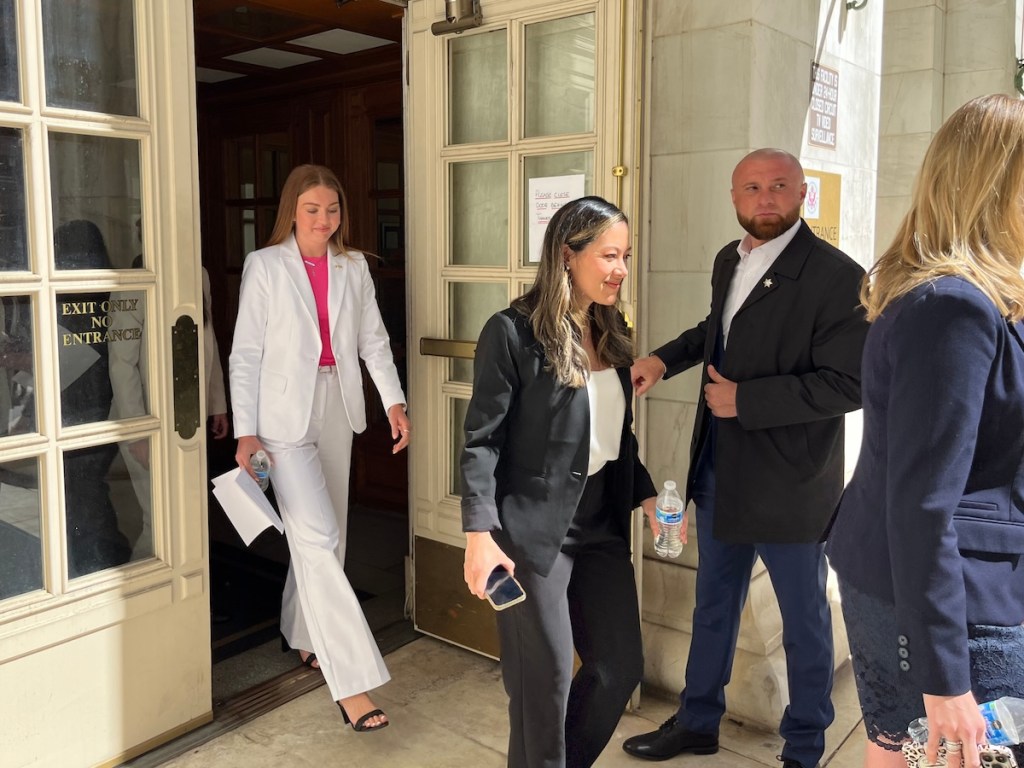
The original plaintiffs were Jaylyn Westenbroek, Hannah Holtmeier, Allison Coghan, Grace Choate, Madeline Ramar and Megan Kosar. Holtmeier and Coghan remain plaintiffs while Haley Rutsch was added to the amended complaint.
The revised set of plaintiffs bolstered their arguments with anti-transgender actions taken by the Trump administration, including the announcement that the U.S. Department of Education was investigating UW for alleged Title IX violations stemming from the sorority’s inclusion of a transgender woman.
The Department of Education has not given an update since it made such an announcement over a year ago. When a WyoFile reporter called the agency’s press office Monday, an automated message said its “information resource center is temporarily closed.” A message left with the agency was not returned by publishing time.
In 2025, Johnson dismissed the case for a second time, though with a final ruling, meaning, the appeals court is now being asked to decide on the merits of the case rather than its procedure.
Monday’s hearing
Angela Lavin, attorney for the sorority sisters, asked the court to reverse Johnson’s decision in her Monday arguments.
“Contrary to the district court’s order, appellants are not here asking the court to define the term ‘woman,’ to manage the sorority’s internal, day-to-day affairs, or decide whether Kappa’s membership may adopt an inclusive membership policy,” Lavin said.
“At its core,” she said, “this case addresses whether the board of a nonprofit organization can make a fundamental change to the organization’s governing documents when the contract between the organization and its members vests the authority to amend those documents with membership.”
Chief Judge Jerome A. Holmes soon cut in, asking how exactly Kappa made a fundamental change.
“Is there bylaws or are there other governing documents that specifically says that when it refers to woman, it’s referring to a biological woman?” he said.
The bylaws do not include such a definition, Lavin responded, but when Kappa was formed in 1870, “it represented itself to be an all-women’s single-sex organization that limited its membership to women.”
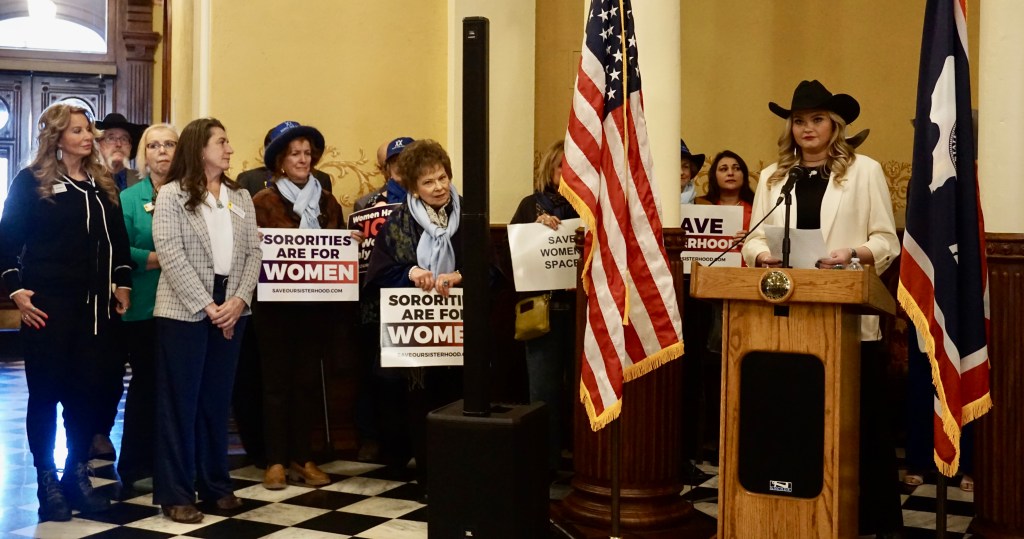
When the organization’s governing board of directors, known as the fraternity council, issued a position statement that it would extend membership to women and individuals who identify as women, Lavin said, it created a new category of members, and effectively broke its bylaws by doing so.
“It’s a private corporation. Why couldn’t the council do that?” asked Judge Timothy M. Tymkovich. “It’s free to establish any sort of membership criteria, and through the position statement, it expanded its membership criteria to transgender women or men who identify as women.”
The plaintiffs would disagree that the council can establish membership criteria, Lavin said.
“The membership criteria in the bylaws is limited only to women,” she said. “[It] doesn’t include anyone else. Doesn’t say individuals who identify as women.”
However, Kappa’s bylaws do not define women and the organization’s council “reasonably interpreted that term to include transgender women,” Natalie McLaughlin, attorney for Kappa, said.
“Appellants call that interpretation an amendment, but the operative membership requirement never changed. A member must be a woman,” McLaughlin said. “Council did not eliminate that requirement; they exercised the precise interpretive authority that the standing rules gave them.”
Tymkovich asked if there’s any limit to the board’s interpretation of the words in Kappa’s charter, and whether it would be a reasonable interpretation under Ohio law, where Kappa is incorporated, if it “added the category of men as part of their definition of woman.”
“No, that would not be a reasonable interpretation. The authority is not limitless,” McLaughlin said.
Tymkovich pressed on, asking “but the interpretation you’re defending does allow biological men to join the sorority, right?”
“Individuals who are born as men but who identify as women, so transgender women, absolutely,” she said. “Reasonableness of interpretation can be determined here by this court using multiple sources that are set forth in the documents before this court in the record.”
Tymkovich then asked “why would it be reasonable for the board to basically discard the founding principle of the organization in favor of a new expansive interpretation of the term?”
“The historical meaning of what ‘woman’ may have meant back then is not relevant,” McLaughlin said. “These are current governing documents that govern this organization that leave that term undefined,” and delegate the authority to define it to the council.



Wyo-File claiming comments are ‘awaiting moderation,’ sometimes days after the post was made is a joke. The paper just won’t admit that an opposing comment hurt their feelings. Wyo-File is a NYT (journalism’s equivalent of a head louse egg) wannabe.
Your anger over a bigoted comment not getting posted quickly enough is silly
Until medical science discovers a safe method to rewrite the human genome; the concept of transgender is impossible.
For Heavens sake Kappa folks: move on. Get over it and get on with your lives. This has become ridiculous and reflects badly on the Chapter and its members.
The panic over trans women in sports (and sororities) is as well developed a moral panic as we’ve seen in modern times. Right up there with the greats.
“Trans” is the culture war ball the religious right very intentionally picked up and ran with after they lost the battle over the LGB part of LGBT.
Just gtaduate college and move on. This is down right pathetic.
Referring to the miscellaneous carpet bagger attorneys cos-playing as “high-powered” attorneys in this boring pageant play is the icing on the cake. All you need to do to understand the seriousness of this matter is to look at the picture of your everyday coed Allison Coglan pictured above, “flanked” by the freedom caucus. Make it stop please!
Judge Johnson made the right decision and saw through KKG’s true motives in this case. And they have savaged the young trans woman who – let us not forget – was legitimately voted in by members who understood she was transgender when she was invited to join. As a member UW sorority myself, I’m very familiar with the process. Respect the process!