


The University of Wyoming athletic department has requested an additional $6 million for its budget over the next two years. The primary driver of the request is the recent NCAA settlement that allows universities to pay college athletes for use of their names, images and likenesses.
Supporters of the increase have framed it as necessary for UW to continue to compete in college athletics. The Wyoming Legislature’s Joint Appropriations Committee was unconvinced and recently omitted the requested funds from UW’s proposed budget. However, the issue will almost certainly be debated again when the Legislature convenes next month in Cheyenne.
The Legislature should stand firm. The statehouse doesn’t need to spend more on UW athletics.
First, consider UW’s budget in relation to comparable schools. While UW will remain in the Mountain West Conference for the 2026-2027 academic year, former conference members Colorado State, Boise State, Utah State, Fresno State and San Diego State will join a newly configured Pac-12 Conference. UW Athletics Director Tom Burman indicated that UW was in the lower third of athletic department budgets of schools in the Rocky Mountain region, and that without the appropriation UW would have to move down to “compete with Chadron State College.” A review of the budgets of all programs involved in the remaining MWC, courtesy of the Knight-Newhouse College Athletic Database, suggests otherwise.
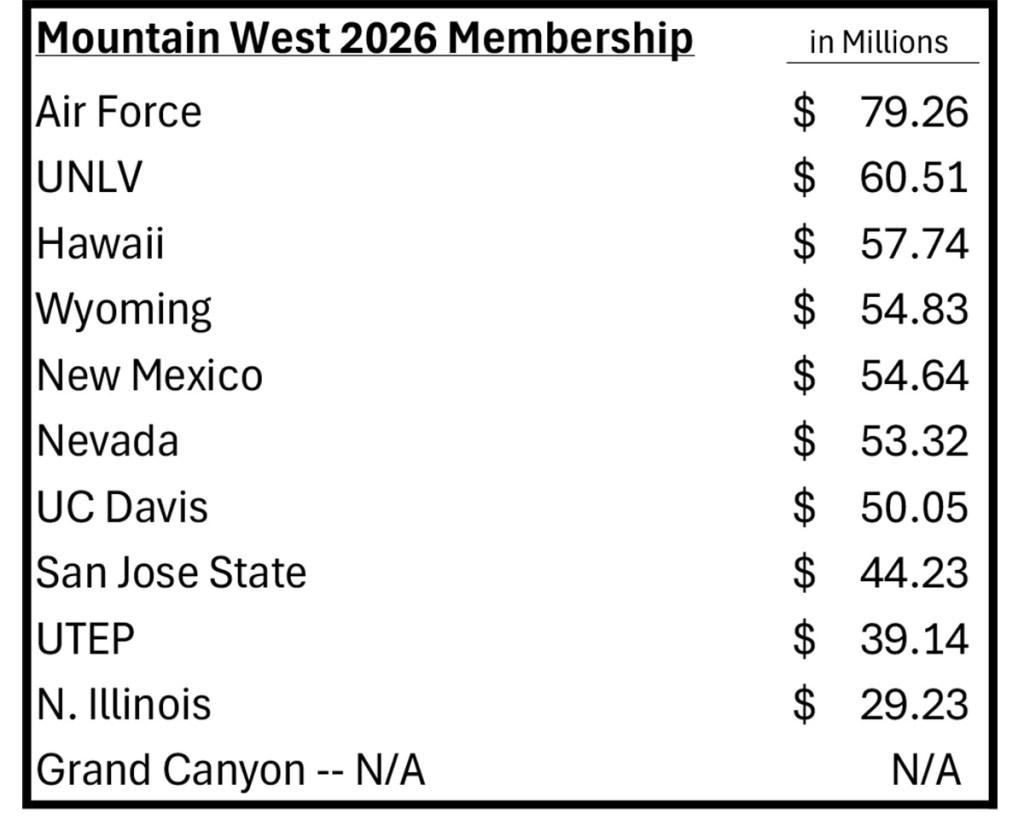
Perusing the data, it quickly becomes apparent that Wyoming’s current budget is about average for the 2026 membership. This does not include the over $100 million that UW spent on upgrading War Memorial Stadium and a new swimming pool. Here is a list of budgets for other Division I schools in the region and former Mountain West Conference members.

Clearly, UW’s existing budget of $54.83 million is in line with remaining members of the Mountain West Conference and significantly higher than regional Division I schools in the Big Sky Conference (though that conference is a lower division in football, which is the primary driver of any college athletics budget).
The NCAA settlement is specifically designed to address schools in the “Power 4” conferences, of which Wyoming is not a member.
Of all of the schools above, it’s important to note that while all remaining members of the Mountain West Conference “opted in” to the NCAA settlement, new member UC Davis did not. Additionally, six schools in the Big Sky Conference did not opt into the settlement. Included in the list of schools that opted out was Eastern Washington, where former UW associate athletic director Tim Collins is now the athletic director. At the Big Sky media days, Mr. Collins indicated, it was in the school’s best interest to press “pause and see how things unfold before we jump in, legally and financially.” Big Sky Commissioner Tom Wistrcill described the new system as “building the plane as we fly it,” reinforcing the desire to wait for clarity.
All of this occurs amid changes to the Mountain West Conference. In late 2024, MWC members Boise State, Utah State, San Diego State, Colorado State and Fresno State announced that they would be leaving the MWC effective June 1, 2025.
To facilitate the newly constituted Mountain West Conference and avoid Air Force and UNLV departing for either the new Pac-12 or American Athletic Conference, UW and the other remaining MWC members had to agree to allow Air Force and UNLV a higher percentage of the penalty funds the departing member will pay (24.5% for UNLV and Air Force vs. 11.5% for the remaining members). This amounts to $25 million for UNLV and Air Force while Wyoming will receive $9.43 million. This is likely only going to make the discrepancy, and ultimately the competitive balance, in the new MWC more skewed toward UNLV and Air Force.
The Mountain West Conference began operations in 1999. In MWC games only, the UW football program has a combined conference record of 77-128 (37.5% winning percentage), while men’s basketball has a record of 171-251, for a winning percentage of 40.5%.
A journalist for Nevada Sports Net, Chris Murray, recently compiled a list of the Mountain West programs that were producing the most “value.” UW ranked dead last.
Over the past 25 years, since joining the Mountain West Conference, Wyoming has reportedly agreed to the following buyouts with former coaches:
- Heath Schroyer – $480,000
- Alan Edwards – $220,000
- Steve McClain – $570,000
- Joe Glenn – $316,000
- Dave Christiansen – $570,000
By allocating more money to UW for athletics, the Legislature is only enabling these types of ill-considered contracts and subsequent buyouts in the future. UW football’s current head coach, Jay Sawvel, has a record of 7-17 in his first two years, and UW appears headed toward another one of these buyouts.
While UW is requesting additional funds to support their NIL program, the trajectory, trend and inability of flagship programs to maintain competitiveness indicates that supporting the NIL program with this allocation from the state is likely too little too late. Without membership in the newly constituted Pac-12, along with the financial imbalance negotiated for the remaining Mountain West Conference members, UW is only throwing more money at the white elephant of college athletics. I urge the Legislature to consider whether the additional investment is appropriate and whether it will produce a positive return on investment for Wyoming’s taxpayers.

https://www.facebook.com/share/17ospTqSfg/?mibextid=wwXIfr
This guy has ALL his facts wrong It’s a shame you would publish this without doing a fact check
Where Bruce? I put a link to every source i used?
You even cite that the request is “driven by the House v. NCAA settlement (approved June 6, 2025): New legal and compliance obligations for NCAA Distribution.”. It is still $6 million to support the same programs. No matter how they try to structure it.
It is just a shell game UW is playing you indicate: “Any compensation or NIL programs will be funded through ticket sales, media contracts, sponsorships, concessions, and private donations, not taxpayers.” So now they are just asking the state to replace that money with state funds.
Also, every article that has led up to this point UW is indicating the fans and state need to adjust to the “NIL world” https://cowboystatedaily.com/2025/12/20/pay-to-play-university-of-wyomings-battle-to-remain-division-i-in-an-nil-world/ and https://cowboystatedaily.com/2025/12/17/ortiz-and-lubnau-name-image-and-likeness-standing-still-is-moving-backward/. It’s really sort of underhanded to try and frame it any other way at this point.
Join FCS/Big Sky Conference in football and basketball. Problem solved.
Without the Mountain West check the UW budget would be in line with neighboring Big Sky members having similar state populations and school enrollments. Big Sky membership would provide local rivalries, less travel expense along with a chance to be competitive and keep a good coach. Anyone who watched the FCS playoffs can see that those schools care about their teams as much as the schools in the CFP. With the state of NIL now, the next Josh Allen isn’t showing up in Laramie so continuously firing then buying out coaches isn’t going to help. Why keep trying to compete in a league that is so stacked against you?
I would suggest that the wealthy Cowboy Joe members pony up the money to pay the athletes.
As somebody noted, football is to education as bullfighting is to agriculture.
College athletics are an unrelated for-profit side business of an institution that really should be focused on education. It may not make much money if you only count ticket sales and TV rights… BUT it generates donations from alumni and others that don’t appear on the balance sheet. The University’s own Economics Department should be asked to research how much, so we can determine to what extent it is worth supporting for that reason. We don’t want to overfund it or let it take priority over the university’s educational mission, but it may be financially disadvantageous to cut funding too much.
I do not want the states money used to pay student athletes. The university is for education, and I’m all for supporting that role.