

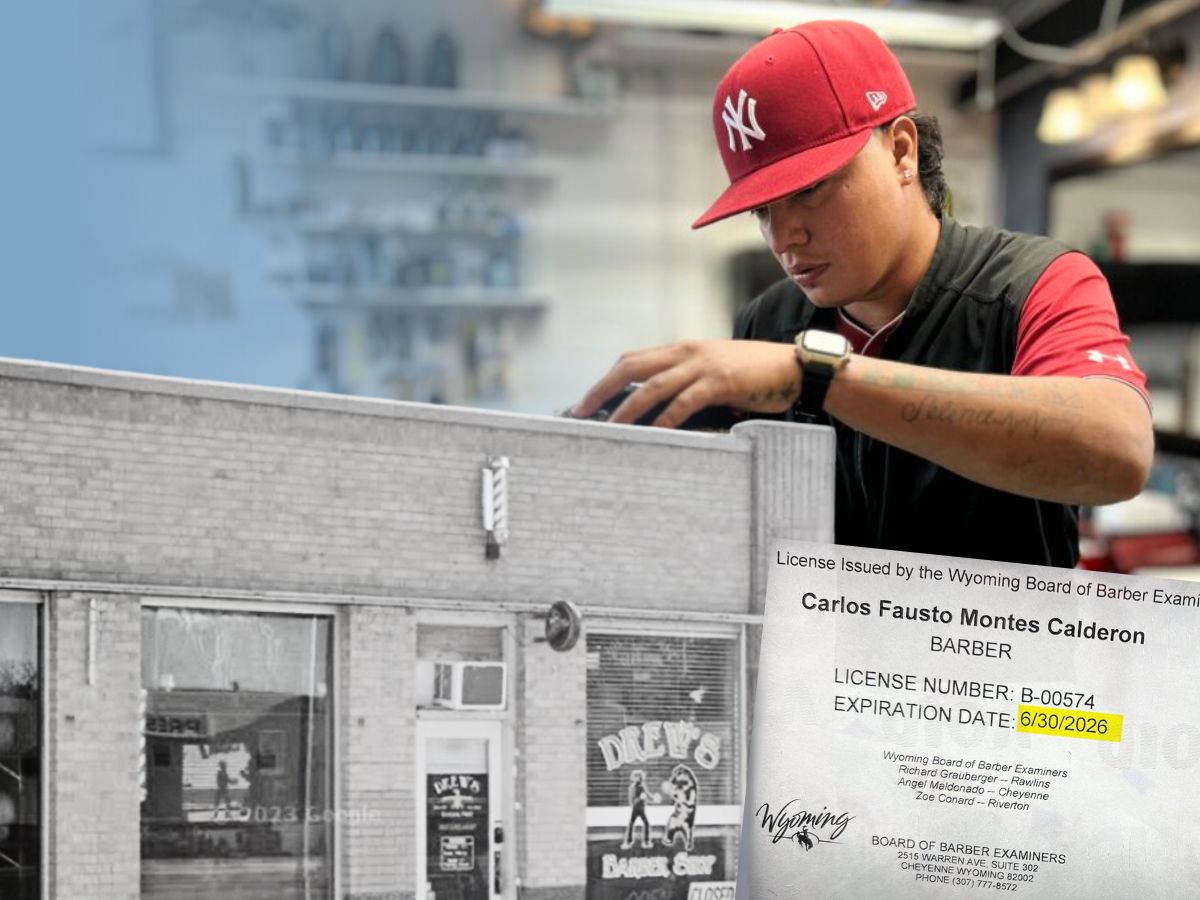
Driving with a broken taillight should not result in a man losing his job, then being secretly taken away from his family and deported to a country where his life is in danger.
Opinion
But it did end that way for Carlos Montes of Cheyenne, despite not having a criminal record and doing everything he could to become a legal citizen of the United States.
Montes is by no stretch of the imagination the “worst of the worst,” the type of person President Donald Trump told Americans he would remove through his mass deportation plan. He repeatedly made that promise during his campaign in 2024, and it’s what he claims his administration has accomplished.
Trump specifically talked about murderers, rapists, kidnappers, drug dealers, gangs, child predators and terrorists who cause communities to live in fear.
But his immigration policies directly led to Laramie County law enforcement stopping a Wyoming barber for a minor traffic violation, moving Montes to deportation facilities in other states and whisking him off to Nicaragua.
His pregnant partner and 5-year-old son, with him during the traffic stop, watched helplessly while Montes was taken into custody. Authorities told them nothing about what would happen next. More than a week later, they learned what transpired from Oil City News, which in partnership with WyoFile, sought to learn what happened.
It took another two weeks for his distraught family to be able to talk to Montes on the phone.
I don’t believe 70% of Wyoming voters who wanted to send Trump back to the White House thought someone like Montes — who was no danger to the community — would receive such harsh punishment.
Why would anyone want to see a young boy and a woman about to give birth suffer like this, and take away the man they love?
Montes entered the U.S. when migrants from Nicaragua had temporary protected status, because staying in their native country put their lives in jeopardy. Trump signed an order terminating that status a year ago.
Barbershop owners Drew Weston and his wife Andrea Shipley hired Montes in April 2025. The couple told reporters he was trying to legally obtain U.S. citizenship, had a naturalization number and was working through the process with the Wyoming Attorney General’s Office.
“I know that he has done so much paperwork to even be here and get his [barber’s] license, that he’s a guy who will do what he needs to do the legal way,” said Weston. “So for this to pop up and then to be treated like this, oh my God.”
Montes is representative of those who are being deported in our names. About 70% of suspects detained by ICE from the beginning of Trump’s second term through this past July did not have a criminal conviction.
ICE considers anyone a criminal who has a conviction, whether it is a serious felony or a minor violation punishable by a fine, like fishing without a license or not keeping a dog on a leash.
Or driving with a taillight out.
This tragic series of events began on Nov. 26, when a deputy pulled Montes’ vehicle over in south Cheyenne for the alleged taillight violation.
The deputy discovered that Montes did not possess a driver’s license or proof of insurance — both misdemeanors that weren’t adjudicated by a court. The sheriff’s office notified ICE of the charges under an agreement Laramie County Sheriff Brian Kozak signed with the federal agency.
ICE took custody of Montes and transported him to an Aurora, Colorado, detention center. Then he was sent to a county correctional facility in Natchez, Mississippi. On Dec. 5 his family used an ICE online tracker to learn about that last move, but it was too late. A day earlier, Montes was deported to Nicaragua.
Last week Laramie County District Judge Robin Cooley dismissed a lawsuit filed by Montes’ former employer, Drew’s Barbershop, and two other plaintiffs who alleged that the sheriff illegally signed three agreements with ICE.
The parties contended the Laramie County Board of Commissioners has the authority to enter into such agreements, not the sheriff. The lawsuit was tossed because the judge ruled plaintiffs did not have standing and could not prove economic injuries arose from ICE activities.
In January, Montes was reunited with his family when they traveled to Nicaragua to live with him and his parents. But what Montes wants is to be able to return to Cheyenne, where he built a good life by working hard to support his family and making many friends.
Such a reunion won’t be possible for between five and 10 years because of paperwork he signed while in custody, Montes told the Wyoming Tribune Eagle. He said being stuck in a single cell with many other immigration detainees left him unable to sleep, and one day he was asked if he wanted to “get out.”
Montes speaks some English but isn’t proficient enough to understand legal documents without a translator’s assistance. Believing he would be going back to Wyoming, he signed paperwork that said he was self-deporting.
ICE wants us to believe Montes signed the document willingly. Sure, why wouldn’t a man who loves Wyoming and his job want to go back to a country where his political beliefs put his life in jeopardy? Why would he want to sign something that ultimately forced his young family to leave home?
If you believe that ICE had a good reason to keep Montes isolated from his family until long after he landed in Nicaragua, you’ll likely automatically put him in the “worst of the worst” category.
According to a polling analysis by Newsweek released on Labor Day, Wyoming gives Trump the highest net job performance rating in the country. His approval rating here is 15% higher than the percentage of Wyomingites who disapprove.
But at the beginning of Trump’s second term, Wyoming had high hopes for the president. He had a net +47 approval rating.
There are myriad reasons Trump’s favorability has fallen by 25 points here in the past 20 months. The most commonly cited nationally are the poor economy and the disastrous war against Iran.
But the failure of the president’s mass deportation policy is no doubt a factor. In communities across the country, there are injustices like what Carlos Montes suffered.
People take notice of that. It’s one reason why Trump’s crusade to build more ICE jails have fallen flat.
I think most Wyomingites pay attention to what’s happening elsewhere. The most recent immigration horror was in Springfield, Ohio’s Haitian community, when the promising future of 20-year-old honor student Pierre Damas Bel ended when he apparently committed suicide after being forced to wear a humiliating ankle monitor that led to him being bullied.
Bel committed no crime. Like Montes, he and his family were given temporary protected status, which allowed about 330,000 Haitians to live and work in the U.S.
The Trump administration ended that protection in July, and ICE fitted Bel, who’d been a cadet in his high school’s J.R.O.T.C. program, and many other Haitians with ankle monitors. The agency said it was an alternative to being detained; the monitors enabled authorities to locate migrants who fail to comply with orders to report to court hearings or ICE check-ins.
This “humane” approach led to Bel’s Instagram post that explained he was “carrying a feeling of shame and humiliation that I never imagined I would experience.”
Bel made a video call to his father, telling him that he was not feeling well mentally because of the bullying. Three hours later, police notified his dad that Bel had walked into oncoming highway traffic and was struck by a truck, killing him.
I believe some day the tragedies surrounding this massive mistake to use undocumented workers as pawns in political games will end. But until then, how many good people will we lose?

I think that Mr. Abas needs to refresh his facts. His statement that Biden deported 1.1 million immigrants is not held up by facts, unless you want to take a 6 month snapshot of his administration…like after he let in 12 million. It certainly is not a “net” number. His broad statements, while they may be true tangentially are misleading at best. And don’t preach to people about religion.
If you think the Democratic Party is interested in solving problems, you are dilusional.
The way the Trump Administration and Republicans in general are treating people is shameful and inhumane. They all need to go to church.
I find stories like this to be unfortunate. On the other side, one can read daily about the crimes committed by illegals against others. One would think that fixing our immigration system would be a priority. All I seem to read is people pointing fingers. Allowing millions of people in the county during the last administration was a huge mistake but then deporting the ones who are trying their best to make a better life for themselves and their families is also a mistake. What a mess.
“On the one side, one can read daily about the crimes committed by illegals against others.”
Get out of your right-wing bubble, friend. Most violent crimes are committed by white males who are US citizens, not illegal immigrants. Very sad that you’ve swallowed right-wing propaganda without even questioning it.
Just a short comment because as I’m writing this the opinion piece is pissing me off. Good opinion Kerry. Maybe some other people will get pissed off also.
People should be treated like people.
For those of you who go to church would God want us to treat people poorly to get them out of a country. For those that don’t go to church I would think you’d come up with the same concept. You would not want people treated poorly just to get them out of the country.
Some facts:
1. President Joe Biden deported 1.1 million immigrants. To my knowledge, none of them were treated horrendously like they’ve been treated under Orange ones administration.
2. So far in this term, only 500,000 immigrants, have been deported and there are thousands of reports of poor treatment, poor facilities, poor food, poor conditions and who knows what other inhumane treatments?
3. American citizens have been killed by ice agents.
4. The DOJ investigated tearing down the statue of liberty because of the words underneath it. I don’t know for sure but I’m guessing that Ding Dong Don had something to do with it.
5. Countries around the world have started hating us because of the current administration.
Hopefully during the midterms, the Democrats will win. I’m not per se a Democrat or Republican. I’m kind of middle of the road. But Humpty Dumpty is ruining our country and it will take decades to make it right. He must go
and the current republicans are to affraid
To do the right thing and impeach him.🤬🤬🤬🤬
He’s already been impeached twice, what do you think impeaching a 3rd time will accomplish that the 1st two didn’t?
Stay pissed off John. You brought up some valid points for everyone to consider, especially the compassion and decency part.
It sure sounded to me like the person Kerry was referencing was trying his best to do everything the right way to become a U.S. citizen. Unfortunately, he wasn’t a white European that was here because of a protected status but a brown Nicaraguan instead. Stephen Miller and Donald Trump must really hate the color brown.
If you are in the USA illegally, go home!
What part of illegal does kerry not understand.
Ask yourself the same question …
The important point which you seem to be deliberately overlooking, is that a great many of the people being deported came to this country LEGALLY, they only became “illegal” when his corpulence, Trumpty, unilaterally ended TPS, started revoking visas, ended DACA, and generally declared war on any none-citizens with Hispanic surnames. That is in no way denying that an insane number of people did indeed enter the US illegally during Dopey Joe’s mis-administration, but the arrests and deportations haven’t been limited to the worst of the worst, or even to illegals.
We still have plenty of room in the good ole’ US of A to provide refugee status for White Afrikaners from imaginary threats at home, but we gotta get all them damn “third world brown types” outta here cuz they’s all turrible criminals! MAGA is, at its heart, a movement to ensure that white Christians remain the majority in the US.
Did not the Afrikaners receive a pretty good bonus to come here in terms of money?
The mass invasion of this nation DURING COVID, has essentially been a damper on even worse runaway inflation.
Bringing in third world, borderline slave labor, across this country including Wyoming has kept inflationary costs artificially lower.
It’s going to get worse, before it gets worse.
What percentage of the 10-11 million that flooded into this country in 3-4 short years have been deported under trump?
5%?
Save your outrage.
At a stupidly ridiculous cost while robbing the US of science and maintenance of our public lands. US policies drove immigration and then we waste billions funding the keystone cops that are deporting actual citizens. Wyoming backed a sociopath for president and the GOP claims legality over humanity, which is exactly what the Nazi’s claimed….its legal….
Greg, if the nation hadnt had a 3 year long invasion fully supported by the previous administration, we would be having this discussion.
Once again BOTH parties are criminals.