


There’s no saying what exactly the National Elk Refuge will propose when it rolls out its long-awaited plan detailing how it will handle a deadly disease forecasted to drastically reduce Jackson Hole elk populations, crushing hunting opportunities in the process.
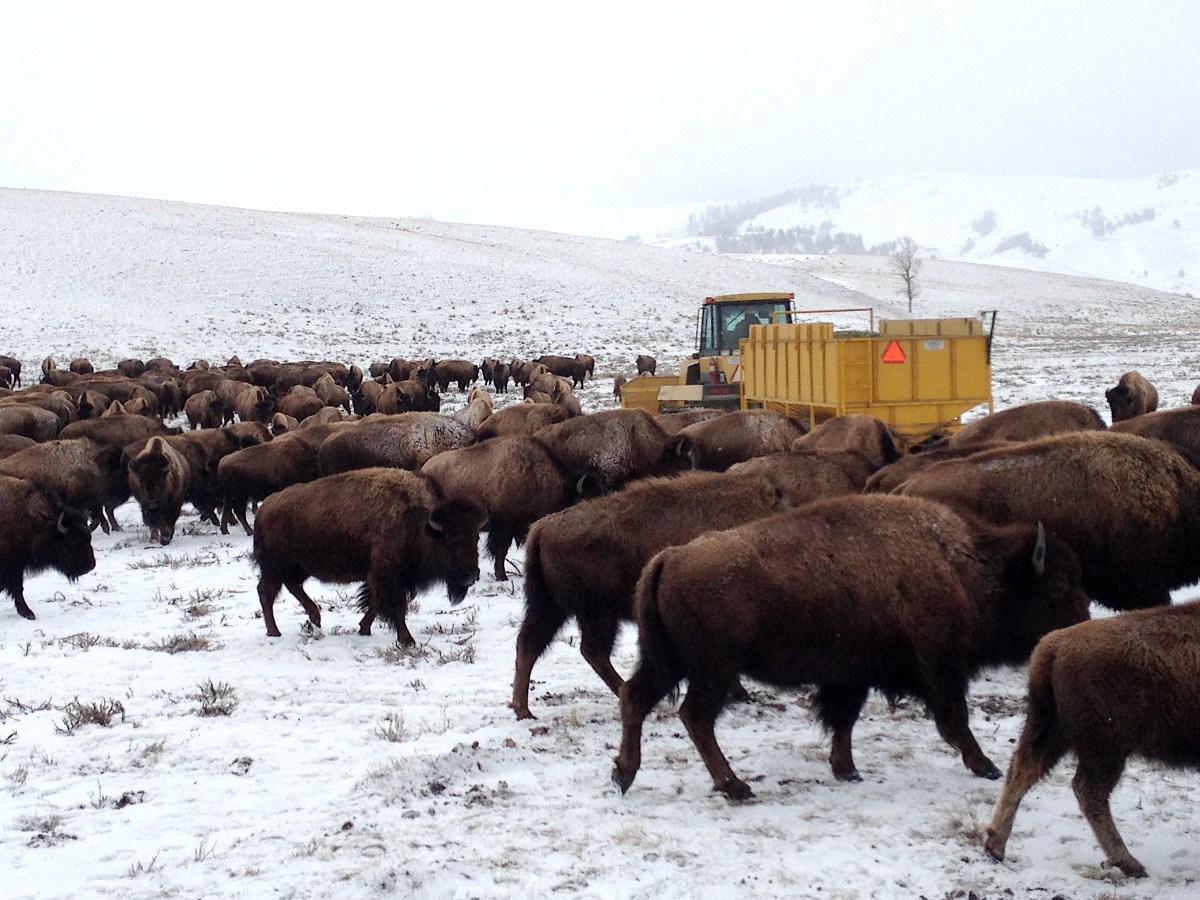
But a new scientific analysis by the U.S. Geological Survey provides a first glimpse of likely components in the refuge’s “preferred” option for dealing with chronic wasting disease on a 25,000-acre federal property where thousands of elk have been fed and unnaturally bunched up since 1912. Specifically, the U.S. Fish and Wildlife Service may roll out a proposal that calls for perpetual feeding of the Jackson Bison Herd, a species that’s immune to CWD. For the Jackson Elk Herd, meanwhile, feeding would continue until rates of always-lethal chronic wasting disease reach 7%.
The USGS analysis predicts what will happen if the refuge opts for increased hunting and a 7% CWD threshold for determining when to stop feeding elk. By year 20 of CWD spreading in the Jackson Herd, rates of the disease will reach an estimated 26%. The population will fall as a result, declining 44% to a predicted 6,100 elk in the herd.
Paul Cross, the USGS research biologist who authored the report, described the particulars of so-called “Alternative D” as a “middle ground.” The assessment supplemented an earlier, broader analysis that uses science to help the National Elk Refuge chart the best path forward.

Elk feeding began more than a century ago and has successfully increased winter survival and kept wapiti out of winter haylines, but the practice is considered antiquated, spreads disease, truncates migrations and poses an unprecedented threat to elk populations because of just-arrived CWD, which is always lethal.
The particulars of “Alternative D” were selected based on discussions with wildlife managers, Cross said, naming the National Elk Refuge and Wyoming Game and Fish Department.
Notably, Brian Nesvik, a former Wyoming Game and Fish director, now oversees the poorly resourced Wildlife Refuge System that includes the National Elk Refuge. He was confirmed as the U.S. Fish and Wildlife director in early August.
The forecast for “Alternative D” is more favorable for elk and elk hunters than if the National Elk Refuge goes with unchanged feeding. In the earlier analysis, that prognosis was for CWD to infect 35% of the Jackson Elk Herd, a rate that modeling predicts would slash the population by more than half, down to 5,200 animals.
The modeling assumed starting points of 11,000 elk and 1% CWD prevalence, both higher than the on-the-ground conditions today.
Elk fare similar under “Alternative D” to the herd’s prognosis if the refuge were to stop feeding cold turkey, the analysis shows. But the newly modeled scenario performs better in other respects, Cross said.
“If you don’t feed, then [elk and bison] are going to be in other places more often,” Cross said. “That results in more calls to Wyoming Game and Fish, more complaints, more elk running around with volleyball nets on their head.”

The Fish and Wildlife Service did not authorize National Elk Refuge staff to give an interview for this story.
It’s not entirely clear when the refuge will release its final Bison and Elk Management Plan, although its website says this fall. The current plan dates to 2007, and mostly hasn’t worked to achieve one of its major goals: reducing elk feeding by 50%. It’s also unclear how much the “preferred alternative” in the forthcoming environmental impact statement will differ from the “Alternative D” assessed by USGS.
“They’ve changed multiple times already,” Cross said. “I don’t know if conversations are ongoing or not.”
There are elements of “Alternative D” that the Wyoming Game and Fish Department has supported, said Brad Hovinga, who supervises the agency’s Jackson Region.
“We were definitely supportive of continued feeding of bison,” Hovinga said.
There are still ongoing discussions about chronic wasting disease thresholds that could idle alfalfa trucks on the National Elk Refuge, Hovinga said. Game and Fish in a general sense will be pushing for an option that’s “more in line” with its state-level feedground management plan, he said.
“That’s been our goal all along,” Hovinga said.

Wyoming’s first-ever feedground plan, completed in 2024, does not compel reform or call for closing any feedgrounds, though it allows for halting feeding so long as consensus is reached with traditionally pro-feeding parties, like ranchers and hunting outfitters.
The chronic wasting disease threshold for stopping elk feeding included in the recent analysis was not chosen arbitrarily, Cross said. The threshold was based on 2016 research. That study concluded that animals gathered on the National Elk Refuge will be pushed into a state of population decline once CWD prevalence in cows reaches 7%.
Correction: Predicted CWD prevalence rates and population sizes have been updated in the third paragraph of this story. The prior numbers used were for a slightly broader geographic area, but the figures are now specific to the Jackson Elk Herd. -Eds.

In his 1907 Annual Report, State Game Warden DC Nowlin wrote to the Governor, “It is imperative that we provide a permanent winter range for the elk. . . . embracing a natural winter range, . . . . so that the succulent mountain grasses may grow and mature, to constitute a safe insurance against starvation during severe winters.” (p.15). Specifically, “We are in urgent need of a strip of territory six miles wide along the Gros Ventre River . . . . nearly to the summit of the Green River Divide; also, about two townships embracing the Big Bend of Green River.” (p.16) Six townships is about 138,000 acres. Such a designation would be, he added, “the solution of the winter range problem.” Fortunately, as was the case 118 years ago, the area he described is still sparsely settled and actually abuts the National Elk Refuge and adjacent USFS winter range between Kelly and Curtis Canyon eastward. About 99% of what Nowlin described is now US Forest Service public land, and there are few livestock that winter on the small private parcels. Instead of investing in dumpsters and incinerators to dispose of diseased elk carcasses on crowded feedlots, and buying hay and alfalfa pellets, a natural and far cheaper solution to healthy elk and other big game is still possible. My gmail is lloydjdorsey. Thanks.
Alternative D seems like a great way for current wildlife managers to transfer CWD challenges onto future wildlife managers. Sadly, evidence suggests, delaying actions will ultimately result in worse outcomes.
CWD is a horrible disease.
It cripples the animal and kills. It spreads among individuals in a herd.
When herds are drawn away from dispersed natural feeding areas to central locations for a free meal, the opportunity for the spread of this crippling and killing disease increases.
For those who only consider percentages and the size of the herd at some future date, I remind that if your goal is a healthy herd future, then the only strategy is to stop the spread by stopping the comingling of the heads at feedgrounds. The future of the WY herd has been discussed, dissected, tossed around, compromised, ad nauseum for the decade or more and the processes restarted periodically.
If there is to be a future herd bite the bullet and shut the feedground.
Typical, we all know where this will end up. CWD will reach the 7% as they have planned and they will implement the remainder of a decision that was made long ago.
Let nature take care of itself. Let Bison migrate. Deer,moose, and moose already carry Brucellosis. I don’t see their migration impeded or herds contained to a national park. Let wolves do their job of killing old weak and diseased. They don’t seem to be affected by CWD, although it does go out in their scat. But do other animals eat their scat ? I know prions can’t be destroyed?? But better than than hunters trying to hit or miss and having meat tested. And hunters always shoot a nice looking animal, not an unhealthy one that a wolf might instinctively detect. Well that’s my opinion. Let nature be the manager and determiner.
Wolves kill whatever they can, more often healthy than not.
HEALTHY calves are their favorite.
Complete nonsense. It’s desirable to have a healthy predator population..
All the Elk will die.. All the deer will die.. All the grouse will die..
It’s as ridiculous as climate change will kill us all. It won’t be long and someone will link CWD to Climate change. I’m surprised it hasn’t happened already.
Hunters, the two legged and four legged kill more than CWD.
Wildlife cycles seem to be something that folks forget about.
Outlaw volleyball nets. The elk were here long before volleyball.
“The modeling assumed starting points of 11,000 elk and 1% CWD prevalence, both higher than the on-the-ground conditions today.”
LESS THAN ONE PERCENT TODAY!
So the real question here is 7% even be reached?
The endless handwringing over CWD is tiring. The Laramie Peak elk herd after 40 years of CWD exposure tells us these apocalyptic dooms day numbers of 25-35% infected are hyperbole.