

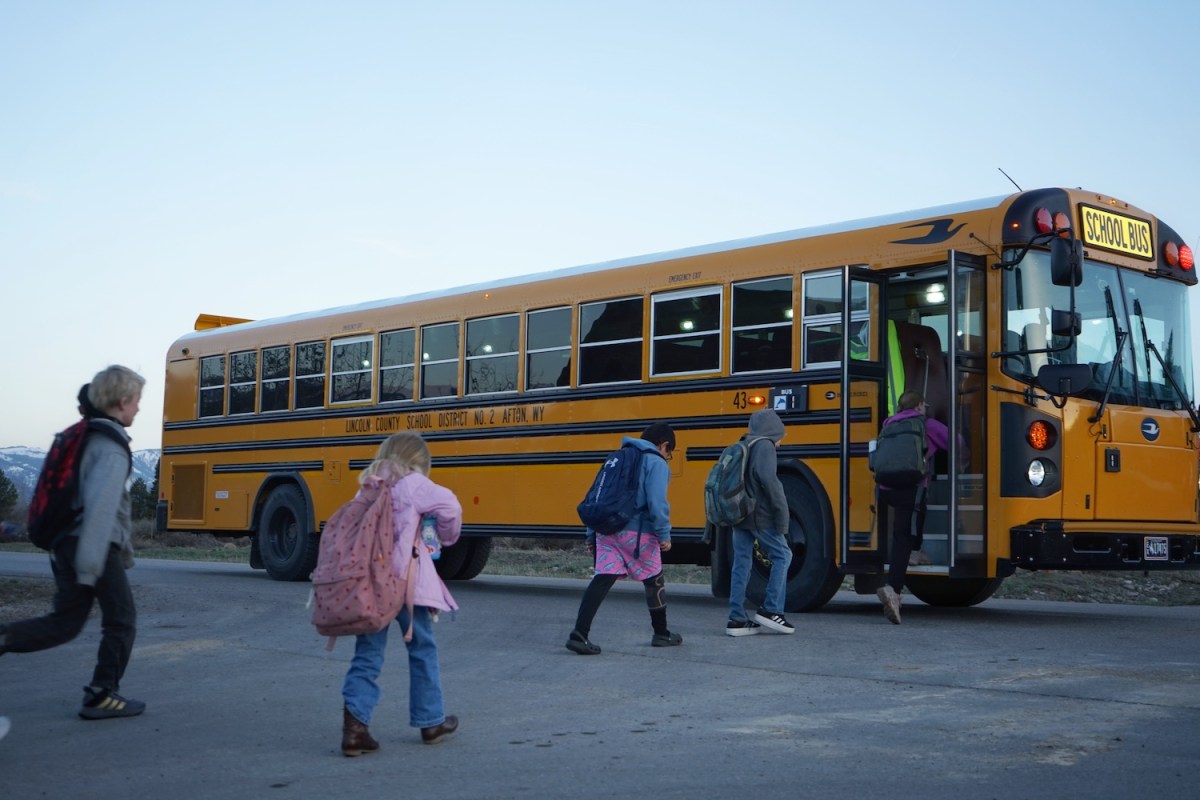
A little over 100 students attend the combined junior and high school in Cokeville, a town of about 500 residents near the Idaho border.
Many of those students participate in three sports, said Shannon Davis, a parent who drove three hours to Lander to testify to lawmakers on Thursday. The small school offers everything from basketball to track, volleyball, band and theater.
“We are small but mighty,” she said, adding that activities enrich kids’ educational experience in a town where sports and school bring the community together. So the recent news that Lincoln County School District 2 is facing a staggering drop in funding for activities and athletics, she said, threatens more than just the school.
“This education system is at the heart of our town,” Davis told the Select Committee on School Recalibration Thursday. “It would be devastating to our entire economy to require us to fundraise an extra $200,000 each year to keep our activities afloat.”
The situation in Cokeville is a consequence of Wyoming’s new funding model bill. The bill, which the Legislature passed in March following an exhaustive “recalibration” process, represents a significant overhaul in how the state pays for public education.
All told, the legislation added more than $250 million in state education funding to be spread across Wyoming’s 48 districts over two years. That included widely supported raises for teachers. The new funding model, which relies on “silo” funding, is much more prescriptive. It also reconfigured calculation formulas for things like special education, transportation and activities.
In the last category, that resulted in disparities — giving 26 districts an increase in funding, and leaving 22 others with decreases. Among the winners in the new formula are Niobrara District 1, which is slated to receive $200,000 more. There are also losers like Lincoln District 2, which is anticipating a decrease of more than $400,000, according to the Legislative Service Office.

Committee members vowed to rectify the situation during two days of meetings in Lander, where they met to discuss outstanding school funding issues, including school nutrition, technology and school resource officers.
“It’s the committee and the Legislature’s standpoint that we don’t intend or never did intend to reduce funding for activities,” said Co-chairman Rep. Scott Heiner, R-Green River. “We became aware of how dramatic this change was, and we’re trying to fix that. We’re trying to be able to make it right for every school district and every school.”
The committee identified a fix it believes could result in a more equitable outcome for Wyoming districts. The change would restore funding for districts that lost funding, while allowing districts that got a bump to retain the money.
The committee ultimately asked legislative staff to look into the change’s feasibility. Members will also continue to study the other issues. The committee meets again in August.
Unintended consequences
The Legislature is constitutionally required to fund Wyoming’s public schools and is tasked every five years with a “recalibration” process. The undertaking involves assessing the state’s school funding model and making necessary updates.
The latest came in the wake of a 2025 court decision that Wyoming was violating the state’s constitution by underfunding its public schools and must remedy that. (Wyoming is appealing that decision.)
The Legislature’s recalibration committee worked for much of 2025 to come up with a bill. Though educators and members of the public expressed strong opposition to parts of it, the committee voted unanimously to advance it to the recent session. After it passed the body, Gov. Mark Gordon let the bill go into law without his signature, arguing it would strip local control and could impact non-instructional expenses related to things like activities and nutrition.
It wasn’t long before concerns bubbled up about funding shortfalls and new restrictions. A major one related to activities.
The Wyoming High School Activities Association Board projected an 8.4% reduction in funding for student activities across Wyoming districts. The $3.9 million activities shortfall could result in districts cutting or consolidating sports, travel and related staffing, the association warned.
“Additionally, the restructuring limits district flexibility by restricting access to approximately $76.2 million in previously more adaptable funding which will result in cuts requiring extreme restructuring of existing activities and athletic offerings,” the activities association stated in a May press release.
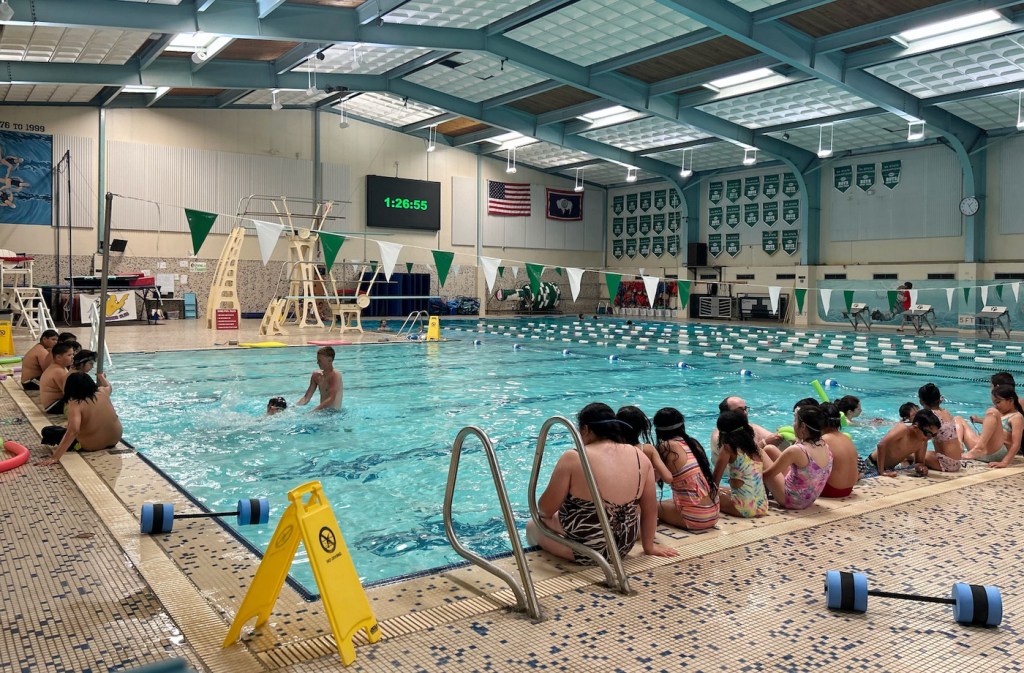
Most districts indicated they will rely on carryover funds to support activities in 2026-2027, according to the association, an approach that is “widely viewed as a temporary, one-year solution rather than a sustainable path forward.”
In the past, Lincoln County District 2 administrators have opted to keep activities afloat by hiring fewer personnel than the model recommended, Cokeville Schools Principal Kenneth Deitz told lawmakers Thursday. But the model’s new “silo” funding restrictions no longer allow that kind of flexibility.
“One perfect example of the damage potentially occurring through legislation put in place at the state level without total understanding of the local-level impact is the activity funding hole created for Cokeville schools,” he said before asking that lawmakers correct the challenge.
Evanston Republican Sen. Wendy Schuler noted that schools in her district are also seeing lopsided activities impacts. “So we gotta fix this.”
The recalibration committee had already planned to convene during the summer months to continue work on several aspects of the model that it didn’t get to in 2025. It also used this week’s opportunity to talk about the activities issue and identify a possible solution.
“The whole purpose of why we put these additional meetings this year into the recalibration bill is that we wanted to look at unintended consequences. We know additional time was needed for these very complex issues,” Co-chair Sen. Tim Salazar, R-Riverton, said. He added that the proposed change is promising.
However, Salazar said, the committee did not meet with the intention of revising the “silo” structure.
“The silo is a cornerstone of the recalibration bill,” he said. “Quite frankly, I don’t believe it would have passed without that mechanism.”
Computers and AI
The committee also delved into funding for school resource officers, school nutrition and technology.
Much discussion was devoted to technological needs, including whether it’s appropriate to continue providing each Wyoming K-12 student with a device. Many pushed back on the idea that K-3 students benefit from learning on Chromebooks.
Though Wyoming educational plans envision technology as a tool to strengthen learning, “many families in Wyoming, myself included, observed that technology has increasingly become the default for instruction, classroom management and student downtime rather than a targeted instructional support,” Laramie mom Teddi Freedman testified.
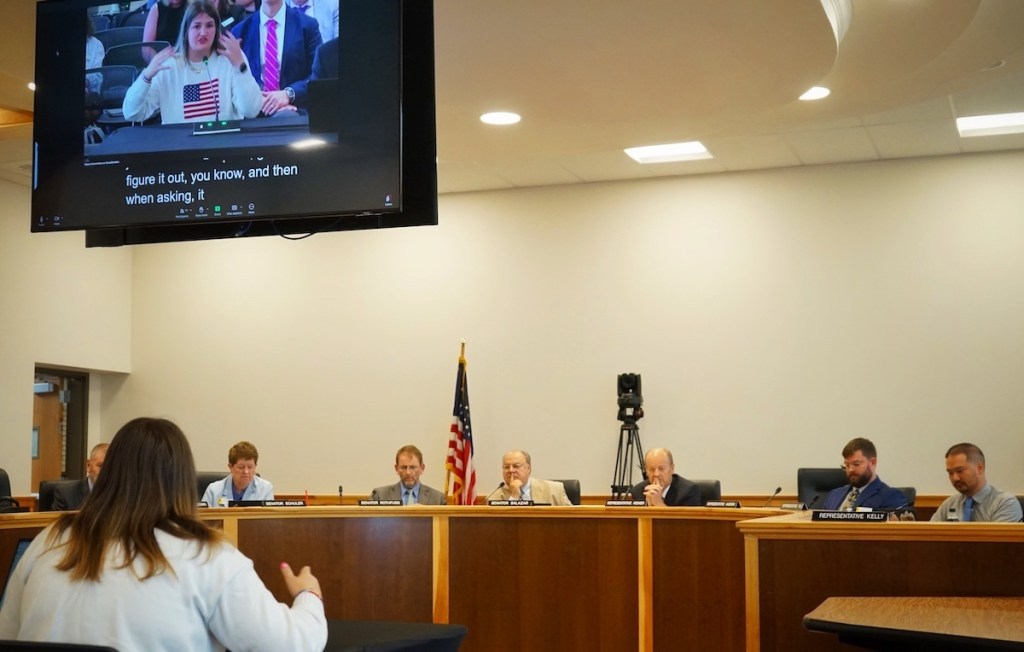
2026 high school graduate Kylie Wall also told lawmakers about her experiences as a student. Since the COVID-19 pandemic, she said, technology has encroached more and more into the classroom, and the impacts have been largely negative. Generative artificial intelligence services like ChatGPT erode creativity, memorization and intellectual brainwork, she said.
“We are losing the ability to be able to think for ourselves,” she said.
The committee scheduled two more meetings over the summer, or interim months, Heiner explained. It plans to draft legislation that could further improve and amend Wyoming’s funding model, he said.
The Legislature’s Education Committee is also studying AI guidance over the summer months.


At one point does a “bad” teacher become a “good” teacher? $100,000 a year? Remember most teachers have a 180 to 185 day contract. As far as activities, when did choir and band become and activity? At one point it was a class no different that Art, English, and Math. How many activities are enough? Let’s be honest……do girls need to be in wrestling? Indoor track? Education has been a black hole. We keep pouring money into it, but where are the results? Have test scores gone up? Can kids actually read, write and do basic math? I am all for paying a fair wage for a fair days work. I think the better teachers should make more than the one’s that don’t. If the state wants to save money, consolidate the school by county lines. Everything above the building principals could be combined. If you look at the number of square miles, or students that Chicago and New York schools have makes sense. Currently there are to many directors of this and directors of that.
The Legislature “is constitutionally required to fund Wyoming’s public schools”, it is not obligated to build and maintain Olympic quality aquatic centers, multi-million dollar artificial turf football fields, and IMAX level auditoriums in every school district in the state of Wyoming. If a community decides that it wants to rally to provide these facilities and amenities to the kids— Wonderful! Go for it! Just please stop calling it an “educational expense” and sending the bill off to the taxpayers.