

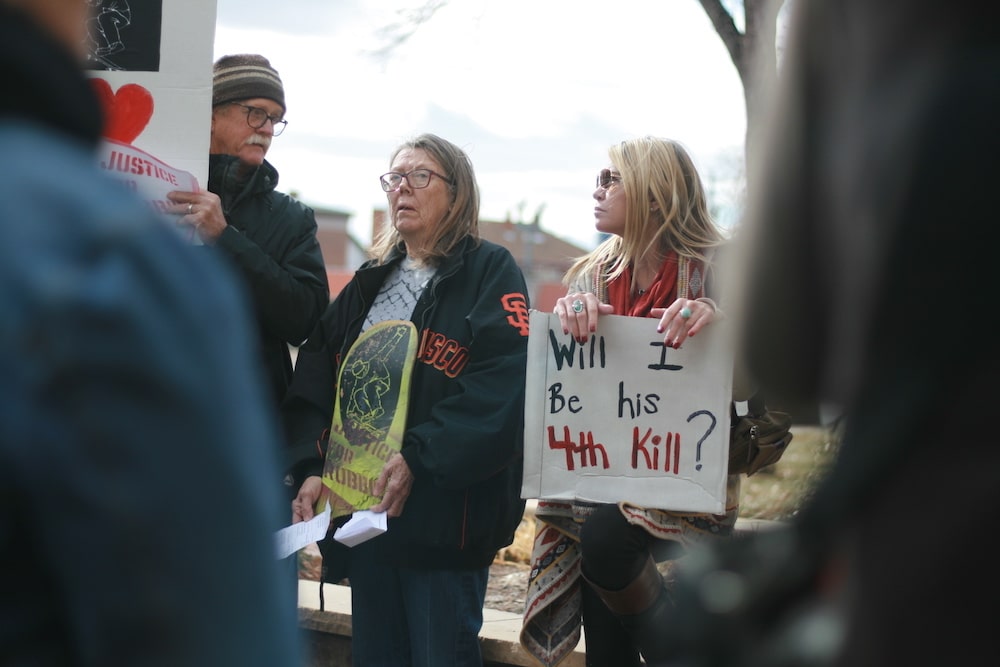
A wrongful death settlement resulting from a controversial law-enforcement killing should remain secret, lawyers for Albany County argued today in newly filed court documents. That’s despite a recent Wyoming Supreme Court ruling that suggests such agreements with government entities are public records.
Albany County made clear it does not want to produce public documents detailing payments made to Debra Hinkel, whose son Robbie Ramirez was killed by Derek Colling, a then-Albany County sheriff’s deputy with a checkered law-enforcement career. Ramirez, a 39-year-old Laramie resident, was unarmed and living with mental illness.
“The information contained in the settlement agreement and information in this matter is highly confidential and sensitive,” John Bowers, a lawyer for the county, said in a sworn statement accompanying the documents. “I am concerned that if public access to the information is not limited to this court and the appropriate officer of the court, it would adversely affect the parties [in the case] and future governmental operations.”
Hinkel’s lawsuit against the county was settled in May 2022, but Albany County lawyers have denied multiple requests for the documents, despite the involvement of a governmental entity.
Albany County denied WyoFile’s initial Aug. 22, 2022 public records request for the settlement agreements because the documents were “privileged or confidential by law,” then-County Clerk Jackie Gonzales wrote in an email on Oct. 2, 2022.
The parties involved in the suit entered into a confidentiality agreement, but nowhere in the Wyoming Public Records Act, the law governing the release of state and local documents, does it say that settlement agreements are privileged and confidential as a matter of law. WyoFile brought that to the county’s attention at the time, but the records were still not made available.
Ten months later, the Wyoming Supreme Court ruled in Gates v. Memorial Hospital that confidentiality agreements do not limit public access to settlement agreements with government entities. In light of the new finding, WyoFile resubmitted its request to Albany County on Aug. 22.
Albany County responded through Bowers on Sept. 1 that further clarification from the court and the parties involved was needed before the records could be released.
“We are currently in [a] difficult situation because of the wording of the settlement agreement,” Bowers, who represented Albany County in the lawsuit, wrote in a letter to WyoFile. “We need the Court to direct us on how to address the request to prevent additional claims being made against the County.”
Bowers filed a motion in the U.S. District Court, where Hinkel’s case was originally heard, asking for a hearing to “set forth the obligations of Albany County, specifically in relation to the confidential settlement agreement and its duties pursuant to the Public Records Act and the recent public records request.”
In the motion, Bowers noted that releasing the settlement could make Albany County vulnerable to additional litigation from the other parties named in the suit — Hinkel, Colling and former Albany County Sheriff David O’Malley — who agreed to confidentiality.
On Sept. 7, U.S. Senior District Judge for the District of Wyoming Nancy Freudenthal denied the motion, explaining that Bowers had “not provided any law, rule or authority which would permit the filing of such a motion in a closed case.”
In other words, the judge would not provide the clarity Albany County was seeking.
Following Freudenthal’s decision, WyoFile contacted Bowers via email on Sept. 7 and Sept. 11 to ask if and when the records would be released. It received a reply today with notice of the new filing, asking a state court to intervene to block WyoFile’s access to the requested settlement agreements.
In his motion filed in the 2nd District Court in Laramie, Bowers argued that “public disclosure of the information in the court record would do substantial injury to governmental operations serving the public.” He specifically cited Rule 6(t) of the Wyoming Rules Governing Access to Court Records, which restricts public access to medical records, as grounds to limit WyoFile’s access to the records.
Bowers did respond to a request for comment by press time.
A troubled past
Before joining the Albany County Sheriff’s Office, Colling was involved in two shootings and a beating in uniform during his time with the Las Vegas Police Department.
In 2006, he was one of five police officers who fired 29 rounds at a domestic-violence suspect. Officials ruled the shooting was justified.
Colling also shot and killed a teenager with bipolar disorder who was brandishing a knife outside his mother’s apartment. That shooting in 2009 was ruled justified as well.
Then in 2011 he beat and arrested a bystander who attempted to film police officers from his own property. Video of that incident went viral, and led to Colling’s firing.
In 2012, O’Malley hired him in Albany County, first as a corrections officer then as a patrolling sheriff’s deputy.

Hinkel’s lawyers characterized O’Malley’s decision to hire Colling as being “unduly influenced by his friendship with Defendant Colling’s father.” Richard Colling is a Wyoming Highway Patrol officer and longtime Laramie resident.
O’Malley defended his decision, telling WyoFile in the weeks after the shooting that he regretted what happened to Ramirez but did not regret hiring Colling, who resigned from the department in 2021.
In suing, one thing Hinkel wanted to understand was how Derek Colling could have been hired by the Albany County Sheriff’s Office after his termination from the Las Vegas Police Department, according to a press release from her legal team announcing the settlement.
“Ms. Hinkel believes that she accomplished what she set out to achieve which was to find out what happened and why,” according to the statement.
Over a year later, the details of how the case was resolved — including the amount of public funds involved — remain out of public view. WyoFile sought to remedy that blindspot with the records request Albany County has yet to fulfill.
“We’re not interested in withholding any information that is legal to dispense to people,” Albany County Commissioner Pete Gosar told WyoFile, without further information about next steps.
‘Gates is clear’
There’s nothing stopping Albany County from sharing the records now, said attorney John Cotton, who argued Gates v. Memorial Hospital on behalf of Jessica Gates. Her requests for medical malpractice claims were denied by the publicly funded medical facility until the Wyoming Supreme Court made it clear that was a violation of the Wyoming Public Records Act.
“My read on the Gates case is that governmental entities can no longer hide behind the facade of these so-called confidentiality agreements in their settlement documents,” Cotton said prior to the county’s most recent filing.
Access to settlement agreements, which reveal names and dollar amounts, “are critical for the public to understand what these entities are doing with public funds,” Cotton said.
With the Hinkel case, the lawsuit could only reach so deep into public coffers, because Albany County’s legal costs and settlement fees are covered by the Local Government Liability Pool — insurance for government entities in Wyoming.
The county paid $62,771.00 for a policy in 2021-2022 and $65,413.00 to cover 2022-23, according to records provided by Albany County.
When the liability pool makes a monetary payment on a claim, the county must pay a deductible much like a co-pay for a visit to the doctor’s office.
Records show Albany County paid a $5,000 deductible for the settlement regarding Hinkel v. Albany County in August 2022.
Colling and O’Malley — in their law enforcement capacity — are covered separately by the State Self-Insurance Program, which may have also contributed to the total settlement amount. Albany County could owe an additional deductible for payments on claims made against Colling and O’Malley.
“Regardless of whether it’s from an insurance company or anybody, the agreement is still an agreement entered into by a governmental entity,” Cotton said, and therefore public record.
While Hinkel has yet to comment on her desire to release the details of the settlement, the press release issued by her lawyers last year said that she spent over $100,000 on investigators, depositions and experts over the course of a two-year legal process.
According to the Wyoming Public Records Act — which provides 30 days to fulfill a request — Albany County has until Sept. 21 to produce the settlement records.

Derek Colling took everything Robbie had and all he would have every had. Colling should have been held personally accountable for that action, as should the Albany County Sheriff. It is the governments responsibility to provide the information of not only how much money was provided as just compensation, but why the money was provided. If the Sheriff’s Dept was in the wrong and had to pay for it, we need to know why. Anytime the Sheriff’s Office does something good we hear all about that. How can the public hold our government accountable when they won’t release the information on the unpopular or terrible things that they did.
The only registered lawyer named John Bowers that I could locate in Wyoming was a personal injury-criminal defense attorney from Afton , way over in Lincoln County, who is also licensed to practice in Idaho, Utah, and Arizona. If one and the same why would Albany County hire so far afield for representation ? The retired Albany County Clerk Jackie Gonzales was last elected with 80 percent of the vote in 2018 Both she and Sheriff David O’Malley were relected to their jobs in November 2018 just two days after the Ramirez shooting incident. It’s safe to say the voters had too little time to congeal an opinion about any of that so late in the ballot game. Gonzales is a lifelong Democrat and served in the Clerk’s office for over 40 years , so this was not her first legal rodeo , and she certainly seems competent and seasoned to render sound judgment. Except in this case it seems to be erroneous , erring on the side of protecting certain public officials who formerly wore law enforcement badges. Make your own case about that former Sheriff who tended his resignation only two years hence when the $ 20 million lawsuit against Albany County naming him was filed. The Spence law firm does not takes cases they feel they can’t win.
All of this only adds to the opaqueness of the mud this Ramiriez-Hinkel settlement is encased in. Of course the grieving mother would want to use legal means to determine what caused her son to be gunned down , and she succeeded. But that information comes with a fungible price tag if it’s paid from a public trust, which it was… a fund we all paid into. Guess we’ll know in a couple days when the deadline to disclose the settlement sunsets over the mudhole.
I actually have an overarching concern , which this case is only one data point in a very long line of connected dots about nondisclosure in high dollar compensatory settlements. Why is nobody willing to be held personally accountable for much of anything these days ? Doesn’t matter if you are an attorney for the State or a private entity or a corporation, few seem willing to attach their own name to outcomes. The money stays dark. Put me in the camp of those who say both the names and the dollars of settlements are in fact two sides of the same coin of the realm, that being public knowledge. I thought Personal Responsibility was a pillar of conservative Republican dogma. Don’t tell us … show us it is so.
I believe one of the many issues the Supreme Court(s) needs to address to give our Wyoming and American system of working democracy a necessary overhaul is to rule that Nondisclosure Agreements (NDA’s) are in fact unenforceable and illegal in nearly all cases not involving national security. The litigants of a civil suit paid out in public dollars by public entities cannot remain in the dark. Let the sunshine in.
Unfortunately , Wyoming is one of the least transparent places in the nation , in so many ways. We need to reform that.
“Police Killing Settlement” in the title of an “news” article.
The headline is plainly, objectively accurate.
Police in Albany County killed a man that resulted in a civil lawsuit for wrongful death which was later settled by the county and now the government is attempting to withhold information from that settlement that state law does not seem to allow them to withhold.
Does any one remember back in time when states were doing away with all the state’s mental hospitals or State Hospitals as they were called. All the Shrinks/Psychiatrists told us via testimony to congress that they could control all these problems with miracle drugs they had? All these problems we face were forecast by other experts if the State Hospitals were phased out. O how much good it would be for these Ill folks to be blended in with “normal” people. Well it looks to me the Shrinks were wrong and us taxpayers are paying a horrendous cost. Not to mention all the Shrinks have gotten rich in process. Why no malpractice suits against the psychiatrist industry? This expirement has been a failure to society.
Please refer to this week’s SheridanMedia.com poll question. Which reads Do your trust government? As with many/most controversies the reality is follow the money. Surely looks like gangster antics. Sometimes Wyofile has some truly bonafide investigative journals. Thanks. Sometime comments are MODERATED and do not appear?
How ’bout Felony charges to any govt. official that refuses to provide public documents? There is absolutely no reason to go through the motions for a FOIA request. Public Doc’s = Public Access….it’s pretty simple
A misdemeanor charge is fine, if the data is provided. The fine and the sentence can go up each day the data is NOT available. Only judges and juries can modify felony charge sentences, but any court official can impose escalating misdemeanor fines in Wyoming. The jail/prison sentences DO require a judge to rule.
Wyoming elected officials claim they believe in “law and order” and that we are a nation of laws, butthese people believe they can violate any law or court ruling they want to. Do not expect the WYOFILE to get any data on Sep 21, 2023. Maybe in 2123?