
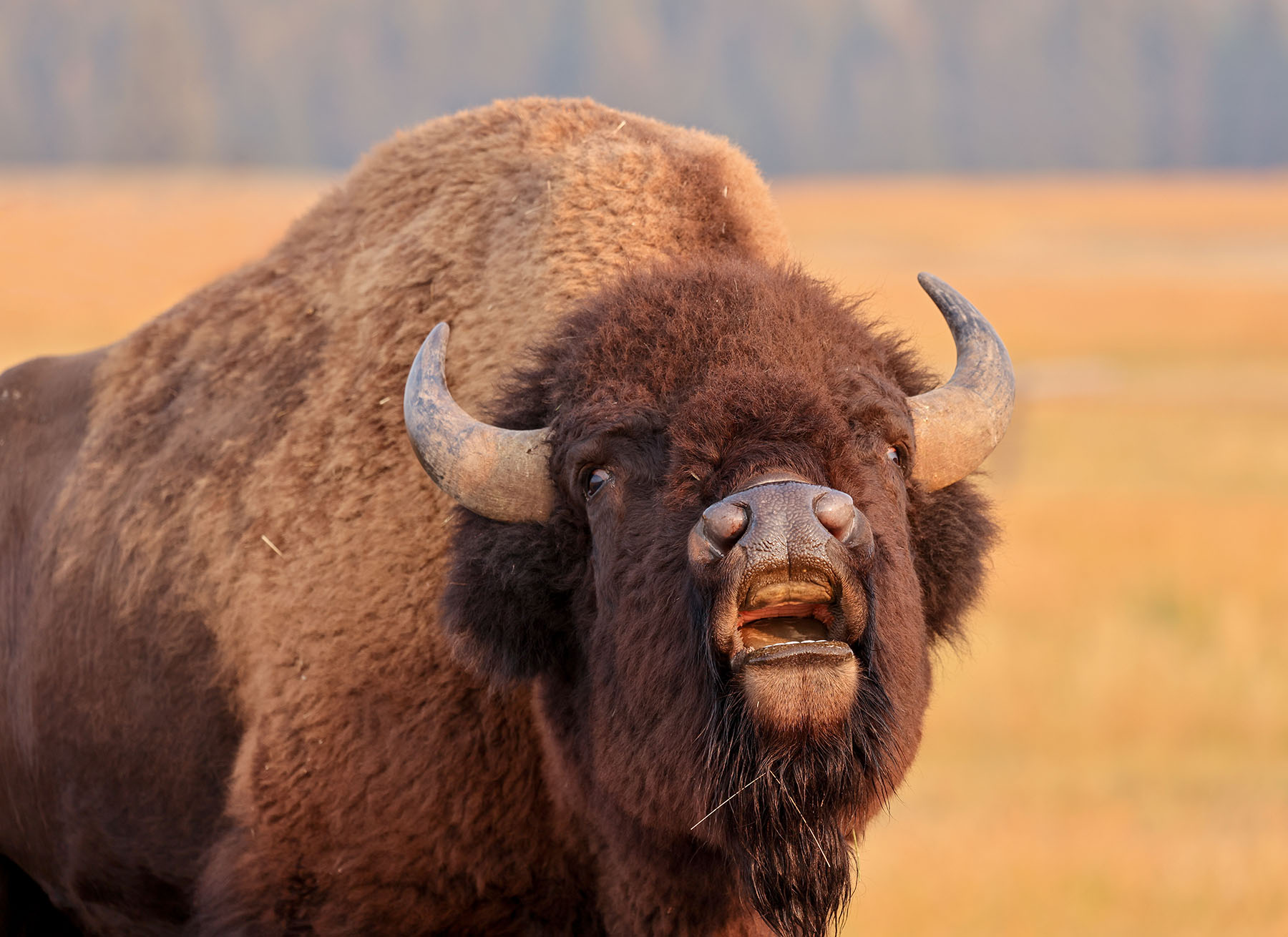

Wyoming’s wild bison are the first of the ungulates (hooved animals) to kick off the fall breeding season, or rut.
For bison, the rut starts in July, but really gets going in August and carries into September. At some 2,000 pounds, bull bison are the largest land mammals in North America.
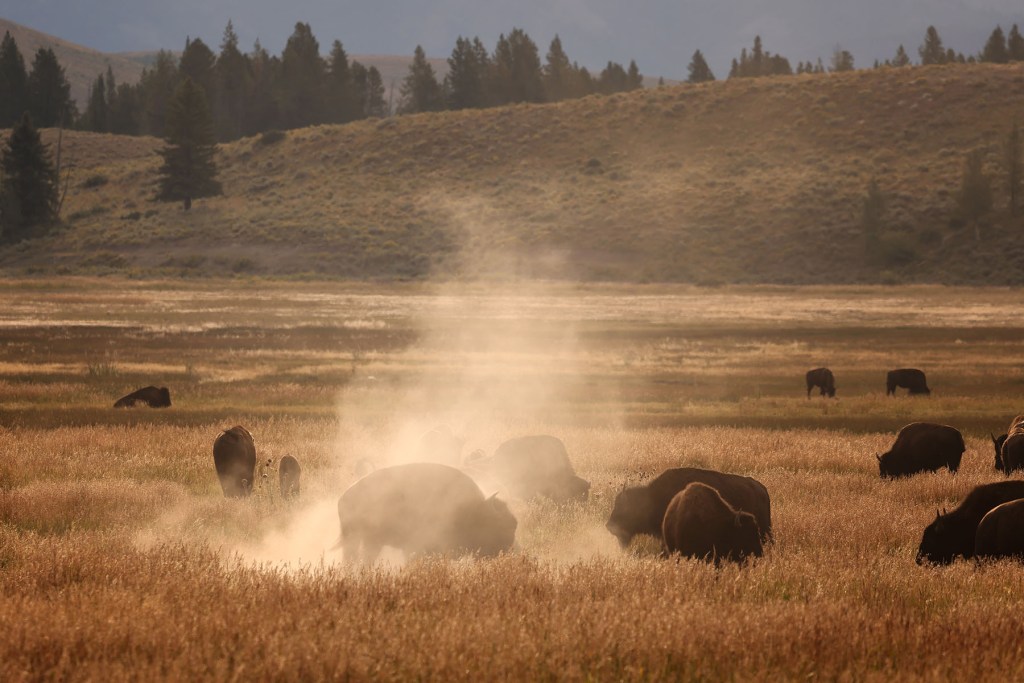
Watching these rutting behemoths battle each other, roll in the dust and incessantly chase the cows is truly an impressive sight. One might think the bison of Yellowstone and Jackson Hole are one big herd, but they’re not.
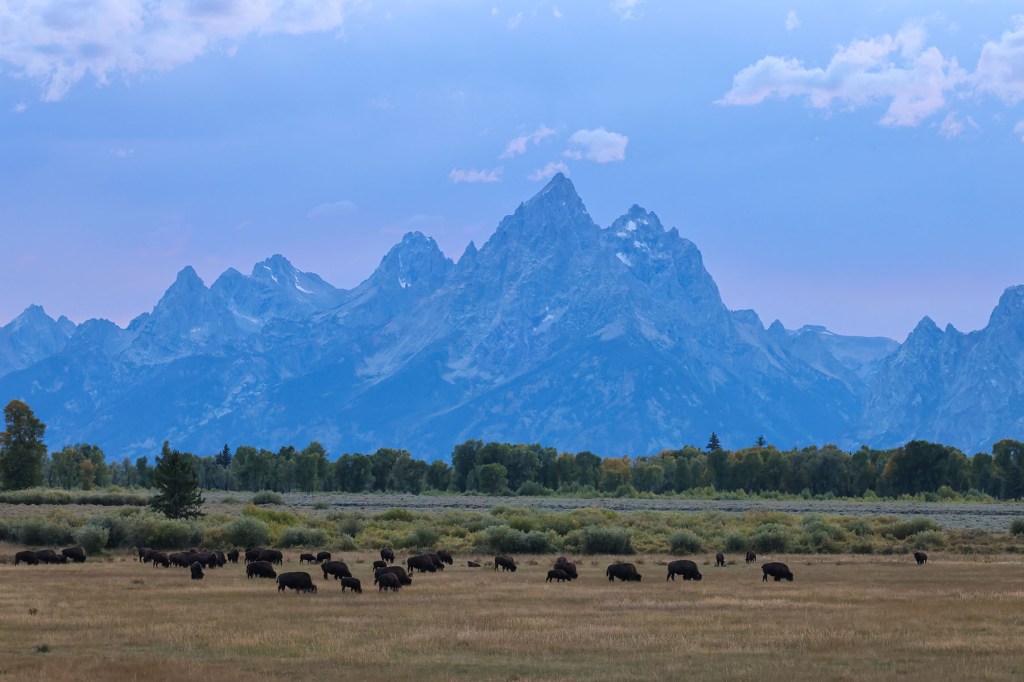
They are two distinct herds, with little interchange between them. The history of the Jackson Bison Herd is an interesting one.
Bison were native to all of Wyoming and several surrounding states, once numbering in the hundreds of millions. The decimation of bison across their expansive range throughout the 1800s has been well documented, and by the mid 1880s they were extirpated outside Yellowstone National Park.

Jackson Hole wouldn’t see bison again until 1948 when 20 animals were brought to a fenced enclosure called the Jackson Hole Wildlife Park west of Moran Junction, near what is known today as Oxbow Bend in Grand Teton National Park. The wildlife park was also a place for visitors to see elk, moose, deer and pronghorn antelope.

The breeding season for elk, moose and pronghorn typically begins in early to mid-September and runs through October. Deer generally start in November and bighorn sheep begin in late November into December.
It is reported that the bison would regularly escape their pen each year and have to be rounded up. In 1969, park officials decided to stop trying to round up the escapees and thus began the modern day free-ranging wild bison herd in Jackson Hole.
In 1975, it is reported that the bison discovered the National Elk Refuge at the southern end of the Jackson Hole valley, near the town of Jackson. Soon after, they would also find the supplemental winter feed that had been doled out for the free-roaming elk herd since the creation of the refuge in 1912.
Absent normal winter mortality, the bison population began to grow at a rapid rate. By the mid-1990s, the Jackson bison herd was approaching 1,000 animals. Bison were showing up on horse and cattle feed lines on private lands, sometimes goring livestock. Bison were also regularly having to be herded off the green grass of Jackson Hole golf courses and residences along the Snake River and in the town of Kelly. Bison numbers needed to be controlled.
As with all of Wyoming’s big game, recreational hunting was the desired tool of wildlife managers for curbing growth. And there was no shortage of hunters ready and willing to help bring numbers down.
However, through legal action, the Fund for Animals successfully blocked bison hunting on the National Elk Refuge until an interagency management plan was approved in 2007, which allowed for hunting on the refuge. By this time the bison herd had hit 1,200 animals.
Over the next several years, hunters would help managers bring the population back down to the desired population objective of 500, which is where it hovers today. Still, Wyoming is one of only a handful of places in the world with a wild, free-ranging bison herd for all to enjoy.
This article was spot on! On our trip in July of this year my son and I saw a lot of bison on Elk Flats. Keep doing the good and informative articles.
I often try to paint a mental landscape of the pre-Columbian era when interior North America had 30-60 million Bison ranging from future Texas to future sub-Arctic Canada, and all the way east to the Adirondacks and Appalachia. Frontier photographer Timothy Sullivan recounted in the 1970’s having to wait three days for countless thousands of Bison to amble past his wagon , stranding him near present day Miles City in eastern Montana before the Great Extirpation had ramped up.
An eyebrow raised here – that a former G&F specialist writes a retrospective about Bison in Wyoming and our two national parks without even a sideways glance at the Brucellosis aspect. The brucellosis bacterium evolved in Central Asia ( where it’s still abundant ) and made its way first to Spain , then Mexico, and was passed north by those over-romanticized cattle drives of western lore. Brucellosis was inserted into Bison ( and Elk , and us Hominids ) by the Stockgrower cattle barons. Neither B. abortus bacterium nor the Hereford Angus Corriente et al bovines that carried it were native to the Western Hemisphere. The Manifest Destiny that overwhelmed the American West in the 19th century perpetrated a great many ecological crimes against the entire planet that have not been fully rectified. The Bison and the Beaver and the Native American populations are all testament to that desecration , but it’s a long list. Recall that before pasteurization 11,000 people in or near the Midwest stockyards died in a single year from Undulant Fever, the human disease called brucellosis in animals.
North America was invaded by Europe over 500 years ago. Another of my mental Charlie Russellesque paintings or Tim Sullivan wet plates of the Rockies and Plains landscape 500 years in the future would show a view nearly devoid of humans by way of self-induced extinction ; the ruins of their once prideful cities ; millions of regenerative Bison and Elk grazing once again . Alongside them are the essential Griz and Grey Wolves apex carnivores whom also deserve to get their homeland restored.
We can so hope. Meanwhile , Yellowstone and Grand Teton preserves today are the long bridge from past to future. I’ve always wondered how that White Bison ended up on the Wyoming flag back during World War 1 …
There’s a small heard of Buffalo & wiid horses ai paynes prairie near Gainesville, Florida. The park is free & open to the public.
They were not numbering in the hundreds of millions. They were at their peak population when market hunters moved west having exploded with the lower native population due to diseases spreading north and east from Spanish conquistadors
Glad to see the bison have returned. I worked in the Park in 1960, the year I graduated from high school. There were few free bison back then. That fall I worked in Jackson Hole, small herds in controlled settlings. Good to see them running free.