

Draft legislation to create deregulated “industrial power zones” to attract large electric power-consuming clients such as crypto-currency miners failed to gain support from the Joint Minerals, Business and Economic Development Committee last week.
The Industrial power zones measure would allow for zones on state-owned lands that are deregulated. That means, industrial power consumers in those zones would pay only for direct costs and not help subsidize the larger power delivery system, as is the practice in a regulated market.
Critics worried that by removing some industrial ratepayers from the regulated system, rates would increase for the remaining customers. Opposition to the measure by both regulated utilities and electric co-ops helped defeat the effort by one vote.
“There’s not too many bills we’ve spent more committee time on … to try to make it into a bill that everybody could agree on, and we still are not there,” Sen. Jim Anderson (R-Casper) told fellow committee members. Anderson voted against the measure.
Another version of the bill, Senate File 71 – Deregulated industrial power zones, failed during the legislative session earlier this year.
Deregulation drive
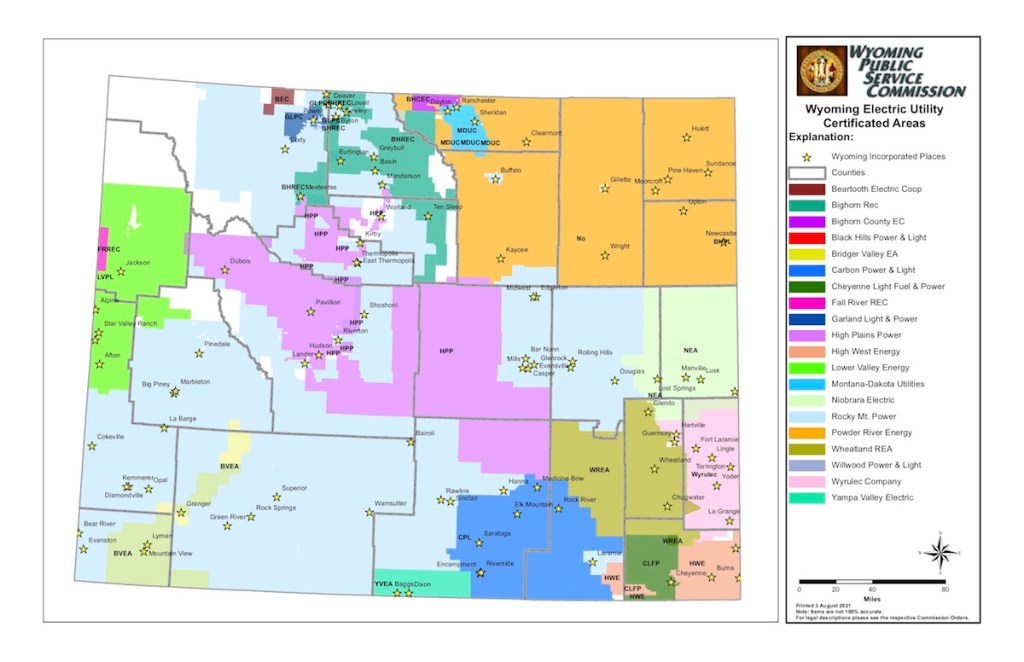
Monopolistic utilities are under the authority of the Wyoming Public Service Commission, which requires those utilities to provide low-cost, reliable electrical service in concert with environmental and safety standards. The regulatory system provides utilities — such as Rocky Mountain Power and Black Hills Energy — a guaranteed rate of return.
“If things are generally working pretty well, it may not make sense to fix something that isn’t broken.”
Tony Clark, utility market analyst
Wyoming ranks among the 10 states with the lowest electric rates in the nation, including for commercial and industrial customers, according to the U.S. Energy Information Administration. Yet those rates are not low enough for crypto-currency and bitcoin miners, who may require new, dedicated power generation, according to Sen. Chris Rothfuss (D-Laramie), who championed the industrial power zones measure.
Regulated utilities, Rothfuss said, would rather continue to export the bulk of their Wyoming-generated electrical power with a guaranteed rate of return rather than redirect portions of that power — or build new power generation facilities — to accommodate large power customers, which also include data centers and high-tech manufacturers.
“I’m not surprised that the regulated utilities don’t like this legislation,” said Rothfuss, who serves on the minerals committee and also co-chairs the Select Committee on Blockchain, Financial Technology and Digital Innovation Technology. “But at the end of the day, it doesn’t deny the need for legislation that tries to address what is not necessarily a common problem, but a significant problem, where we have large power demands and we don’t have a system that is readily adapted to those demands.”
Deregulation skepticism
Tony Clark, who served on the Federal Energy Regulatory Commission and is a former chairman of the North Dakota Public Service Commission, testified before the minerals committee last week for about an hour.
The reason crypto-currency miners might prefer deregulated areas of Texas and the northeast rather than Wyoming “probably has to do with things like available workforce and infrastructure issues and things like that, that are just available in more densely populated areas,” said Clark, now a senior advisor with the D.C.-based firm Wilkinson Barker Knauer.
Deregulation, even within limited zones, is a “high-risk, low-reward proposition” for Wyoming, Clark said, because the state already has utility rates that rank below the national average.
Several states deregulated utility markets in the 1990s hoping it would attract large industrial economic development. But 25 years later, “it really hasn’t changed much for those states,” Clark said. Nine of the 10 states with the highest electric utility rates have some level of deregulation. Some of those states, including Montana, now also struggle to meet peak demand, exposing customers to expensive spot-market prices, he added.
“If things are generally working pretty well, it may not make sense to fix something that isn’t broken,” Clark said.
The minerals committee last week also tabled Direct electric utility service agreements — another measure aimed at limited deregulation. Rather than deregulated zones, this measure would allow any electric power producer to sell dedicated power generation outside the confines of regulated utility rules to industrial customers regardless of where they locate in the state.

I wish someone could explain to me why Wyoming would want to encourage bitcoins, what seems to me like a giant Ponzi and tax evasion scheme, anyway.
I agree with Frank Hodge, anyone that encourages deregulation should just take a look at what happened in Texas when hit with that ice storm and with no way to bring in electricity off an external grid.
Hooray! Do not deregulate electric power, period. The regulations serve actual purposes, they are not arbitrary.
There are a significant number of large old oil fields in the Bighorn Basin and other basins in Wyoming that use large amounts of electricity. Because these old fields produce at high water cuts (over 90% water) and the individual wells have high daily fluid rates (100’s to several 1,000 BWPD), they move the water with very large electric submersible pumps set in the wells. I suspect all these big old oil fields would want to switch to the lower cost industrial electricity. I don’t know the answer, but it seems like allowing the oil fields to have the separate lower industrial electricity rates will drive up the cost for the remaining rate payers. Of course that will make marginal wells moving lots of water more economic and ultimately result in more oil revenue for the state because it will extend the life of these wells.
Electricity cost is a big issue for these high water cut oil fields. Merit Energy recently built an electric generating plant at Oregon Basin in Park County to produce their own electricity using natural gas from the field. As an aside, the timing in retrospect was poor since the price of natural gas went from being extremely low for a long time to now being very high.
You’ve stated the problem. However, deregulation is not a neutral solution. Texas demonstrates why regulation of electrical power providers is needed. Find anothe solution. How about nuclear power?