

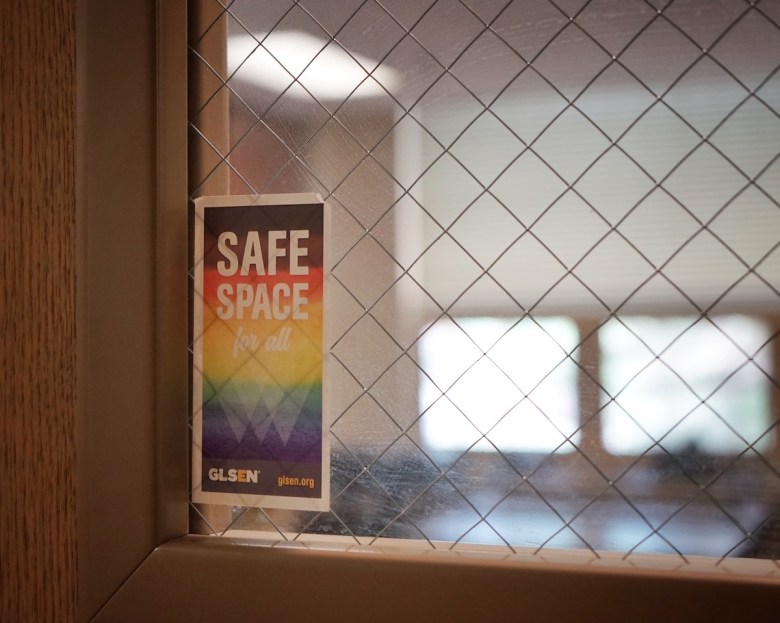
Wyoming school districts and community interests have clashed for several years over gender identity policies and parental rights.
Opinion
That’s not likely to end soon, despite a federal judge’s well-reasoned decision last week to dismiss a lawsuit filed by parents against a Sweetwater County school district that respects student requests to use their preferred name and pronouns in school. Under the policy teachers do not discuss the issue with parents unless they ask.
Lawmakers in Wyoming have passed several controversial gender-related bills, including a ban on transgender girls competing in sports against cisgender girls, and prohibiting gender-affirming health care for transgender minors. It’s part of a concerted far-right crusade to limit the rights of transgender youth.
At the heart of the Sweetwater County case is the important legal question of whether school districts must notify parents about changes in their child’s preferred name and pronouns. The “well-being” of children is typically cited, no matter what action is advocated.
In 2023, Rock Springs parents Ashley and Sean Willey filed a civil rights lawsuit against Sweetwater County School District No. 1, alleging it violated their rights during the 2021-22 school year by withholding information about their child’s request that the high school’s teachers and staff use a preferred male name and pronouns.
The parents accused the district of keeping that news from them by continuing to use the high school student’s gender assigned at birth in their presence, while using the teen’s preferred name and pronouns in school.

U.S. District Judge Scott Skavdahl, dismissing the lawsuit and ruling in the school district’s favor, explained why the parents’ rights weren’t violated.
“A respectful and nondiscriminatory school environment is a legitimate state interest,” the judge wrote. “Referring to students by preferred names and even declining to proactively inform parents to respect a student’s choice are both rationally related to that interest. Thus, the district policies and staff members’ actions pass constitutional muster.”
It’s a profound conclusion that has been voiced in other states, including a 2022 Wisconsin case that kept a school district’s policy intact. The Wisconsin ACLU said in an amicus brief that outing children to their families could be dangerous because one-third of transgender children are rejected by their families after coming out.
According to the Human Rights Campaign, 22 states and the District of Columbia have laws requiring schools to provide non-discriminatory environments in which students can safely express their gender identities. Unfortunately, Wyoming is not one of them.
Skavdahl dismissed all of the parents’ claims, including a separate allegation that Ashley Willey, a special education teacher at another Sweetwater County school, said she didn’t follow the district’s policy to use students’ preferred names and pronouns but was never disciplined or retaliated against for her decision.
Still, she maintained the policy itself violated her rights to freely exercise her religious beliefs as a parent and as a teacher. Willey claimed the district’s failure to proactively inform her about her child’s gender identity changes interfered with her religious beliefs because it kept her from information she needed to counsel her child.
That’s a heck of a stretch, and Skavdahl noted why it’s out of bounds.
“A person’s constitutional right to freely exercise their own religious beliefs does not require that the state also exercise those same religious beliefs,” the judge wrote. “To conclude that the district’s failure to act in accordance with plaintiff’s religious beliefs is a constitutional violation would turn the First Amendment on its head.”
The Willeys asserted parents have a right to make decisions about their children’s well-being, including their physical and mental health. The judge agreed, but added there is a “laundry list of circumstances that could affect a child’s ‘well-being’ even in the slightest that would require constant, detailed information sharing from the school, with constitutional consequences.”
The judge noted the school district “merely respected” the student’s voluntary choices, didn’t withhold information from the parents, and when the Willeys sought it, the information was provided. Skavdahl added the district didn’t require the child to go by a preferred name or pronouns, or “discourage students from discussing their gender identities with their parents.”
The Willeys contended teachers facilitated the student’s gender transition socially, and invalidated the parents’ right to make medical decisions for their teen. But Skavdahl wrote there was no evidence the school provided any type of medical transition or social transitioning, “and defendants were not involved in changing the student’s clothing or hairstyle.”
I don’t think parents should blame the school district or teachers for not voluntarily providing answers to every question they have about their child, including gender identity. Educators are frequently reminded by parents that while they are paid to instruct their child during school hours, parents are primarily responsible for their well-being, medical needs, instilling religious values, etc.
I find it improbable that a parent who may question a change in their child’s appearance or behavior can’t pick up some clues from observing their interactions with others, including family members and friends. Skavdahl is correct: parents are entitled to information about their children from educators, who must honestly answer these questions when asked.
But if teachers and staff are required to identify every change in a student’s “well-being” and notify each parent, not many lessons will be taught.
I have other concerns about how courts will handle future school gender identity cases. The Willeys’ lawsuit took two years to be dismissed. The parents, as is their right, will appeal, according to their attorney.
I think it’s fair to say that across the country, the extreme right’s anti-trans campaign has picked up speed, particularly under President Donald Trump’s new administration, and public support is unfortunately waning for school district policies protecting students’ gender identities.
How this will play out in the courts is anybody’s guess. Last May the U.S. Supreme Court declined to take up a case about a Maryland school district’s policies to support transgender students and when parents may challenge them. But the high court declined it because the parents who sued did not have standing, not because of the case’s merits.
Several conservative groups and 17 red states filed a friend of the court brief, arguing “parents must have the right to ask for the court’s help in securing the fundamental right to know what schools are doing with their kids.” What will the conservative court do when a similar case isn’t dismissed for technical reasons?
In another Maryland case the U.S. Supreme Court heard last month, justices’ questions seemed to overwhelmingly favor allowing parents to opt out their children from language arts lessons that included LGBTQ books.
A Politico article took a stab at predicting how the high court will weigh the interests of transgender or gender-nonconforming children and “their public school protectors versus parents’ interests in making decisions regarding the health care, education and upbringing of their children.”
“It is easy to see where the trajectory is going,” Politico concluded. “Conservative ‘values’ will probably win.”Does a thoughtful ruling like Skavdahl’s stand a chance to prevail at a higher level? It deserves to and it’s a victory worth celebrating in Wyoming, but I too have little faith that in the end Trump’s conservative Supreme Court majority will allow that to happen.

Reading this reminds me of Lindsey Graham asking MS. Ketanji Jackson to define a woman? With AOC as your only hope MR. Drake, making Socialism Great Again may be a steep climb! Thank you Matt, well said!
So nobody even talked about this issue until the 🍊airhead made it an issue
Why does it matter. We should not harass anybody based on race, creed, color, sex, national origin, age, ancestry or handicap or any other physical or mental
Condition that makes them a little different . We are all the humans.
My only other comment is that parents need to parent. From what I have read on this case is that these parents had no idea what their child was doing. When they found out, they should then love that child.
“Gender Affirming Care” is just a warm and fuzzy name for “pseudo Sex Changes.”
There is no such thing as a ‘transgender/transsexual’ person until science finds a way to effectively, safely, and ethically rewrite a person’s DNA to become the opposite sex. In the meantime we have GDM’s (Gender Dysphoric Males) and GDF’s (Gender Dysphoric Females) for what I suspect is a tiny minority of the population that truly suffer from gender dysphoria, and there are PF’s (Pseudo Females) and PM’s (Pseudo Males) for the vocal group pretending to be the opposite sex for whatever reason.
Parents need to recognize that kids at different ages explore things to gain an understsnding or just try it out. If you are an interested and engaged parent you are aware of what you kids are doing . To attempt to place the responsibility for that knowledge on someone else is not parenting. Take a parenting class and learn about communication and involvement. The insight into your kids will be much better and you won’t depend on someone else to be there for your kids.