

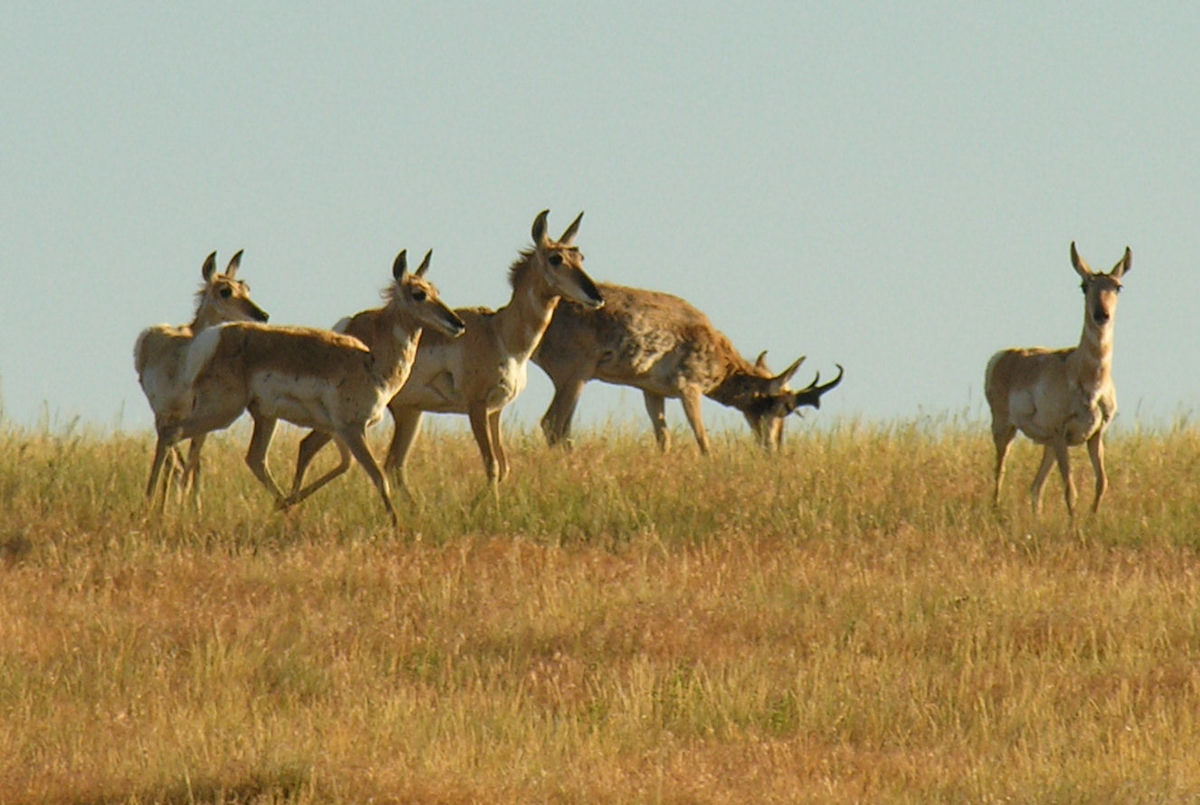
In an apparent response to pressure from Wyoming officials, federal land managers are stepping back from outright preservation of ungulate migration corridors and toward the state’s policy, which is more permissive of development.
The Bureau of Land Management last year proposed protecting the state’s first officially designated, and perhaps best known, migration corridor as an ‘area of critical environmental concern’ — a plan that would allow no surface disturbance along the route mule deer travel from the Red Desert to the Hoback River basin and well beyond.
Gov. Mark Gordon and his staff weren’t fond of that approach, which the BLM outlined in the preferred alternative of its controversial draft Rock Springs Resource Management Plan. Wyoming should “have the lead” on migration corridors, Randall Luthi, then Gordon’s chief energy advisor and now his policy director, told WyoFile last winter.

“Lead means [we] go through the designation process,” Luthi said. “BLM and other federal agencies should fall in line with that.”
At a meeting last week in Rock Springs, BLM-Wyoming Director Andrew Archuleta hinted that Wyoming would get its wish.
“Within the draft Rock Springs RMP, there was a nomination to designate this corridor as an [area of critical environmental concern], but that creates some difficulties for us,” Archuleta told members of the Wyoming Legislature’s Select Federal Natural Resource Management Committee.
The migration path primarily crosses two field offices: Pinedale and Rock Springs. There’s no area of critical environmental concern in the Pinedale field office (where the resource management plan is not up for review). Adding one — such a designation could have prevented gas drilling, or road building — in the Rock Springs office would create inconsistencies in management, he suggested.
“Our priority is supporting what the state is doing … or does or doesn’t do with their process,” Archuleta said.
Archuleta spoke during a discussion about Wyoming’s in-the-works Sublette Pronghorn Migration Corridor, a section of which punches through the Gros Ventre Range to Jackson Hole and is known as the “Path of the Pronghorn.” BLM’s draft Rock Springs RMP doesn’t address the proposed pronghorn path, which — like the deer migration — also winds through two field offices. The agency’s draft planning document does, however, currently propose an ACEC on 224,000 acres of the 150-mile-long Red Desert to Hoback mule deer migration corridor.

Brad Purdy, BLM’s deputy state director for communications, told WyoFile he doesn’t think that it’s fair to characterize the removal of a proposed ACEC designation as a change of course.
“A draft RMP is just that: A draft RMP,” Purdy said. “I’ve said it a million times, and everybody’s tired of hearing it, but … all alternatives and all aspects of all alternatives remain on the table until BLM issues that decision.”
The BLM plans to release a final environmental impact statement and draft decision on the Rock Springs RMP “later this summer,” he said.
The BLM’s draft environmental impact statement contained an option — Alternative D — which called for copying the state’s migration policy, which is being used for the first time since a 2019 overhaul. The Wyoming governor calls the shots under that executive order. Wyoming’s migration policy does not afford blanket protections to corridors like the area of critical environmental concern destination would have in BLM’s draft resource management plan.
“The executive order only applies to the stopovers and the high-use areas,” Game and Fish Deputy Chief of Wildlife Doug Brimeyer testified to the Wyoming Legislature’s Select Federal Natural Resource Management Committee.

Where it applies, Wyoming’s policy does not necessarily preclude development but can be used to inform and influence where and how infrastructure is sited. It’s only completely prohibitive of development in the tightest portions of migration corridors, called bottlenecks. To date no developments have been proposed in official bottlenecks, though a gas lease was OK’d in bottleneck of the not-yet-designated Path of the Pronghorn. As of late last year, all of the roughly 60 developments proposed in designated migration corridors — some of which are in stopovers and high-use areas — have been vetted and allowed to proceed.
Because of the permissiveness, some environmental advocacy groups are urging BLM to keep with its plan to go above and beyond Wyoming’s policy in some manners.
“Managing to support the unimpeded movement of big game herds is a complex endeavor — it’s going to take science-driven policy and complementary state and federal management,” Julia Stuble, Wyoming manager for The Wilderness Society, wrote in an email.
In a follow-up conversation, she pushed for BLM policy that leaves stopover areas and high-use sections of corridors completely unscathed.
“We believe that the research shows us those are the needs of the migrating animals: There needs to be some areas where they don’t encounter development,” Stuble said.
While it remains to be seen if BLM emulates Wyoming’s migration policy, at least one lawmaker is encouraging the state and federal agency to work together to figure it out.

An upcoming step in the labyrinthine process of designating the Sublette Pronghorn Migration corridor is the creation of a stakeholder group. At the Select Federal Natural Resource Management Committee meeting, Rep. Scott Heiner (R-Green River) called for including the BLM in the effort.
“We have been advocating for a seat at the table with our federal partners to be able to participate in management of public lands, and I think that street goes two ways,” Heiner said. “Just as we need to have input from private property [owners] … I feel like it’s important that we have input from those that administer the public lands, so that they collaborate and they agree.”
The comment was directed at Luthi, who was initially resistant.
“Historically, we as a state have been pretty adamant that management of wildlife is a state function,” he said. “You might say I’m a bit ornery about that.”
Luthi later came around to Heiner’s idea to include the BLM in its migration planning process. He noted, however, that federal law might not allow it.

Very short sighted of the agency to back off on protections for this critical migration corridor. Most of the pushback was totally unwarranted and based on misinformation about what was actually in the preferred alternative. Sad sign of the times that people would get so upset about something based on hyperbole, rather than make the effort to really understand the rationale behind the BLMs decision. Let’s hope we don’t lose one of the last great intact migration routes in North America because the public didn’t understand what was being asked of them. And make no mistake, all that was being asked was to simply leave it as it is.
The BLM has gotten itself into a sticky situation. Major Federal actions require an EIS or other decisions which are commonly documented in Record of Decisions. The problem here is that the BLM originally approached the migration corridor issue as a component of the rock springs RMP revision, that is, the migration corridor issues would be resolved by an open public participation process. Now it appears, the BLM has apparently removed the migration corridors matter from consideration within the Rock Springs RMP revision and implied that it will be resolved by political pressure from the State of Wyoming. The State of Wyoming has a legitimate argument here but it is normally approached by the State acting as a cooperating agency and submitting the State’s opinions and alternatives via an open public review process – along with thousands of other letters from interested parties. So am I right – did the political pressure process prevail?? This wasn’t the intent of congress when NEPA and FLPMA legislation was enacted – the legislation established a well known process and path to determine natural resource issues on Federal lands. This article did not adequately address whether or not the BLM has formally entered some form of Record of Decision in the public record explaining why they reversed course – but what could they say – we reversed course due to political pressure??? This approach appears to me to be wide open for review by the courts – BLM should have stayed with the RMP revision process especially since the Final RMP is due out in a few months. Imagine what FOIA requests would uncover concerning this about face or what testimony would come out during Federal court hearings. I may be wrong ( again ) but I feel uncomfortable with this turn in events.
I concur with Harvey.
Let the state control the migration corridor and in a few years the issue will be moot. There will be no more muleys to migrate. Problem solved.
Wildlife and their migration corridors are a vital resource in Wyoming and we should be fully committed to the protections of these resources. It would be a mistake for the BLM to back off on protecting the migration corridor for mule deer from the Red Desert to the Hoback River Basin. If the state is given full or partial reins to control the migration corridor, there is no guarantee that policies won’t change to favor energy development. And once concessions are made and energy development starts, the damage to a migration corridor would be difficult, if not impossible to undo. My vote is to fully protect the corridor now through more BLM action and not risk losing a critical wildlife resource through state actions from which there is no return.
Wyoming does manage most of the wildlife in Wyoming; however, habitat is managed by the owner of the surface estate, That is, private land owners manage the habitat on their land, the State manages habitat on school sections, the tribes manage habitat on their reservations and the Federal agencies manage habitat on Federal surface ( usually USFS or BLM ). Migration corridors across BLM lands in SW Wyoming are habitat management not actual management of the critters. Therefore, migration corridor decisions and policy are primarily a Federal matter on BLM land supplemented by recommendations and best available science provided by Wyoming Game and Fish. The BLM is well within their authority to manage habitat on their surface estate – the State of Wyoming should only provide input and not try to control decisions about migration corridors on BLM Federal surface estate – the State can and should have primacy over migration corridors on State school sections though – and, private landowners have primacy over migration corridors and habitat on their surface estate subject to any county imposed land use restrictions such as land use plans and any legislative adopted regulations of which there are probably none.
Well it’s business as usual for the BLM. Forget the science, just ask the oil and gas industry and ranchers what a migratory corridor should look like.
Considering the long range health and well-being of Wyomings wildlife nothing is more important than protecting migratory corridors for wildlife.
Look how small and how few the actual tracts of State Land show on the large area migration map. A miniscule percentage, nearly all comprised of the 2 single square mile ( 640 acre) sections of state land arbitrarily deeded to the state inside every 36 square mile township way back when. I would think the State of Wyoming’s authority over any of this begins and ends on those State lands. The real problem here may be ridiculous maps drawn by clueless bureaucrats in ~1890.
Sidebar: Perhaps Wyoming should start working on a long term 1-for 1 swap with the BLM of those scattered disparate state sections to better consolidate land management , by entity.
I agree Harvey. What is best for the animals is best for Wyoming in the long run. Fossil fuels will ruin this state, there is a direct correlation between energy extraction and habitat thus animals – it is inverse.
I guess the Freedom Caucus claims of the Feds “War on Wyoming” sadly extends to our wildlife also. However, we all know the that the hypocritical Freedom Caucus, who no doubt supports development in these critical migration areas, will in no way applaud the decision by the feds overrule the state in this case.
The feds should not defer to the state regarding management activities on federal land. This is BS!
The feds should tell Wyoming officials to take a hike. If the state had its way, every square inch of land in the state would be developed, or plundered. If the story is true, then my opinion of the Department of Interior is even lower than before. The only good thing is that over-breeding, that has led to overpopulation will rid the planet of us, sooner than we may think. Hopefully there will be some water and feed and cover for the poor creatures we have decimated during our gruesome “reign” as top species. We monkeys are just more evidence that there is no god…
Amazing how clueless people are to how the animal migration in Wyoming works! You can go to any rig site or field and see the animals laying around the machines, I have lived in a mule deer, antelope and elk corridor for 30 plus years, and the biggest problem Wyoming has is predators and highways
https://cowboystatedaily.com/2020/01/22/energy-development-part-of-complex-problem-in-wyo-mule-deer-decline/
Study on the impact energy development has on mule deer population.
https://onlinelibrary.wiley.com/doi/10.1111/gcb.13711