


JACKSON—Visitors to Grand Teton and Yellowstone national parks left more than 500 comments in response to a Department of the Interior call for feedback on signage that disparages American history.
None of those comments, collected between May 2025 and January 2026, expressed concern about history being represented in a biased way.
“What I saw in the comments that were specifically on Grand Teton were overwhelming support for the history exhibits, and even additional information,” said Allison Michalski, the National Parks Conservation Association’s senior program manager for Grand Teton.
The comments left at Grand Teton and Yellowstone were a small portion of 35,000 comments released in late May through a lawsuit brought against the Interior Department by the Sierra Club. The goal was to gain access to the comments via a public records request.
The saga that led to the collection of comments began more than a year earlier.
In March 2025, President Donald Trump issued an executive order titled “Restoring Truth and Sanity to American History.” The order sought to remove materials that “inappropriately disparage Americans past or living” and to instead “focus on the greatness of the achievements and progress of the American people.”
Interior Secretary Doug Burgum released a follow-up secretarial order in May 2025, ordering that parks post signs with QR codes for visitors to use to report negative information and history and establishing a process for reviewing materials. In Yellowstone and Grand Teton, comments began rolling in around mid-June.
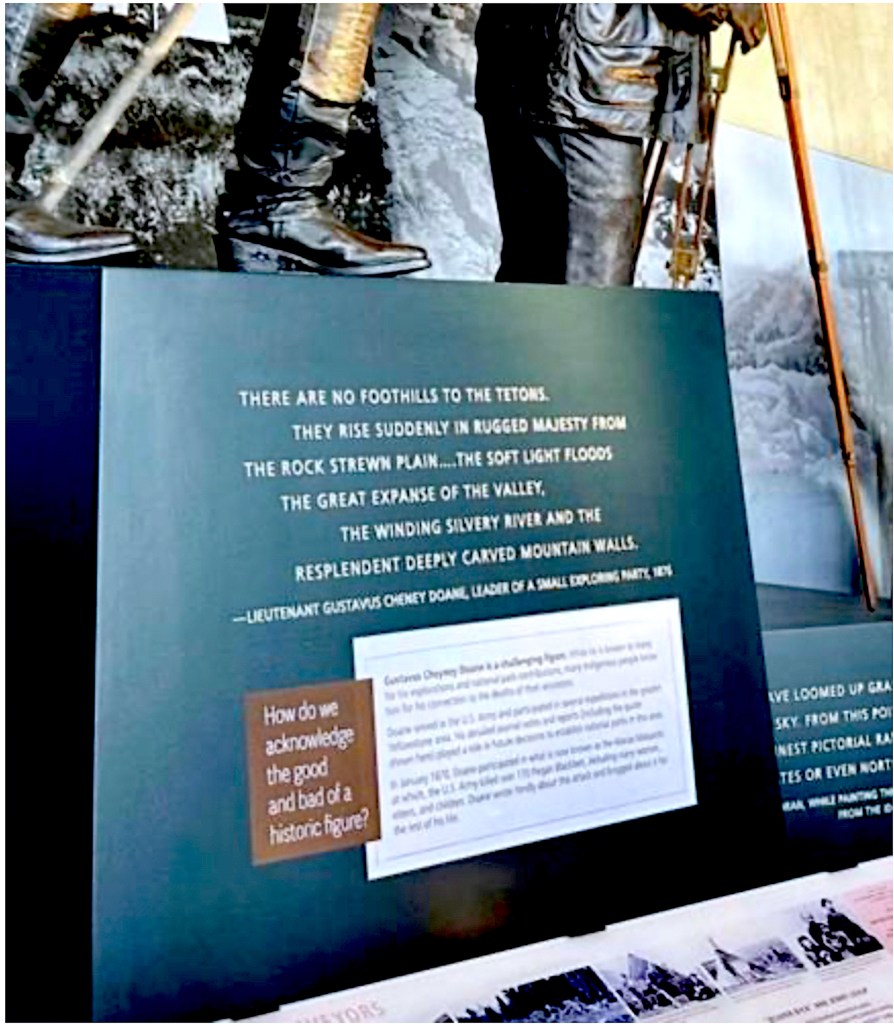
Burgum’s order also instructed park staff to flag any materials that may be misaligned with the department’s priorities for interpretive materials. The National Park Service subsequently removed materials at several parks, including a sign in Grand Teton that included details of how an explorer depicted in the Craig Thomas Discovery and Visitor Center participated in, and bragged about, a massacre of Native Americans. That sign was removed sometime before Jan. 28.
Yellowstone did not have any interpretive materials removed, said Michelle Uberuaga, the National Park Conservation Association’s Yellowstone senior program manager.
The issue of interpretive materials in the parks has reemerged in recent weeks, as litigation filed in response to the federal government’s actions to remove historical materials winds through the legal system.
On Friday, about two weeks after the comments left at parks were released via lawsuit, a federal judge in Massachusetts ordered the National Park Service to restore and reinstall any materials that have been removed since May 20, 2025. The order also prohibited the removal of any other interpretive materials while litigation is pending.
That order came as part of a lawsuit filed by the National Parks Conservation Association and other organizations against the Interior Department in February.
The Interior Department will have to report to the court the steps it has taken to comply with the order. The department also will be required to provide the court weekly status reports on compliance with the order thereafter.
Judge Angel Kelley of the United States District Court for the District of Massachusetts cited the comments collected via a QR code in her order.
“Tens of thousands of public comments submitted through QR codes at park sites have criticized the Defendants’ actions, demonstrating that these materials instead promote the public’s ability to form stronger connections with park resources,” she wrote.
The department does not plan to back down.
“The ruling is from a Biden appointed judge,” an Interior spokesperson wrote in an email. “The department is looking at our appeal options.”
Colorful comments
The signs posted at national parks solicited feedback on areas that need repair and services that need improvement. They also ask for intel on “signs or other information that are negative about either past or living Americans” or that “fail to emphasize the beauty, grandeur and abundance of landscapes and other natural features.”
Commenters were taken to a page that allowed them to categorize their comments into those three categories, or about “something else.”
Commenters were given a generous 10,000 characters with which to express their thoughts.
Yellowstone netted 324 comments and visitors in Grand Teton left about 202, a small percentage of the millions of visitors who visited in the eight-month period.
Most expressed frustration with the administration’s public lands policies, including the attempt to revise signage and other interpretive materials, staffing cuts and proposed budget cuts. The comment period coincided with last summer’s proposed public lands sale in the U.S. Senate. Though the proposal would not have impacted national parks, many comments included concerns about that as well.
Some used colorful language, including profanity, to express their grievances.
Parks advocates were not surprised to see unanimous support for the national parks and their staffs.
“Yellowstone has done different use surveys in the past and it is overwhelming that people are having very positive experiences,” Uberuaga said. “I think putting QR codes out just gave people the opportunity to say that.”
Commenters, specifically at Grand Teton, reported positive interactions with staff, in conversations, Junior Ranger programs, on ranger-led hikes and at ranger talks. At least 11 comments referenced positive experiences at educational programming, on topics including wolves, bears, geology, astronomy and anthropology.
“For the public, those rangers are not only critical protectors of those resources, but they’re also keepers of the stories,” Michalski said.
The comments included a small number of critical comments about other aspects of park operations. Two comments left at Grand Teton criticized bathrooms, including those at the Colter Bay Campground and vault toilets generally. Another comment, however, specifically shouted out the park’s “very clean” bathrooms.
Two comments left at Grand Teton also expressed concern about traffic in the park and suggested using buses to relieve congestion.
“Traffic jams are taking away the pleasure and serenity of park visits,” one commenter wrote. “Some interventions must be put into place.”
A few other comments complained about not seeing moose and bears where they were supposed to be, though it’s unclear whether they were tongue-in-cheek.
Some Yellowstone commenters believed the impacts of last year’s layoffs are noticeable.
“There are less rangers to control things and it feels chaotic in the park,” one commenter wrote.
Another wrote that, of all the parks, Yellowstone “feels like it needs double the staff.”
Uberuaga does not think that impacts to park staffing have impacted the visitor experience.
“I really would expect visitors to get to have a positive experience that is fairly normal,” she said. “It’s all the behind the scenes stuff that I think is where people are hurting.”
Ongoing suit
The lawsuit over the removal of materials in the park is still in its early stages.
Kelley, the federal judge assigned to the National Parks Conservation Association’s lawsuit, ordered the reinstatement of the materials on the belief that the plaintiffs are likely to succeed in court. Their arguments opposing the department’s actions include that they were arbitrary, against the law and an overreach of its authority.
The judge found that the department’s explanation that it could not disregard the president’s executive order did not constitute rational decision-making.
Kelley also found that the actions, if not halted while litigation is pending, would cause “irreparable harm.”
The Trump administration argued that the harm was not irreparable, as evidenced by the fact that the plaintiffs took several months to seek a temporary suspension of the policy. That policy had been in place since May 2025, and the plaintiffs did not request the suspension until March 2026.
Kelley found that the plaintiffs’ actions were not unduly delayed, given that the department did not ramp up its efforts at removing exhibits until early 2026. She ultimately favored the plaintiffs.
The order degrades “the public’s trust in the government, as the Executive Order ignores congressional directives and carelessly razes decades of efforts in the pursuit of its unilateral agenda,” she wrote. “These harms are, in all senses of the word, irreparable.”
The Interior Department, for its part, maintains that the order was not intended to whitewash or erase history.
The order directed a review of material “to ensure parks tell the full and accurate story of American history, including subjects that were minimized or omitted under the Biden administration,” a department spokesperson wrote in an email.
That includes slavery and the treatment of Native Americans, the spokesperson said.
The point of the order was to identify materials and signage that might “warrant clarification,” according to the spokesperson.


If they truly wanted clarification on the signage, why did they remove rather than replace? Or are the replacements slated to be installed AFTER the opposition finds another hill to die on? Quietly erasing/ whitewashing history when everyone turns away?
History that our ancestors (as a country) were involved in IS our history, whether we were on the right or wrong side of it. If we hange how it gets interpreted so it sounds more positive … how do we learn from our mistakes? People generally learn more from mistakes than they do success. Let us learn.
As a retired historical interpretive NPS ranger, and a graduate of UWyo. I wish the impact on Ft Laramie Nat. His. Site was included. Also a statement that no previous administration has ever tried to dictate interpretation. Interp. Ideas/ materials/signage are created from the latest science, historical research and what is relevant to the public. Lastly, the admin. exempted rangers from rifs only due to public pushback. However they can’t do their jobs without the behind the scenes folks. But Great article overall.
The hypocrisy of saying orders were “to ensure parks tell the full and accurate story of American history, including subjects that were minimized or omitted under the Biden administration,” is astounding! The rump administration WANTS the full and accurate story of American history REMOVED! Also, most of the signs in national parks have been there far earlier than the Biden administration. The MAGA’s have made Biden (and Obama) the ultimate boogieman! It’s just all so ridiculous!
Agree!
The orange menace and his minions (Barrasso, Lummis, and Hageman to name a few) are against public land and are trying their best to destroy it and change history. The demise of the roadless rule is another example of these grifters attempt to over ride the public will. History will not be kind to them.