

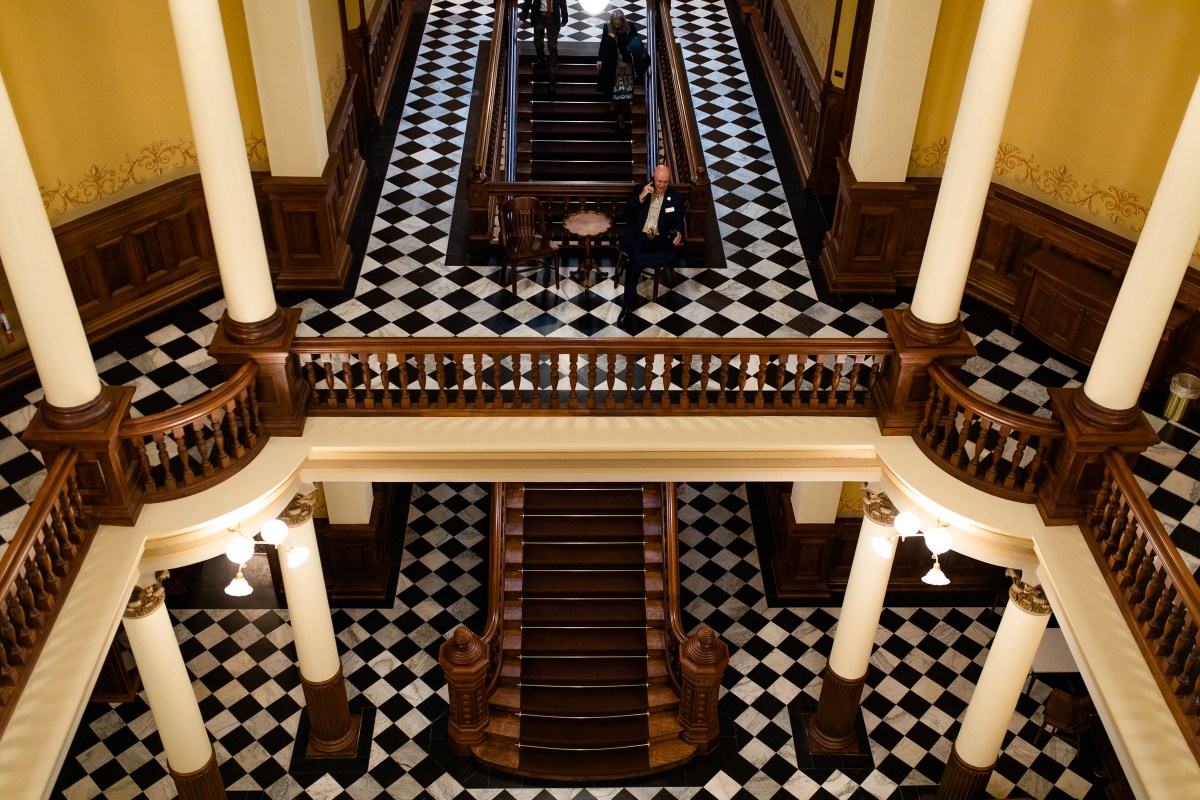
Lawmakers reversed course Thursday on a policy to restrict photo- and broadcast journalists from the halls that run next to the House and Senate floors in the Wyoming Capitol.
The Select Committee on Legislative Facilities, Technology and Process voted unanimously against a recommendation to the Management Council it had previously supported.
Committee Chairman Sen. Cale Case (R-Lander) — the lone Republican to vote against the measure in September — agreed to put it on Thursday’s agenda after Sen. Dan Laursen (R-Powell) had requested the chair do so.
“There’s quite a lot of chatter out there in the media that we’ve taken away a big item for them to be able to be on the floor taking pictures,” Laursen said of his request.
Sen. Chris Rothfuss (D-Laramie) also described feedback he’d heard after his original decision.
“I was not a strong supporter. I was just a supporter,” Rothfuss said. “I thought good arguments were made in favor of this policy change, and we didn’t hear a lot of objections at the time, so I was comfortable making this policy recommendation.”
There was no opposing public testimony at the committee’s meeting in September, and the 6-2 vote in favor of the policy mostly flew under the radar until an October WyoFile report.
“Since that time, obviously there have been serious concerns that have been raised, and I don’t think the value of this policy change rises to a level that justifies overcoming the concerns that have been raised,” Rothfuss said before making a formal motion to reconsider the recommendation.
Legislative leadership made the original call for a media-policy change, citing increased traffic in the hallways as a problem. The policy would have eliminated the opportunity for journalists to gather eye-level images of lawmakers at work in each chamber, relegating documentation to more removed galleries above.
Discussion and testimony
Laursen offered a couple of suggestions to the committee as potential compromises. One would have allowed access on select days during the session, another would have involved the Legislative Service Office taking photographs for media use.
But neither of those were adequate, Case said.
“Although I appreciate it, I don’t think that we can think in our minds that having our own staff produce internal photos is somehow a substitute for press photographers being able to look and compose and think and try to tell a story and try to convey what’s happening,” Case said.
“I think some of the most dramatic images that come out for our people are the non-special times, you know, the late night when somebody’s still there and catching that image,” Case said. “I mean, that’s news, and that’s the drama of the Legislature.”
The LSO credentials between 50 and 60 journalists each session — a designation that provides a media badge and access to a basement media room. Photographers make up a very small portion of that number, LSO’s Anthony Sara told the committee.
Meanwhile, the total number of journalists who cover the entirety of the Legislative session in person has hovered between six and 10 in recent years.
“We don’t have people piled on top of each other and taking photos at those doors [in the hallways],” Sara said, reiterating comments LSO’s Matt Obrecht made earlier in the meeting.
“It’s usually one or two at a time. It’s, like I said, self-policing. They’re, as far as we know, courteous to each other,” Sara said.
“Well, if it ain’t broke, why are we fixing it?” Rep. Dan Zwonitzer (R-Cheyenne) responded before opening the meeting up to public comment.
WyoFile’s Chief Executive and Editor Matthew Copeland was the sole public commenter at Thursday’s meeting.
(Disclosure: Copeland did not report on, write or edit this story.)
“It’s been argued that the Legislature can with its cameras and microphones provide the requisite transparency itself. It cannot,” Copeland said. “By focusing solely on active speakers, chamber-mounted cameras miss more than they capture. They omit, for example, all of the context happening around the individual microphone — who’s huddling together in the corner, who’s bouncing their leg in agitation, who’s furiously scribbling notes, who’s nodding in approval or shaking their head in opposition, who’s busy texting on their phone.
“The people of Wyoming have a right to know,” he said.
The committee voted 6-0 against recommending the policy to Management Council.

Great job, WyoFile, shining a light on this issue.
Thank God, somebody has some common sense. “If it ain’t broke, why fix it.” Our legislators need to address the issues to make Wyoming better. It was such a pointless effort.
Sen. Dan Laursen proposed to have “inside staff” take photos in place of the real media? What? Other then his undying love for the Orange Fuhrer, Laursen apparently has something to hide when he’s doing the supposed legislating for the people in his district. Just another self serving wanna-be from the Big Horn basin that’s an embarrassment to us up here in NW Wyoming. Anyway, what a horrible idea of curtailing the media by these “Freedom” caucus thugs