

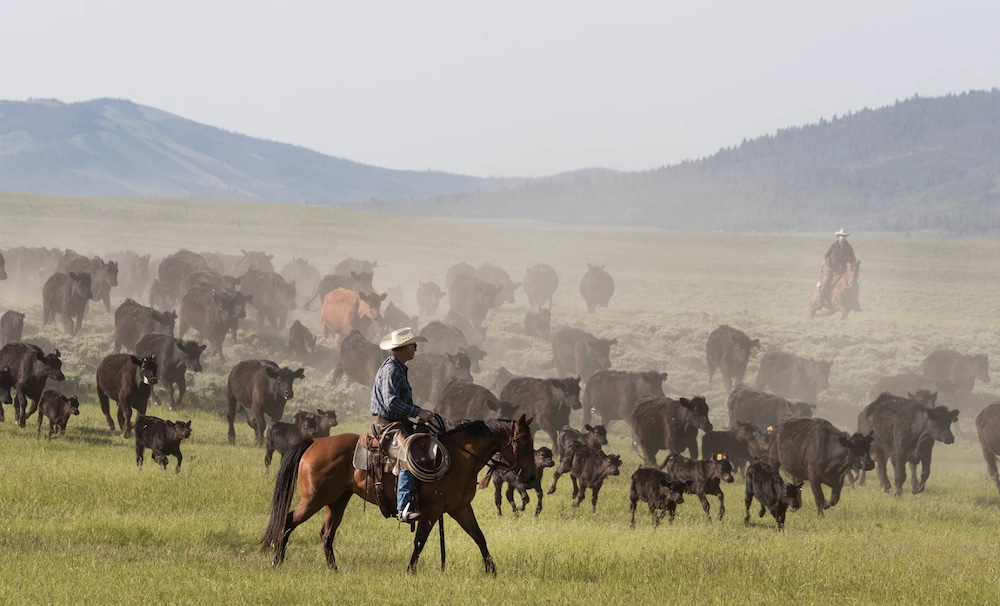
An influential cattlemen’s group is trying to rescind a U.S. Interior Department big game migration route protection order that brought $3.2 million to Wyoming in the last three months.
The 121-year-old National Cattlemen’s Beef Association says stockmen and women haven’t been considered in the program spawned by former Secretary of the Interior Ryan Zinke’s Secretarial Order 3362. The year-old order seeks to improve habitat in Western big game migration routes and winter ranges and directs federal agencies to act accordingly.
Elements of Zinke’s wildlife migration declaration “typically result in inappropriate restrictions on grazing and ranching activities,” the beef trade group’s resolution reads (see below). The cumulative result is “prioritization of big-game habitat conservation and restoration,” and “inappropriate impacts to adjacent private lands.”
The Wyoming Stock Growers Association, which recently asked Wyoming Game and Fish to suspend designation of new migration corridors until the impacts are fully considered, backs the national group. “WSGA shares the concerns of NCBA with Order 3362 and have supported the NCBA Resolution,” Jim Magagna, executive vice president of the Wyoming association, wrote in an email.
The NCBA passed its protest resolution shortly before Interior publicized local benefits that derive from Zinke’s 2018 fiat. Secretary of the Interior David Bernhardt in the last three months announced that Zinke’s order 3362 and associated grant and private programs have directed $12.2 million toward migration corridors and habitat enhancement in Western states. Fully $3.2 million will be spent in Wyoming.
Money for mulies
Money began trickling in in March when Bernhardt, then acting secretary of the Interior, announced Wyoming would get $293,800. The money is part of $1.5 million granted west-wide for private land habitat projects authorized through the U.S. Fish and Wildlife Service’s Partners for Fish and Wildlife program.
Bernhardt in May announced Wyoming would get another $1.1 million in grants for mule deer migration and winter habitat protection, plus an additional $2.9 million in matching funds. With contributions from the National Fish and Wildlife Foundation and ConocoPhillips, $10.7 million will be spent west-wide on federal lands and on private lands whose owners choose to participate.
“The important role that private lands play in conservation cannot be overstated,” a statement in March quoted Bernhardt saying. “Of course, our public lands play a pivotal role conserving habitat and migration corridors as well, but we must continue to be a good neighbor and all work together.”
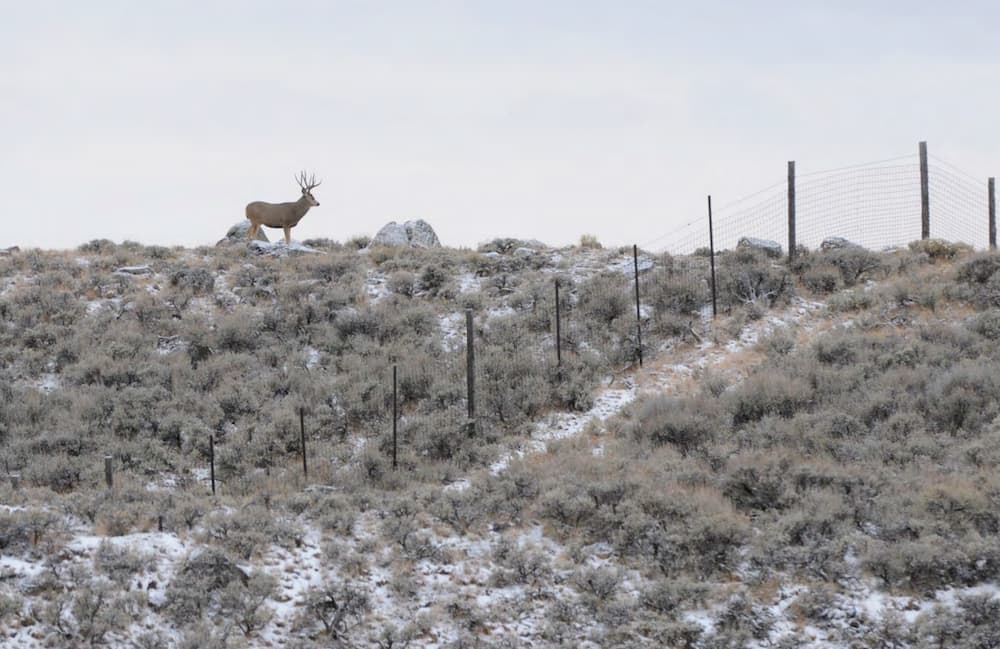
The National Fish and Wildlife Foundation described two of the funded projects. One will fight invasive weeds across 25,560 acres, modify 55 miles of fences and restore 2,355 acres of public land to benefit the Platte Valley and Sublette mule deer herds.
In addition to the $913,000 that project received from the competitive grants program, another $1.4 million in matching funds will help complete the work.
A second effort seeks a 280-acre conservation easement on unnamed private land to permanently protect and connect wildlife habitat in the Upper Green River Basin and the Gros Ventre and Wyoming mountain ranges. The plan is to extinguish development rights and prohibit subdivisions within the Sublette mule deer herd’s migration corridor — known as the Red-Desert-to-Hoback route.
The Jackson Hole Land Trust received $100,000 and will contribute $1.5 million in matching funds. That local contribution is key, said Dwayne Meadows, executive director of the Wyoming Wildlife Federation.
“The important thing is the match,” he said. “It’s real, local money. That’s communities throwing fundraisers.”
Corridors now a bio-political mashup
The data underpinning the mapping of migration routes and their official recognition by agencies also is important. “This type of work on the ground would not happen without scientifically identifying these habitats,” Meadows said. “The fact that crucial habitat is designated is why that money comes forward.”
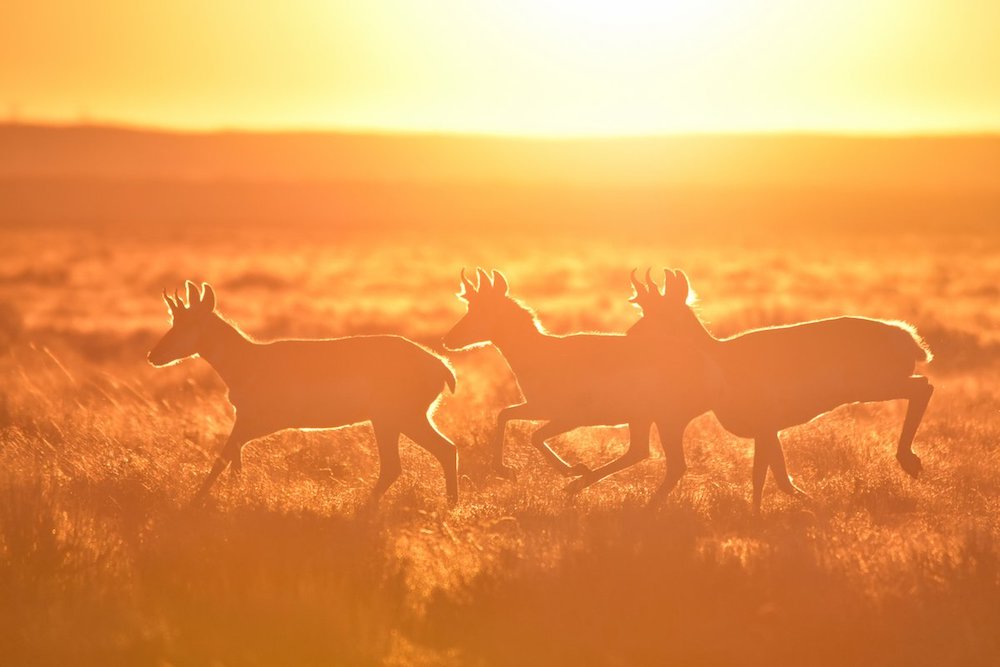
That science was evident as Wyoming Game and Fish Department proposed protecting two additional migration routes. Researchers followed 111 pronghorn fitted with tracking collars and tracked 230 individual migrations over 12 years to create the proposed Sublette Pronghorn Corridor outline. Researchers captured and collared 126 mule deer and tracked 505 migration sequences over four years before Game and Fish mapped the proposed Wyoming Range Mule Deer Migration Corridor.

Despite that research, migration protections have grown from conversations “among a couple of [non-governmental conservation organizations]” drawing corridors “on the back of an envelope,” said Ethan Lane, the National Cattlemen’s Beef Association senior executive director of federal lands. The result could be “putting producers out of business,” Lane said.
“We’re not saying [migration protection] shouldn’t happen,” Lane told WyoFile in a telephone interview from Washington, D.C. “We’re just saying it can’t happen without us being part of the conversation. Perhaps we missed a [step] in the process.”
Zinke announced his order last year at the Western Conservation and Hunting Expo in Salt Lake City, Utah, a venue for hunters. He briefly acknowledged the role of ranchers in preservation of big game, saying migrations can be protected, among other ways, “by working with ranchers to modify their fences.”
The National Cattlemen’s resolution reads that if Zinke’s order is not fully rescinded, the agency should at least clarify the role of NGOs and associations. The cattlemen ask that “only affected parties or those who possess relevant site-specific knowledge be allowed to participate.”
“We very much support and respect the right of all Americans to comment on the management and planning of federal lands,” Lane said. “But there should certainly be a place for impacted and affected parties who own land that is going to be materially changed or altered.”
The resolution is a starting point, Lane said. “In no way is it the end of a conversation — this is a beginning,” he said. “We need to engage.
“Up to this point this really has been a conversation that’s resided among the NGOs and conservation organizations with very little input or engagement with the landowner community.”
Ranchers provide wildlife habitat
Twenty-two thousand stockmen and women hold federal grazing permits on 250 million acres, Lane said. They own another 120 to 140 million acres in home-ranch lands. Decisions made for a community with a 400-million-acre footprint should involve that community, he said.
Without the voice of ranchers and cattlemen, however, the beef association fears disruption from corridor protection. “How do we keep these landowners that have ongoing operations viable and still meet these [wildlife] objectives,” Lane asked.

The trade group, which claims more than 25,000 members, opposes “additional habitat management goals, measurable outcomes, wildlife management, or wildlife habitat conservation and restoration activities in land use plans,” the resolution reads. Federal policy or guidance should be consistent with state and local statues, including open-range and legal-fence statutes, the resolution states.
The U.S. Bureau of Land Management and U.S. Forest Service planning that is envisioned in Zinke’s order produces management plans every couple of decades that are “very large, complex and cumbersome,” he said.
“Often what’s generated is the government’s best effort to not lose in court when the environmental community sues them which [is] almost guaranteed,” Lane said. “What you don’t necessarily get from that is good policy.”
When it comes to protecting wildlife, “I don’t want anyone to get the impression we’re standing in the middle of the road saying ‘stop,’” Lane said.
Shortly after the NCBA passed its resolution earlier this year, resistance to the designation of migration corridors emerged in Wyoming as well. An ad-hoc coalition of statewide organizations, including two stockgrowers associations, two farming entities, two extractive industry coalitions and the Wyoming County Commissioners Association asked Game and Fish Department in March to suspend the process of protecting migration corridors until that process is clarified.
But the national resolution “was not discussed and was not a factor,” in the Wyoming protest letter, Wyoming’s Magagna wrote WyoFile.
“The [Wyoming] letter was based solely on concerns with G&F moving forward with potential designations of a significant number of new migration corridors without full consideration of the potential impacts,” Magagna wrote WyoFile in an email.
Wyoming leads the efforts
Many wildlife observers say Wyoming has been a leader in the documentation of migration corridors and their protection. Some protections began, bureaucratically at least, in 2008 with the Bridger-Teton National Forest’s designation of the Path of the Pronghorn. The effort grew in 2016 with the Wyoming Game and Fish Commission’s decision to designate migration corridors as protected vital habitat.
Now New Mexico’s U.S. Sen. Tom Udall and Virginia’s U.S. Rep. Don Beyer, both Democrats, have acted at the national level, introducing the Wildlife Corridors Conservation Act of 2018 in December. The bill sought to “protect and restore fish, wildlife and plant species,” across the country but died in the last congress.
“With roughly one in five animal and plant species in the U.S. at risk of extinction due to habitat loss and fragmentation, one of the simplest yet most effective things we can do is to provide them ample opportunity to move across lands and waters,” Beyer said in a statement announcing the bill. Current law lacks requirements and incentives for decision-makers to connect habitat at a landscape level and across jurisdictions, a statement on Udall’s website reads.
That landscape-level need may have moved Zinke to act, said Linda Baker, director of the Pinedale-based Upper Green River Coalition advocacy group. “Perhaps he understood that migration routes cross state and international boundaries and that the animals that use them don’t recognize those boundaries,” she said.
Support in-depth reporting during WyoFile’s spring fund drive
“It’s like the currents of the ocean in its scope,” she said of migrations. “To put the thumb in the dike, the thing the cattlemen are trying to do, it’s absurd, in my opinion.”
“Migrations are occurring throughout the world at this time everywhere,” she said. “It’s the natural order of the world.” Wild animals and their migrations, “they are the essence of Wyoming,” she said.
This post was updated May 7 by attaching the resolution — Ed.

“The cattlemen ask that “only affected parties or those who possess relevant site-specific knowledge be allowed to participate.”..
What a bunch of entitled, arrogant jerks. Who the hell do they think they are? It’s PUBLIC land, not their own private cattle pasture.
Dont worry about the migration of the deer, elk, antelope, etc. The wolf introduction like in Yellowstone Park, etc. Will take care of that and you can save your money$$$$$.
The fact that is often glossed over by rancher organizations is that although twenty-two thousand stockmen and women hold federal grazing permits on 250 million acres, they don’t own it. We the American people own it, all 323 million of us, collectively, and ranchers need to be reminded of this often. Although many Americans do not participate in watchdogging the “locals” or even understand the process, many use public lands. We are represented by conservation organizations, millions of us. We deserve a vote, just like the local land users.
Thank you for this comprehensive article. I didn’t know that Zinke had done anything remotely good while he was in office. The wildlife corridor plan and the money supporting it are important for wildlife survival. Wyoming is an important location for wildlife conservation.
Here’s $8 million dollars’ worth of wildlife migration corridor preservation drawn “on the back of an envelope.” Greetings from Big Wonderful Wyoming!