

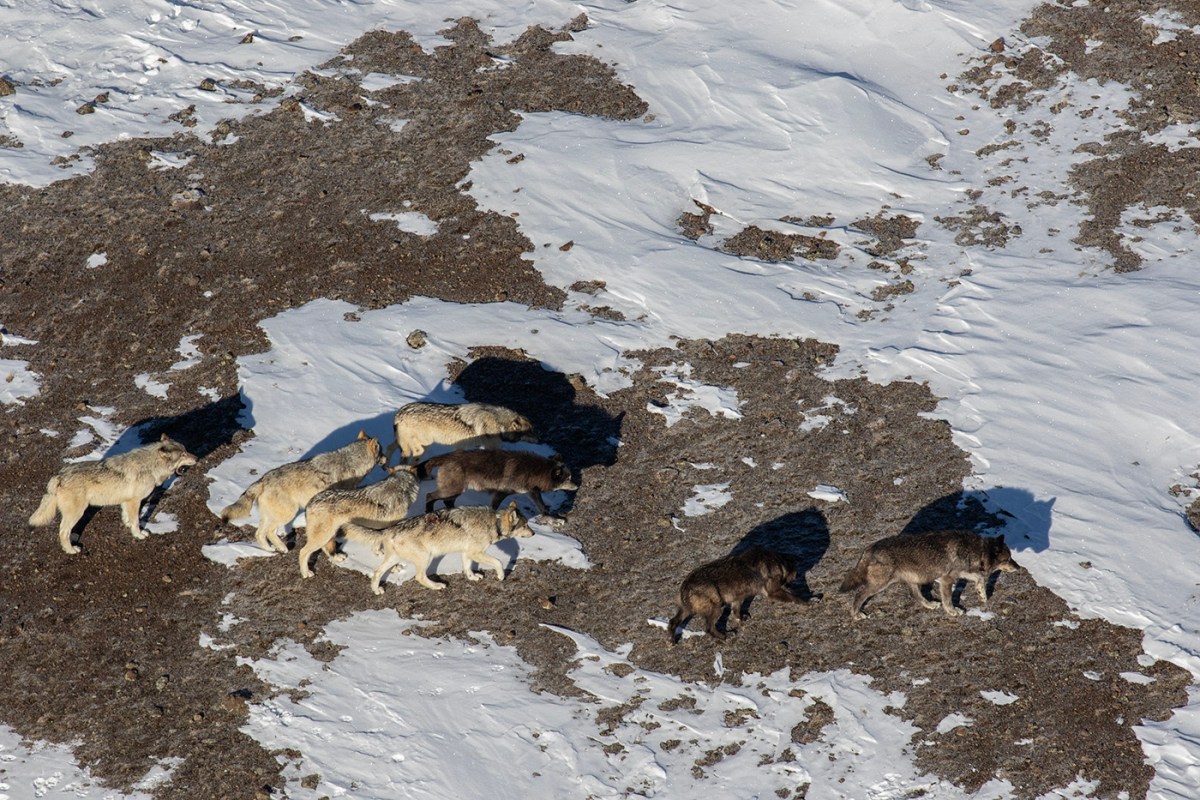
EVANSTON—Yellowstone National Park’s last original wolf pack, Mollie’s Pack, emerged unscathed from a hunting season that opened last week and has already closed, Wyoming wildlife officials announced Monday.
Dan Smith, a Wyoming Game and Fish Department interim deputy director, provided the update, allaying concern that had run rampant online and in circles of wolf-watching devotees. Worries centered on the Mollie’s Pack, named after the late U.S. Fish and Wildlife Service Director Mollie Beattie, who died of cancer during the historic 1995-96 reintroduction.
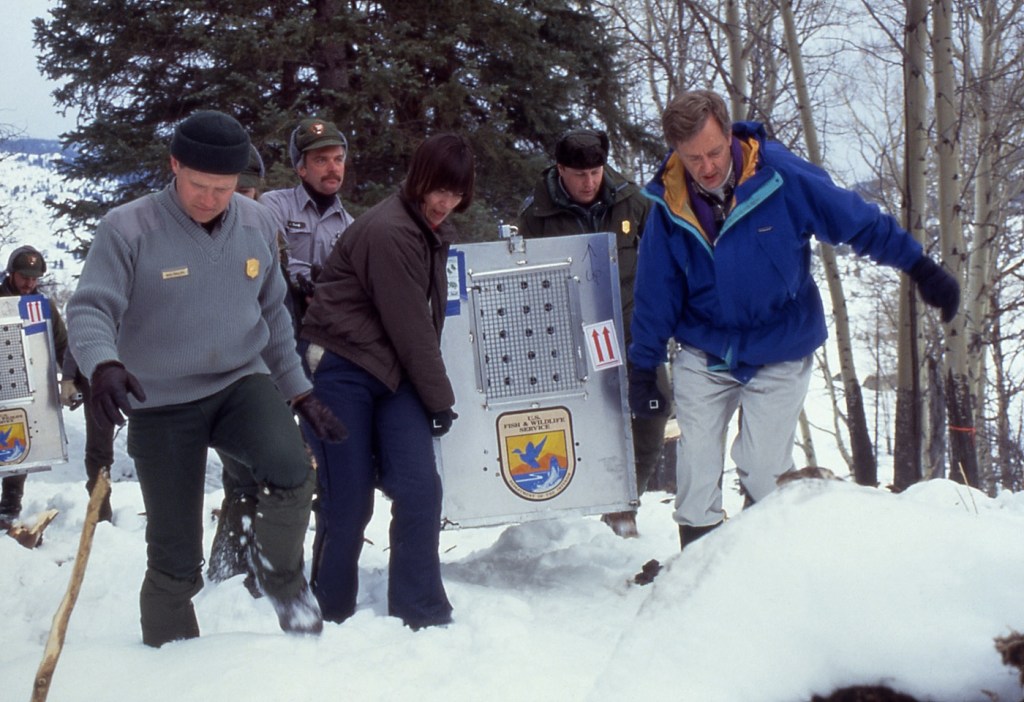
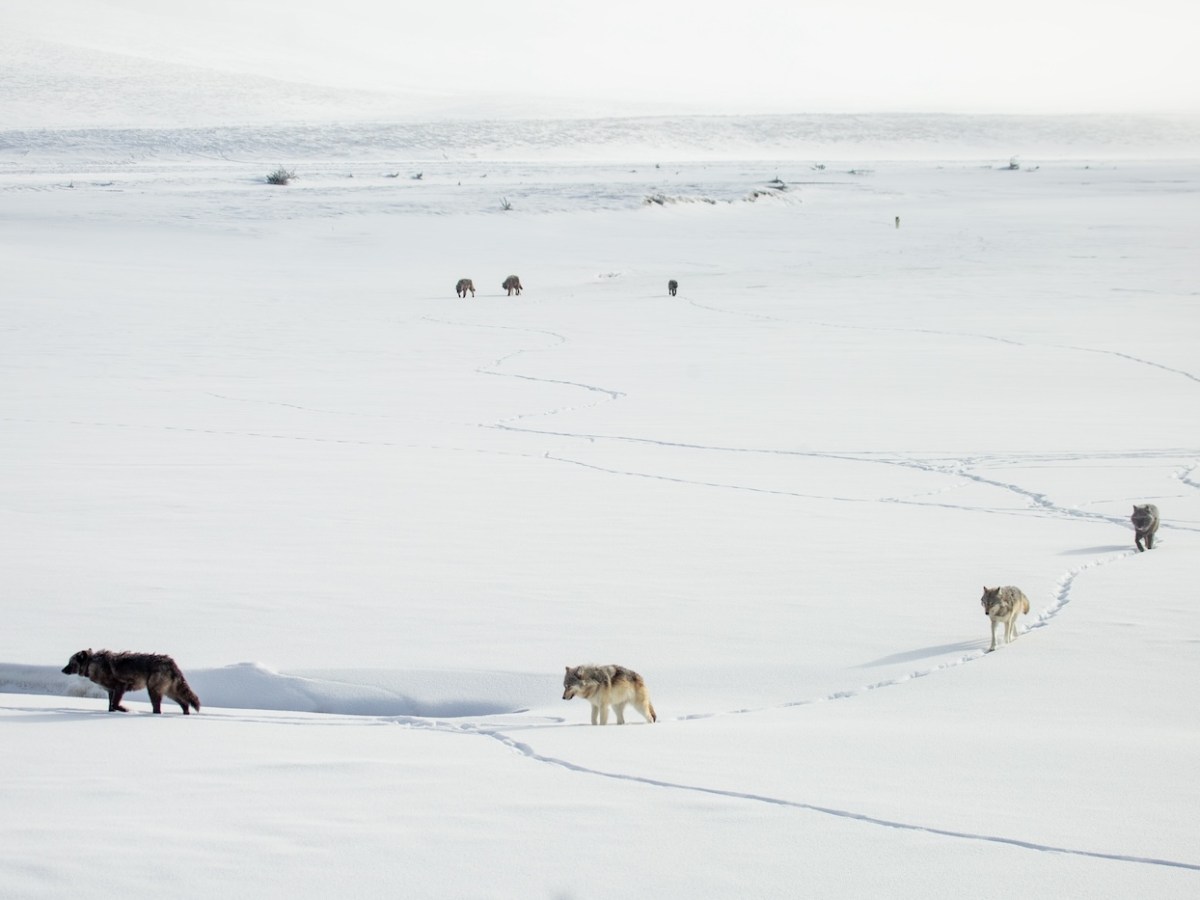
Today, Mollie’s Pack is the last remaining wolf pack still intact since reintroduction three decades ago. The famous pack had been making headlines for leaving the safety of its longtime territory in Yellowstone’s Pelican Valley and mostly spending late 2025 and the first half of this year in Wyoming’s wolf hunt area one, located northwest of Cody.
“Wolf hunt areas one and two did close on Saturday, after reaching the mortality limit of four wolves,” Smith told the Wyoming Game and Fish Commission. “None of the wolves taken were from wolf packs previously assigned to Yellowstone National Park.”
Recent movements had put Mollie’s Pack in a good position to survive Wyoming’s hunt. Ahead of hunting season, the National Park Service had reported to WyoFile that the pack, which consisted of five adults and five pups in July, was “mostly” back in Yellowstone, where hunting isn’t allowed.
Wildlife advocates had been pressuring Wyoming wildlife managers to close down the hunt area where Mollie’s Pack had been spending time. Monday’s news came as a relief.
“Mollie’s Pack survived the hunt,” said Wyoming Untrapped founder Lisa Robertson, who traveled to Evanston for the commission meeting. “For more than three decades, they have taught us about resilience, family, adaptation, and the enduring nature of the wild.”
Yellowstone officials declined an interview Monday, saying the wolf hunt is a state issue. Packs crossing park boundaries, mostly into Montana, have altered the park population at times. Wolves that spend most of their time in Yellowstone are poorly suited to survive hunting because they generally lack a fear of humans, and sometimes even badly habituate to crowds.
Where wolves are managed as trophy game, Wyoming’s hunt is already tightly managed relative to Idaho and Montana. This year hunting opportunities were reduced as a result of a distemper outbreak that has dropped the population to its lowest level in two decades. The state OK’d hunting regulations that allow the killing of up to 22 wolves — half of 2025’s limit — during a season that runs through the end of December.
Game and Fish set a quota of four animals that could be killed in hunt areas one and two. Hunters reached that limit over the weekend, Smith said.

Statewide, 10 of 22 wolves that can be killed in Wyoming’s wolf trophy game area have been dispatched by hunters during the first week of the season, according to the state’s mortality database. No other hunt areas have reached their mortality limit.
Wolf hunting is a notoriously difficult pursuit. Wyoming’s hunters devote about 500 days of effort per animal they kill. Especially early in the fall, the pups of the year are the most vulnerable.
Wyoming’s trophy game area covers just 15% of the state. Across the rest of Wyoming, wolf hunting regulations are scant and wolves are managed as predators. No licenses are required in the remaining 85% of the state, and killing takes place without limit and few restrictions on method year-round.



Humans are the most invasive species. each member of the pack has specific jobs the lose of any pack member causes issues .why is the department formed to.eraxicate all predators for hunters that bunting amd fishing licenses pay their pay in charge of this biased if you ask me I come from one of the first cattle ranching families in Colorado recognized as a one hundred year ranch we left n nature as we found it predators and yes we had wild .mustangs back then they were here long before us.the name rancher comes from hard work and respect we accepted the ten percent loss of rhe herd to nature predators disease and weather your feed lots now dont even ride and protect your own herds on your own land blm leases my great grandfather said if you dont have enough grazing or employees to.hadle the herd cull.them you.have killed the wolves prey who’s fault is it if you lose cattle which your payed for handsomely corporate feedlots most of you never earned the name rancher
Thank you Shelley! You’re way of life is a true Rancher and the idea to work with all predators, not kill everything that invades the herd. I appreciate your comment and hope others will realize that this is the real way to ranch. Thanks again for speaking up.
Unbelievable the amount of support for an animal that the Sportsman supports and raises. We were duped into thinking giving and inch would lose a mile. It just never ends that is why sound judgemental actions are not used anymore
The quotas are so low its ridiculous to assume there will be any impact on sound ecological reasoning and subsistence living together together. That is what you get when people govern from the armchair in their basement
This is truly devastating to read. Wolves are beautiful, majestic creatures and have as much right to be here as we do. They don’t deserved to be hunted at all, especially for sport. I don’t support this or the hunters. If your life is in danger from a wolf, that is the only way I can see it being acceptable. I hope Mollies pack will be ok!
leave the wolves alone or go meet them on their terms. Dont bait them and hide in a tree and pussy kill them. they were there first. they make the whole thing work. yellowstone will slowy die without them.
They can’t and won’t. Most can’t even track anymore
Humans are rhe largest invasive species.we kill their prey and ring the dinner bell and wounder why they kill to.eat like these supposed n hunters claim
This breaks my heart completely! Such a huge loss.
I cannot believe that you people are still hunting an animal that just came off the endangered species list. I am one half Native American, and wolves were sacred to us. There is no bravery or respect given for hunting an animal that can only run away.
Your people said that there had been an outbreak of distemper in the last year or two. Could you possibly team up with some area veterinarians and try to treat the problem. Tranquilize them, get any medical information you need and then give them the vaccinations needed. It’s worth a try.
This type of behavior towards Wolves, that are essentially the grand father’s of Millions of regular home kept Dogs of different breeds, is completely heart breaking. These animals have a right to live and thrive in our earths environment without a Holiday for man to hunt and kill them for sport. The Bible say’s, at Genesis 1:30- “of every animal having life.” Life in the Bible means “a living Soul .” All living souls have a right to life.
Shame on all of you who willing participate in the Killing of a Living Soul.
In your wolf hunting report, I noticed that you stated that each hunter that kills a wolf has spent 500 days to kill that family animal. That makes no sense to me. Wouldn’t their time be better spent doing something constructive instead of destroying a life just to hang it on their wall??
You killed it now eat it.
I have hunted the most dangerous thing on the planet and I am still alive I was and always will be aU S Army Ranger Sniper I don’t Hunt something that cannot defend it’s self.For all you trophy hunting cowardly human vermin how would you like to be hunted
I’m with you. It’s disgusting.
Were you “successful” in your hunting as a US Army sniper?
Is this a veiled threat?
Effin’ horrible.
How about dealing with the REAL invasive and destructive species, humans.
Absolutely agree
Asa thirty year retired vet tech native too the distemper was human caused just like mange was released by our go-to kill.off coyotes every time our government steps into.claim to fix nature they mess it up.worse
Facts and truth
Has anyone seen Wolf’s Rain? 4 wolves needed to die for the world to restart. Their blood started creation when mixed with the blood of the flower.
Why are we still killing animals for sport?
How could anyone be even remotely close to one of these stunning canines and decide to kill it. Not out of necessity or survival. For sport. To say “I killed the biggest wolf this year so my junk is bigger than the rest of you inbreds!” Wolves were critically endangered at one point. What do we do? Let them be so their numbers grew until they were delisted from the endangered species list. And THENNNN, turn around and kill them again! If you are one of these hunters imagine being that close to such a magnificent creature. Heck one of them may even approach you due to its lack of fear because of interaction in Yellowstone. Killing one of these stunning overgrown fur babies takes the opposite of bravery. It’s complete and utter cowardice. It is so cold blooded I’m ashamed to say I’m a human like the weasels who “hunt” them. Btw if you really want to hunt an animal, take a spear or a bow and arrow. Leave the tree blinds at home and do it like a real man. Not one hunter would even consider this. It’s not easy enough. Human beings are the single most destructive entity on the planet. Not only will we destroy ourselves at some point with a nuclear holocaust, but we will take every other living thing on Earth with us. There is a reason God is angry with us. There is a reason we can’t have nice things. With grizzly bears, killer whales, great whites, lions, and so many other apex predators we live almost hand in hand with, the number one predator on earth is???? You guessed it! Humans. You and me, me and you. I personally could not kill such a beautiful and mysterious animal whether it was a wolf, a bear, bird or otherwise. If we don’t destroy the entire planet first, we will eventually encroach on animal habitats so greatly that they will be forced to attack random humans. Why can’t we just be peaceful? Seriously.
What a great statement. I applaud your effort and agree whole heartfelt. If we can’t leave nature alone we will no longer have life on this planet.
Facts and truth. wolves have values those so called hunters will and can never have and jealousy drives them most can’t even track.they use drones dogs and four wheelers their not hunters their jelous children
This is ridiculous. Wolves were basically just removed from the endangered list and should not be hunted. Quit killing our ecosystem.
And we need to kill wolves why?
The fact that 85% of WY doesn’t require any paperwork to treat wolves as predators & shoot them at will is ridiculous. Wolves are apex predators. They balance the whole system. Why would people want to shoot them? Do they still believe in the “Big Bad Wolf”? I don’t believe they do much thinking in WY . Just a lot of immature boys, acting out.
I think wolves are quite tasty I like eating their nut sacks!!! Sometimes I do just shoot for fun why not they’re a predator hahaha!! Maybe I am evil maybe not
Why are people hunting wolves!!?!?!
It would be wonderful if they would leave wildlife alone always having to hull some type animal out for some ungodly reason ! ?
Im am so disgusted by pathetic weak minded men who need to kill everything because its predator or has teeth. Unlike the useless ilk that take part in this crap Wolves perform a service and they dont destroy the earth or take more than they need. You have massive grazing land so you loose a cow or two to the natural workings of our world….raise your beef prices a penny to cover it. Go home and quit crying you pathetic weak minded pussies.
Humans deserve nothing. Thinking they know what’s best. No proof of any kind to warrant such evil
Like many of these emotion driven stories, the comments are something else. Obviously many have probably never left the city to even see the wilds of the suburbs, let alone wilderness.
“humans don’t value a living souls right to live freely”
animals have souls?
“The wolves had no choice they were placed in montana for big game hunters”
Montana? This is about Wyoming
“Yosemite is Beautiful… that’s the only wolf pack left ”
Yellowstone and LOTs of other packs
“Predator hunting is rarely justified. Stop messing with the food chain”
It’s called wildlife management, has been done for centuries everywhere
“You jerks almost wiped out Yellowstone Park”
The only thing that can wipeout Yellowstone, is Yellowstone. lol
” you don’t open the park to a bunch of jerk hunters to kill off any pack members they want”
None of the wolves were hunted in the park, 100% illegal
“Hunting wolves and other predators that help control the deer/elk population should be outlawed.”
Humans control/manage the deer/elk populations better than wolves and it feeds HUMAN families. Wolves will kill to the point of almost no ungulates left 80-90+%
” Too bad humans can’t be hunted, since our population has grown over centuries”
The all too common self hating human
“IF you want them gone. Ever heard of tranquilizers Then relocate them to either a zoo or another state.”
WOW, look south to Colorado for relocation horror stories, spreading disease.
“I am sure Wyoming doesn’t want the truth of what they are doing killing the remaining population of the wolves who should roam free on these lands.”
Quotas in the GYE ensure all wolves wont be killed, such low quotas have zero effect on overall population
“Gun hungry men and women with little intelligence to understand how critical the wild animals are to overall conservation are clueless”
Hunters are FAR MORE in touch with nature and the outdoors that most criticizing them that never leave a city.
“My parents and grandparents instilled in my brother and I that you only take game for food, nothing else. Killing. For sport is appalling and should be banned.”
Wildlife management is for ensuring the health of an animal population. Would you rather see animals starve to death than be hunted to reduce numbers that the habitat can sustain?
Awesome reply Chad! You nailed every point.
Thank you Chad, that was PERFECTLY said!
Wolfs and animals DO have souls. And ability to feel pain, and suffering. Just like humans.
Wolfs and all animals were created for a reason for this world. Trophy hunting is an abomination and should forever be banned and there is nothing to be proud about for whoever takes part in it.
You are so wrong. My husband was a licensed guide in the middle fork of the Salmon for years. He was from a town. I was living in the woodlands. When we married we had land on the edge of Forest Service land. He got to see the deer eating with our horses. One winter a doe and her two fawns spent most of the winter in our barn due to the mother having a broken leg, by their choice. We never touched them or corraled them. He got to see the family side of forest animals and stopped hunting. He said he didn’t want to be a target for other hunters, either.
“Trophy” hunting is a disgusting practice. Wolves contribute to the health of ecosystems. Just stop.
If a hunter simply kills for trophies their the lowest form of people on the planet, if ya don’t eat it don’t fukin kill it dumb asses
My parents and grandparents instilled in my brother and I that you only take game for food, nothing else. Killing. For sport is appalling and should be banned.
I absolutely agree – this “trophy” hunting has taken too many animals that might have been the saving grace of a pack. White Moose, white deer, white lion, white rhino etc. it’s just too much and needs to stop!
Stop the killing before you destroy! What the wolves have IN PROVED through the years..
I am sickened that there is wolf hunting period. What kind of person takes pleasure in killing something they can’t eat? These hunters are deplorable.
I am 100 percent in agreement with this concept.
I am sure Wyoming doesn’t want the truth of what they are doing killing the remaining population of the wolves who should roam free on these lands. Gun hungry men and women with little intelligence to understand how critical the wild animals are to overall conservation are clueless and cannot look beyond a head on the wall or hide to walk over on their floor but this stupidity and violence to precious resources the State should welcome will have an impact on Wyoming and Yellowstone as a whole.
Why are they allowing wolf hunts..?
They are so few of them to start with!!.. the beef ranchers think they can do anything they want on blm lands they lease for very cheap and that are owned by the taxpayers…
They ,the ranchers,are flying around in cessna planes and even have airstrips on their properties to land their planes..yet they persist in killing wolves and coyotes as predators because they say they are cutting into their profits…the ranchers are receiving huge subsidies every year not to plant certain crops…if u can afford a cessna plane u should not be applying for subsidies!
Four wolves removed was not near enough to protect the newly appraised 3.9 billion dollar elk herd in Wyoming.
How many millions of dollars worth of elk have the wolves taken from the State of Wyoming?
From a past Wyofile article, GYE wolves kill an estimated 11,600 elk a year times the newly figured 40,000 dollars a head. That is 464 Million dollars.
https://wyofile.com/many-elk-yellowstone-wolves-eat/
Game and Fish needs to remove the quota system in the GYE ASAP.
It’s all about the money greedy mankind
Your point of view is the exact reason why we should not allow hunting for sport only. Do not the predators and prey have a right to the land as we as humans do? Why should it be about a monetary price? Its a sick way of thinking!
WHY ARE HUNTERS KILLING WOLVES? Majestic creatures whose existence *matters* as much as any other of Earth’s inhabitants. Sending swift karma to those who took part in this.
They are allowed to kill 10 out of 22 wolves? That’s some bull****!! No wonder animals are going endangered and extinct! How tall said that these POACHERS do it for trophy. That’s disgusting and they should be ashamed of themselves!
253 wolves live in Wyoming.
It’s amazing to me how wolf’s has roamed for centuries, without hunting, and nature took care of itself. Now we have hunting for the over population and trophy hunting. To me this is sickening!! Too bad humans can’t be hunted, since our population has grown over centuries!
Yes!
Agreed! We are the issue. Especially how we consume. We’re destroying the planet; not the animals.
But of course, speciesm and the floating man in the sky say it’s okay to kill and destroy every nonhuman. That’s what will kill us all in the end.
If they allow hunting, why are the introducing packs, ie mollys pack? This seems to be confusing to me.
To Hell with anyone who would shoot and kill a wolf.
Yellowstone didn’t want to leave a comment because they didn’t want to say, yes some of the pups or ALL were killed by hunters because these hunters have NO RESPECT FOR ANIMAL Life or for humans for that matter. IMO Never have hunters hunt Wolves. IF you want them gone. Ever heard of tranquilizers Then relocate them to either a zoo or another state. SMH killing them WILL only make things worse. Like putting them on the endangered species list. That’s when more hunters want to kill them for sport. Please use your own BRAINS! 😡
What is wrong with this world? Let nature be stop destroying our world. We do enough of that each day . Leave the animals alone and the echo system do it’s thing.
I won’t be going to spend my money in any state that allows wolves to be hunted cause when I think of the west I think of wolves coyotes mountain lions bison lynx bobcats and all other wildlife donkeys and mustangs included they wander out of an area and they are something to be destroyed just so somebody can brag
Hunting wolves and other predators that help control the deer/elk population should be outlawed. Trophy hunting means sacrificing an animal just for decorations. That is a form of animal abuse. This is America not the wilds of Africa.
Sad truth, hate they have to hunt them. Pop control.
You jerks almost wiped out Yellowstone Park with your stupidity by removing wolves in the first place. Stop playing with nature. Leave the wolves and mustangs alone. You are causing more damage than you are worth. Allow the ranchers to shoot them IF they are bothering their herds, but you don’t open the park to a bunch of jerk hunters to kill off any pack members they want. Someone with a brain needs to oversee this agency which is out of control.
Why do people get off on shooting animals like the wolf I don’t understand what a hunt like that has to do with using the resource as a form of food it just gives real hunters a bad rap
Predator hunting is rarely justified. Stop messing with the food chain
Why were wolves reintroduced among lfood procers of human food iinsteqad of cities and towns where there was lots folks knew how to feed them and were willing to pay the cost> Instead they were planted among the human food prducers to support them at their own cost. If you want something YOU should be willing to pay fir it yourself.
I don’t have any issue with issuance of depredation permits if ranchers are taking all reasonable measures to protect their wildlife or pets, but issuing 4 tags in an area is a bit of a joke. It is like they are just trying to make a point. Why bother? Èach to his own, a wolf as a trophy…what a joke…May as well have raccoons up on the wall or feral dogs. That is all it is– a big long- legged dog…nice job great white hunter.
Yosemite is Beautiful & I hope it stays that way for the home of all the Animals & Mollies Wolf Pack. It’s sad that that’s the only wolf pack left and that hunting them is allowed. Its Amazingly Awsome that they survived thru the hunting season and can keep living. I think this precious pack should have the ultimate protection & they should not be hunted at all. I support Mollies Wolf Pack & hopefully see them around in the future with much more precious Wolf babies to come. Thank you to all the people that care for and protect our Planet & the Beautiful Animals in it.
You are greatly appreciated.
You obviously didn’t read the article carefully. Yosemite is 800 miles away. This pack is NOT the only pack in Yellowstone. This hunt was in Wyoming, and carefully regulated by the Wyoming DNR. Mollie’s pack lost zero members because they had migrated back to Yellowstone where no hunting is going on. This article is describing intelligent scientific wildlife management. It BENEFITS the overall ecosystem of the wilderness. The hunters that spend hundreds of hours our in the wild are much more connected to the land than people who sit at home and react emotionally to criticize. These hunters are not trophy hunters building their machismo. They are people who have actually spent time, energy, and money doing what is good and healthy for the environment. Please get a real education about how the whole ecosystem works with human interactions, rather than skim reading and knee jerk reacting.
Killing will never be the answer.
Watch Cowspiracy and look at the science from a different point of view.
How humans consume is the REAL issue here. But, you’re probably conditioned to believe you’re superior, aren’t you?
The wolves had no choice they were placed in montana for big game hunters..sad
Wow this is has become very pathetic, I can remember setting in meetings in the early 90s and the feds telling us they won’t leave the park, of course any person with a brain new better, now when nature takes over and distemper kicks in , it’s game over, it’s the same deal with grizzlies, total politics and money!
This is evil.
I wish that our wildlife would be left to be free as it was intended,.so sad that humans don’t value a living souls right to live freely, they have more rights to be on the planet than humans