

Two water development officials have criticized a proposed expansion of the state’s cloud seeding program into the Little Snake River valley.
State Sen. Larry Hicks (R-Baggs) objected to adding $150,000 to expand the program to include the west slope of the Sierra Madre above Savery and Baggs. Wyoming doesn’t use or get credit for any additional runoff that cloud seeding creates in the Green/Colorado River basin, he asserted.
Liisa Anselmi-Dalton, an at-large Water Development Commissioner from Rock Springs, voted against the expansion because local financial support is not counted toward the state’s share of the cost of Colorado basin cloud seeding program in Wyoming.
The objections came at a series of legislative water meetings early this month. Nevertheless, the Water Development Commission voted to add two Little Snake ground-based cloud-seeding generators to the agency’s 2022 budget, which the Legislature will vote on early next year.
In Wyoming’s Green River Basin, “we don’t use all of that water that we’re allocated,” Hicks said at a workshop with the Water Development Commission. “So it’s obviously running downstream.”
Any extra cloud-seeding runoff that flows down the river system to Lake Powell should accrue to Wyoming’s credit, Hicks suggested. But apparently, it doesn’t, he said.
Colorado River laws and agreements require Wyoming, Colorado, Utah and New Mexico to not diminish flows below Lake Powell beyond a minimum. Compacts require curtailment of those upper-states’ use if the minimum flow can’t be met. Lower-basin states Arizona, California and Nevada contribute to the cloud seeding program in Wyoming.
“The fact is we’re subsidizing the state of Colorado, because it’s not making it to Lake Powell,” Hicks said of cloud-seeding runoff. “It’s been used in the system someplace,” he said of the flows.
“It’s not helping us one iota on any future curtailment on the Colorado River system.”
Sen. Larry Hicks
Without credit for cloud-seeding runoff, the weather enhancement program would not help Wyoming if drought forces the state to limit water use in the Little Snake River/Green River/Colorado River basins.
“We’re participating in this project … with the idea that it might help [the] curtailment issue or drought mitigation,” Hicks said. “That argument doesn’t weigh out if the water doesn’t show up” in Lake Powell. “It’s not helping us one iota on any future curtailment on the Colorado River system.”
$2 million program
Anselmi-Dalton voted against the cloud-seeding expansion because Wyoming trona mining companies’ monetary contributions are not calculated as part of the state’s share of cloud-seeding costs in Wyoming. Wyoming industries are paying part of the 63% that’s supposed to come from other states, Anselmi-Dalton said in water meetings earlier this month.
She called for changes to allow Wyoming industry and civic contributions to be calculated as part of the state’s 37% share instead. She supported cloud seeding in general.
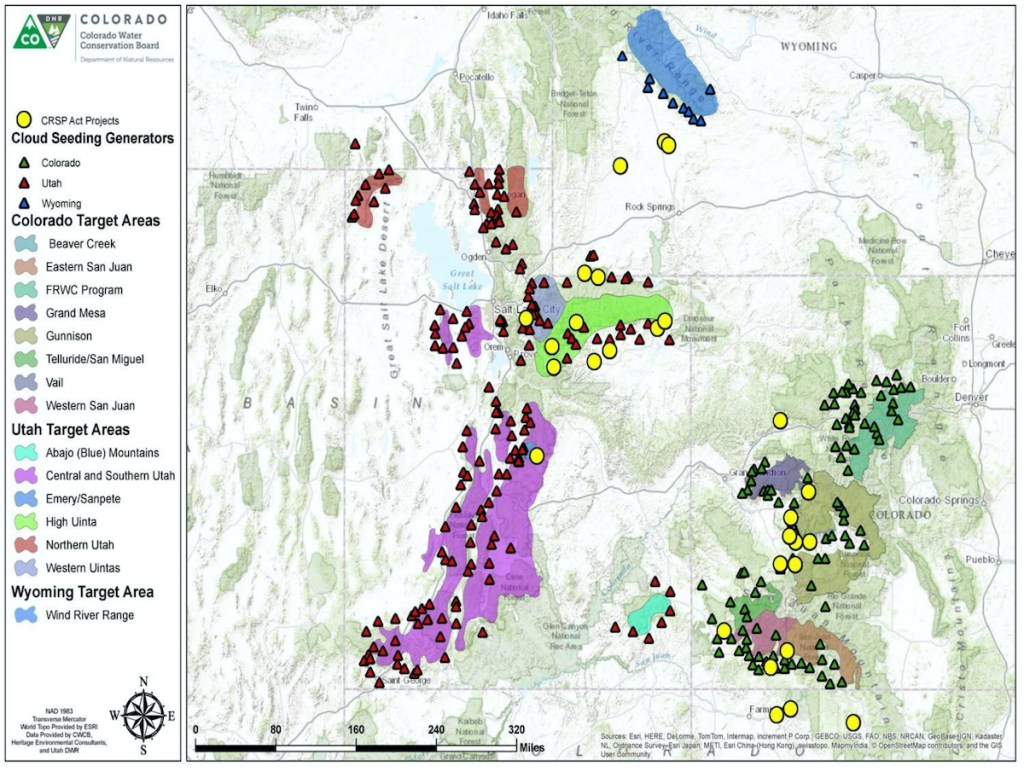
Altogether the Wyoming Water Development Office seeks $1.4 million from the Legislature for the statewide cloud-seeding program for the 2022-2023 winter. It would fund aerial cloud seeding in the Medicine-Bow and Sierra Madre ranges in southeast Wyoming, mostly in the North Platte River drainage.
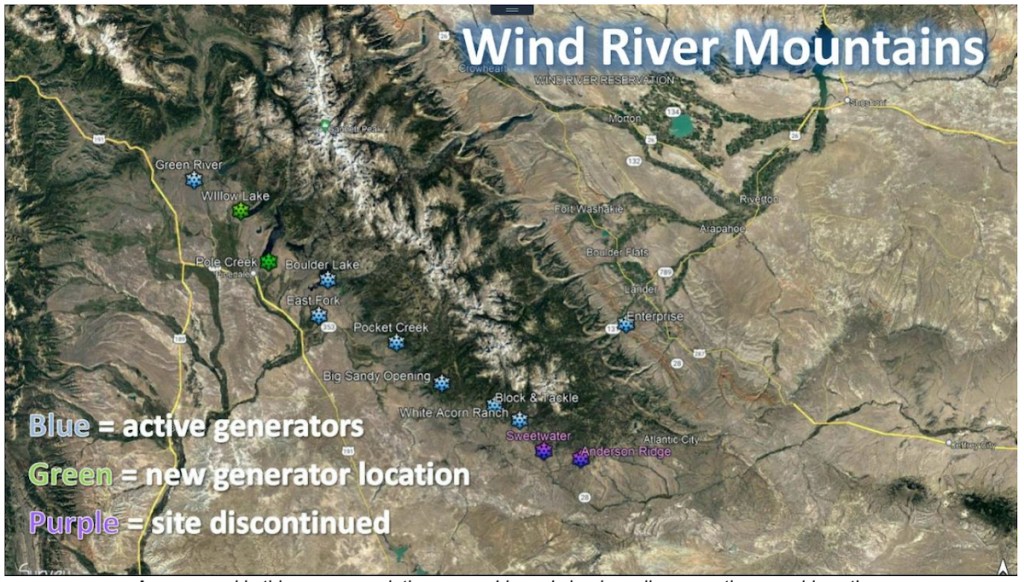
It would also finance ground-based cloud seeding in the Wind River Range and the expansion to the Sierra Madre above the Little Snake River. The budget request breaks down to $823,490 for southeast Wyoming/North Platte and $316,000 for the Wind River Range/Green River/Little Snake River program and expansion.
The budget would also fund a $300,000 cost-benefit analysis of the Medicine Bow-Sierra Madre seeding. When adding out-of-state and other contributions, the statewide program in the 2022-2023 winter would total $2 million.
In addition to the new generators, the budget calls for two more weeks of Colorado River Basin cloud-seeding, operating the Wind River Range program from about Nov. 7 to April 22.
“With the recent Tier 1 Colorado River Shortage declared for 2022, drought mitigation efforts have taken center stage in Wyoming and other western states,” Water Development Office project manager Julie Gondzar wrote in an outline. “There is encouragement and support to expand cloud seeding operations within Wyoming’s Little Snake River drainage.”
Adding two new ground cloud-seeding generators would cost approximately $150,000. Although Hicks criticized the expansion, he said he would support the existing Wind River Range cloud seeding.
While panning additional weather modification, Hicks has backed irrigators in the Little Snake River drainage who want more water storage. The Wyoming valley is the site of the proposed West Fork Dam that would impound 8,000 acre-feet to serve 67 to 100 irrigators. The 280-foot-high dam would cost $80 million, according to estimates made in 2017.
New cloud-seeding measuring
The proposed $300,000 cost-benefit analysis would focus on southeast Wyoming’s Medicine-Bow and Sierra Madre, using new studies, data and technology, Gondzar said.
Existing studies of the area are “not reflective of actual operational parameters,” she wrote. The new analysis is needed “to validate the assumption that ongoing operations are indeed producing [a] higher yield than previously thought.”
Better data could reduce skepticism about cloud seeding among legislators who debate its merits too often, Rep. John Eklund (R-Cheyenne) told colleagues.
“Every time you get to cloud seeding, [the debate is] robust, and it’s usually like 12-38 in favor of passing that thing on through,” he said. “I’d rather not spend an hour-and-a-half or two hours debating it,” he said.
Wyoming cloud-seeding studies in 2014 and 2018 failed to convince skeptics the program is worthy. Early Wyoming estimates said the program added 12,500 acre-feet to runoff annually. Newer calculations estimate additional flow from 12,000 to 49,000 acre feet, according to Gondzar.
There is more new information. A 2017-2020 study in Idaho showed that three of 18 cloud-seeding events there were successful, according to an announcement by the National Center for Atmospheric Research and the University Corporation for Atmospheric Research.
One 67-minute flight dusted some 900 square miles with about a 10th of a millimeter of extra snow, the scientists said. The three successful seeding flights produced the equivalent of 571 acre-feet of water, the researchers said, referencing a scientific study.
The study was “a revelation,” an NCAR scientist said in February 2020.
“We can definitely say that cloud seeding enhances snowfall under the right conditions,” Sarah Tessendorf, co-author of a research paper, said in a statement.

“Wyoming trona mining companies’ monetary contributions”
“Wyoming industries are paying part of the 63% that’s supposed to come from other states, Anselmi-Dalton said in water meetings earlier this month.”
I am left failing to understand why trona mining is tied up in all of this. Please explain. What does cloud seeding and trona have in common? Obviously, the mines use water (holding ponds, etc), but I thought fracking used excessive amounts of water, not trona per se. Got that wrong? What am I missing?
It is amazing how convoluted the money trail gets in Wyoming.