

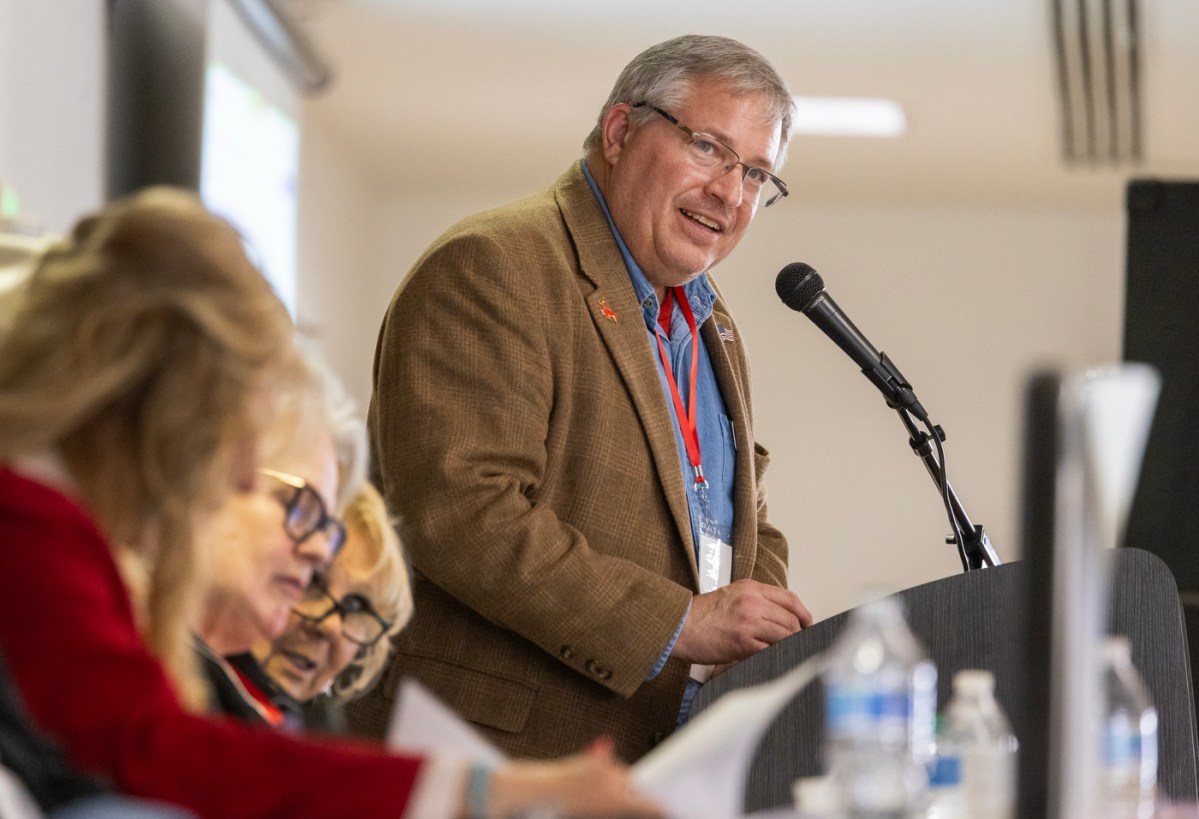
DOUGLAS—Standing front and center in a spacious cafeteria at the Wyoming State Fairgrounds, GOP Chairman Bryan Miller asked to give grace.
It was past noon on a cloudy, spring Saturday. Ham sandwiches and potato salad served on paper plates awaited the more than 300 Republicans gathered to decide the party’s business. Some of Wyoming’s top elected Republicans would soon give remarks, Miller said into a microphone, as is tradition when the party meets every other year for its statewide convention.
But first, the chairman wanted a moment to reflect. What began as a lively morning with the local marching band had turned into a drawn-out and muddied procedural debate over the agenda and floor rules.
Eventually, the party completed its work, casting a vote just before lunch to approve dramatic changes to its bylaws that are expected to spark legal fights and could impact who represents Wyoming in the statehouse and Congress.
Miller thanked the Lord for getting the party, “with a little bit of confusion and a lot of intent,” through the morning’s work. Though a single line item on the day’s agenda, the new bylaws set into motion the boldest challenge yet in a yearslong dispute over state law and the party’s constitutional rights as a private organization with public responsibilities.
“Thank you for the food. Thank you for the people who are here. Thank you for all of those that have brought this convention to bear,” Miller said. “In Jesus’ name, Amen.”
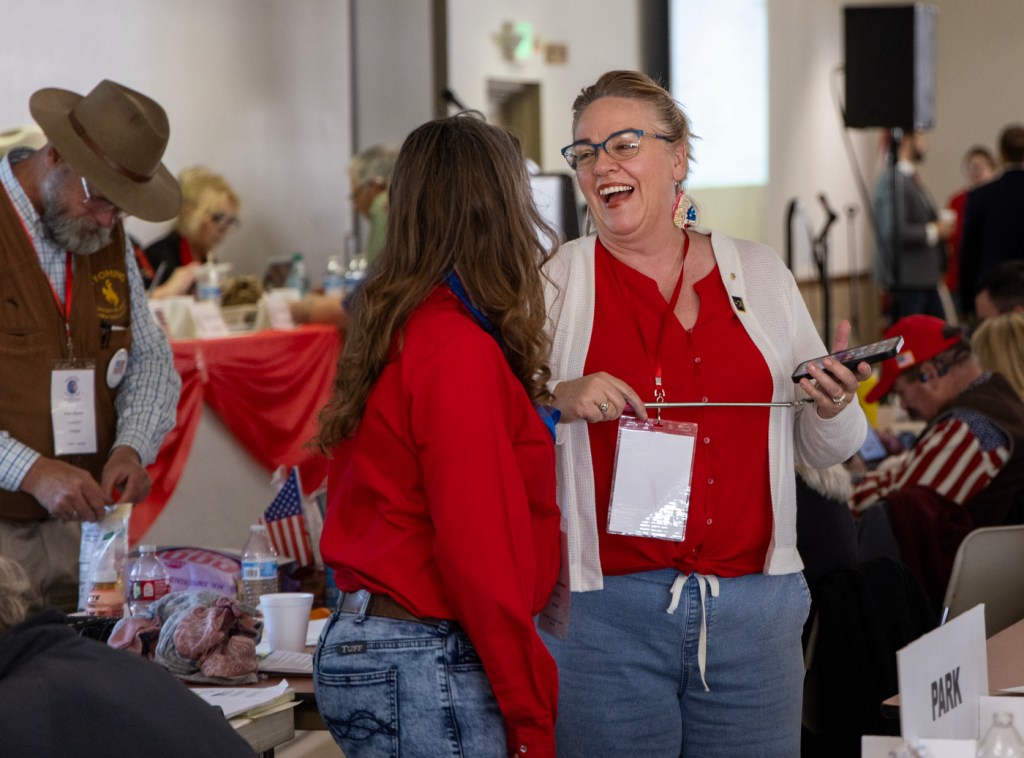
For years, the Wyoming Republican Party has argued that because it is a private group, state laws that govern its organizational structure and prohibit it from endorsing or financially backing one Republican over another before the primary election are unconstitutional. The state GOP may be a private organization, but that doesn’t mean it can ignore the law, opponents say, particularly since the party has public duties such as filling vacancies in elected offices.
The dispute has resulted in several court cases in recent years and more than one controversy. Just over a year ago, the party’s former legal counsel advised county parties to disregard state law and a Wyoming Supreme Court ruling when considering who should be allowed to vote in local party elections.
“I will see your statute and raise you a Constitution,” the attorney wrote in a letter.
This weekend, the party adopted bylaws reflecting that outlook by establishing a framework to vet, endorse and financially back Republican candidates ahead of the primary election — an act that would openly defy Wyoming’s election laws. Historically, the party would back whichever Republican won in the primaries. In more recent years, though, the party has been more selective in supporting candidates after they’ve won in August. Now, the group can recommend one Republican candidate out of a field of several others before voters have a chance to weigh in.
That decision comes ahead of what’s shaping up to be a critical primary election in August, with open seats for U.S. Senate and House, governor and Wyoming secretary of state, and as the Freedom Caucus is pushing to gain further control of the Wyoming Legislature.
“I expect we will get lawsuits,” Miller said at a Thursday bylaws committee meeting. “We always do.”
“But we’re prepared for it this time,” he said later in the day, adding that the party has already taken steps, including hiring high-powered attorneys out of Washington, D.C., to mount a legal challenge against the state.
This election year all of Wyoming’s top state-elected offices will be on the ballot alongside two congressional seats and about three-quarters of the state Legislature. It remains to be seen what kind of effect a party endorsement would have on any given race, particularly in the financial realm, as litigation and infighting depleted the party’s coffers in the not-too-distant past.
The newly adopted vetting process will evaluate candidates based on their “commitment to the Wyoming Republican Party Platform,” which includes private property rights, religious freedom and “family values,” as defined by marriage as being “the union of one man and one woman.” The vetting process will also consider a candidate’s “demonstrated loyalty to the Party’s principles, legal eligibility to hold office, and for incumbents, their voting record.”
The new bylaws are also the latest effort by the state GOP to cement itself as the decider — and enforcer — of who is a Republican in Wyoming and who is not.
“There are only two states that are limited by the statute. That’s Wyoming and North Dakota,” Mark Koep of Crook County said Thursday at a bylaws committee meeting. “Every other state, the Republican Party can choose their candidates and actually say who’s a Republican and who’s not.”
(Ballotpedia indicates state laws across the country governing political parties and pre-primary nominations and endorsements are more varied.)
At Thursday’s meeting, some GOP members raised concerns about breaking state law, litigation costs and the direction the bylaws may take the party.
“I am in favor of our party getting its autonomy and everything like that,” Natrona County’s Marsha Neumiller said at the meeting. Still, “it feels very power grab in my mind.”
“And I’m not sure that this is the right way for us as a party to present ourselves to the public and the rest of the Republicans throughout the state,” she added.
Committee debate
By the time the proposed bylaws hit the convention floor Saturday, the bylaws committee had already spent almost 18 hours debating them over the course of Thursday and Friday.
That was a new record, according to Corey Steinmetz, Wyoming GOP National Committeeman, who said his first committee meeting 10 years ago lasted less than three hours.
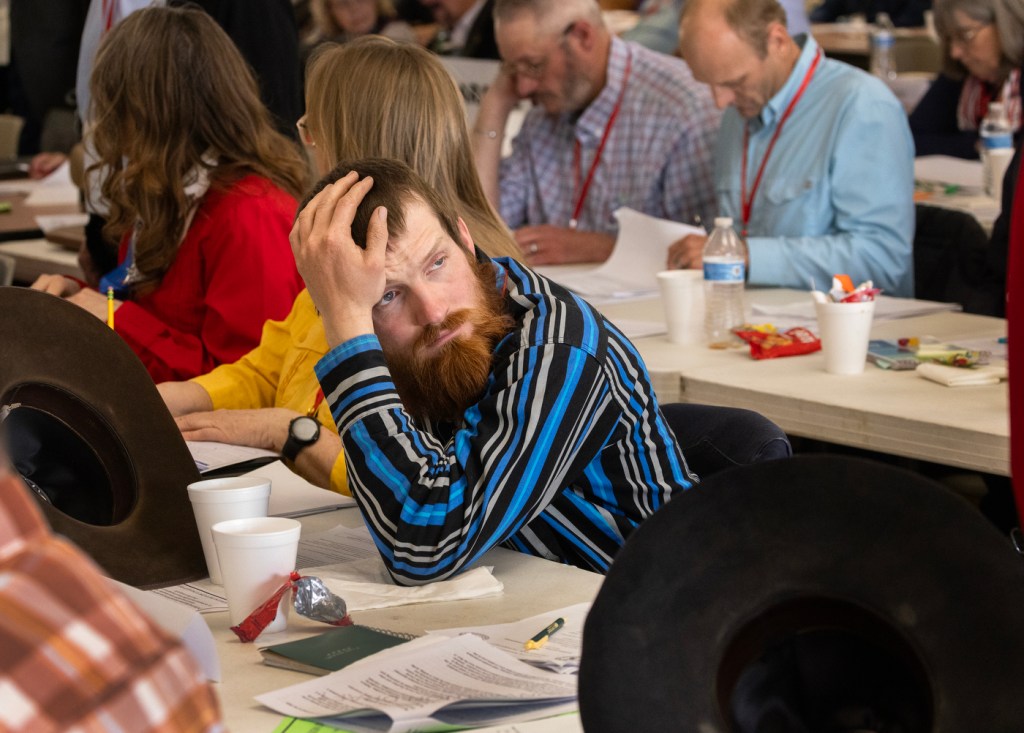
Some of the new bylaws deal with proxies — a person authorized to cast a vote on behalf of another absent member — at county and state GOP meetings. Others made changes to the party’s controversial Dispute Resolution Committee. But the bylaws committee, made up of GOP members from each of the state’s 23 counties, spent most of Thursday debating changes that would allow for the vetting and endorsing of candidates.
Miller opened the meeting with remarks that encouraged the committee to take action.
“What we as a party are moving toward is what people have been asking for for decades,” Miller said before pointing to a U.S. Supreme Court ruling from 1989.
In Eu v. San Francisco County Democratic Central Committee, the high court ruled 8-0 that California’s bans on political party endorsements in primary elections alongside regulations on internal party structure violated the First Amendment’s guarantees of free speech and association.
The bylaws committee first considered directly referencing the case in the preamble to its new bylaws. Instead, the panel settled on language stating the party “is a private, voluntary association of its members, exercising rights of free speech and association protected by the First and Fourteenth Amendments to the United States Constitution.”
“Pursuant to the Supremacy Clause of the U.S. Constitution … the Party possesses the absolute and exclusive right to determine its own leadership, define its own organizational structure, select its standard-bearers, and articulate its own message,” it reads. “These Bylaws, as adopted and amended by the members of the Party, shall be the sole and final authority for all Party governance.”
As the debate got underway, Scott Clem, a Campbell County commissioner and former state lawmaker, was among the first to raise concerns.
“Not necessarily in opposition, but I am trying to figure out the implications of this and how this all works,” he said.
The Wyoming Republican Party, for example, Clem said, is a private organization, but even so, “a private organization is still a corporation” and “corporations, according to the Wyoming Constitution, are a creature of the state and can be regulated.”
“So there’s some of those things that we have to grapple with,” he said.
Koep, the Crook County party chairman, soon spoke up, arguing “there’s some confusion in the room,” and brought the debate back to the 1989 ruling.
“The court said, very specifically, the government cannot tell a political party who its officers can be, how long they can serve, how big its committees can be, or whether it can endorse its own candidates,” Koep said. “Those are the party’s decisions to make.”
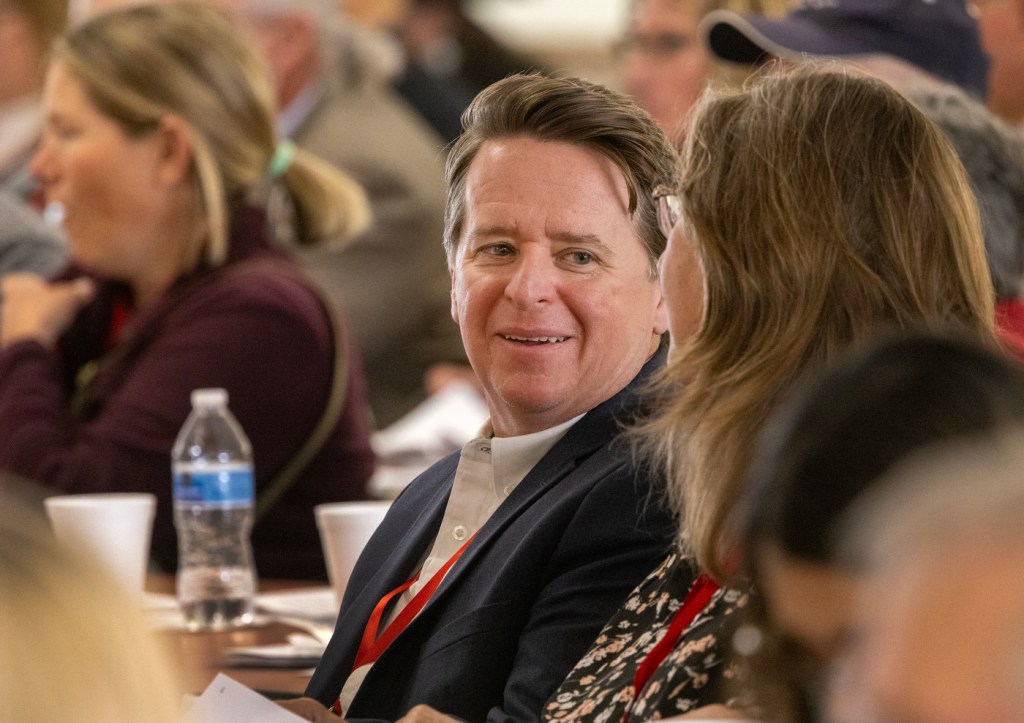
Uinta County’s Karl Allred, who briefly served as Wyoming secretary of state, also weighed in, speaking in some respects from experience.
Allred was a defendant in a legal dispute in Uinta County over who could vote in its 2021 officer and state committeeperson elections. A party bylaw adopted that same year gave outgoing precinct committee people a vote due to their past positions in leadership. The plaintiffs — a group of Republicans on the outs with the further-right Uinta County GOP leadership — argued it was a violation of state law.
Ultimately, the Wyoming Supreme Court sided with the plaintiffs in its ruling. The high court, however, did not decide on whether the state law was unconstitutional since it was “not properly presented and the Wyoming Attorney General was not notified of, or allowed to participate in, the litigation.”
Allred said Thursday, “I really don’t care what the Wyoming Supreme Court said, because they did not look at the U.S. Supreme Court already deciding this.”
Concerns, however, remained unresolved as several members, including Clem, questioned how the new bylaws would work with the current primary election system, which the state administers using taxpayer dollars.
Clem said he was OK with what was being proposed, “but this changes things.”
“Like, are we going to a caucus? Is that the idea? Are we going to, is the Republican party going to fund its own primary? Is that what our donors are going to be expected to do? Because this is where the rubber meets the road,” Clem said. “So that’s what I need to know.”
Meanwhile, Carbon County’s Michelle Sidun said she had “read all of the different Supreme Court rulings” and looked into how different states deal with political parties. But what Sidun was against, she said, was the party declaring its bylaws supersede state law.
“I would love to see our energy not put into these bylaws saying, ‘we’re not going to follow the law,’” she said. “I would love to see the energy put into changing the state statute.”
Vince Vanata of Park County pushed back.
“We are making a statement by putting it in our bylaws that we will not have our First Amendment rights infringed anymore,” Vanata said. “They have been infringed upon for 37 years. Moving forward, this is how we’re going to do business, and if it’s going to require a lawsuit, then so be it.”
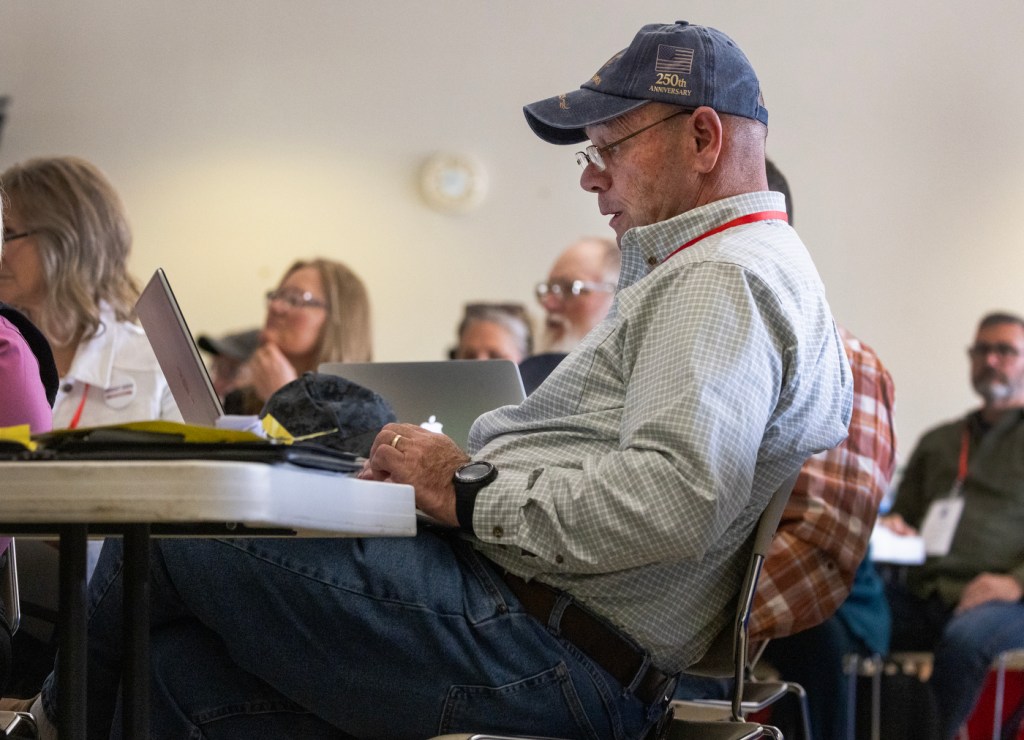
Allred followed up, adding that the party has tried without success “to get the Legislature to come in line with what the Supreme Court has done.”
Miller offered more details about the party’s legal plans. Earlier this year, he said, he received “authority from our state executive committee to engage a legal firm called Barr and Klein, who does this for a living.”
The firm is no stranger to Wyoming politics, having litigated — and won — several freedom of speech cases in the state over the years.
“We’re just excited to be on board for another free speech case in Wyoming,” Stephen Klein, one of the firm’s founders and partners, told WyoFile.
Super PACs allow anybody to spend “unlimited money in support of any candidate,” Klein said, while state law leaves political parties “completely hamstrung.”
And when it comes to spending money in campaigns, Klein said, “that’s really where the party can exercise more control over who’s sticking to the platform and who’s not.”
But, Klein pointed out, that would go against Wyoming’s “unequivocal ban that prevents the party from giving a dime to one Republican over another, or one Democrat over another, right, if it’s the Democratic Party.”
“I think it’s just blatantly unconstitutional,” he said.
In his remarks at the meeting, Miller announced that Klein’s firm had “agreed to do this case effectively pro bono.”
Convention floor
After the Douglas High School Bobcat Band opened the ceremonies on Saturday with its drum line, it performed “The Star-Spangled Banner.” There was a prayer and the Pledge of Allegiance before three girls from Niobrara County sang The Chicks’ “Travelin’ Soldier” to recognize veterans in the room.
Republican members hailing from Douglas, distinguished and young alike, gave remarks, including former state lawmaker Bill Tibbs and Gabe Saint of Turning Point USA’s University of Wyoming chapter.
“It’s good to be home, good to get away from Laramie,” Saint said. The college town, in Albany County, is a pocket of blue in a sea of red.
Then Republican Rep. JD Williams of Lusk, welcomed folks to Eastern Wyoming, a place, he said, “is the most Republican by the numbers.”
And yet, he said, “it is astonishing to me how many lifelong conservative Wyoming Republicans have no idea that the state party is meeting in Douglas, Wyoming today.”
“At this point in history, they don’t really care. That breaks my heart,” William said. “They’ve checked out. Some did five years ago, some have in the last few months.”
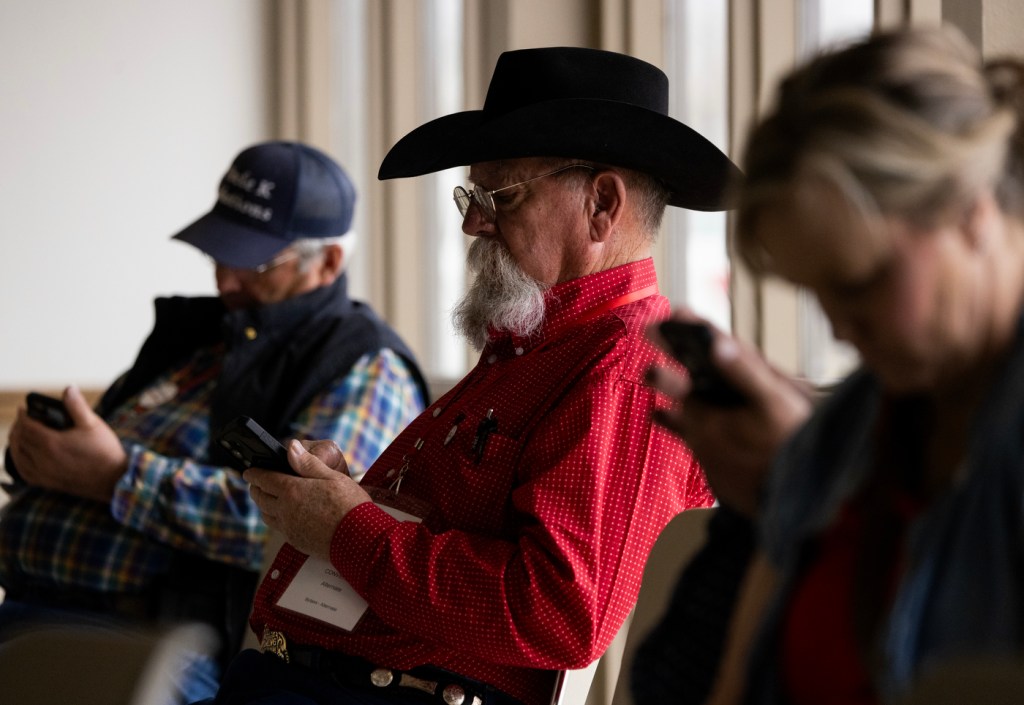
To Williams, who ousted a Freedom Caucus-backed incumbent in 2024, “these are rumble strips,” he said, like the ones he sometimes hears working near the highway on his ranch.
Williams also pointed to Republican lawmakers opposing “legislation that supports coal, oil and gas” and “ethically questionable behavior during the last legislative session,” an apparent nod to the controversy involving a Teton County conservative activist handing out campaign checks on the House floor.
“This is not the first time our party has been on the rumble strips,” Williams said. “Question is: What are we going to do about it?”
“Keep it between the lines, my friends,” he said. “Every mile of road has two miles of ditch.”
Some applauded Williams’ remarks. Others sat silent.
Just before the convention got to its bylaws portion of the agenda, Miller described to the party what he saw as the stakes of their business. He pointed to a Friday ruling by a Natrona County District Court Judge to halt Wyoming’s newest anti-abortion law while a legal challenge proceeds.
“For many of us, this is deeply concerning because it speaks directly to how we protect the most vulnerable among us,” Miller said. “And this brings clarity to where we stand, because without the right to life, the rest of our rights lose meaning. Without life, there is no freedom of speech.”
But if the party chooses “to stick together and fight like hell,” Miller said, it can “win back that ground we have lost,” including Albany and Teton counties. The Legislature’s seven democrats represent those two communities.
Next, Lance Oviatt of Lincoln County brought a motion to ratify the party’s decision to hire a law firm to take legal action against the state.
“I think there’s three ways by which we affect change in this country: the ballot box, the jury box and the ammunition box,” Oviatt said. “Hopefully, we never have to get to number three.”
“We need to go to the courts,” he said, and soon the group voted to do just that.
Correction: This story has been updated to correct details about energy-related legislation. —Ed.

well, i can see that the ‘pride’ of the Park County GOP was there, once again embarrassing all in Cody, Powell, Meeteetse, Clark, Ralston and Frannie. He’s already ruined the local County GOP and looks like an attempt to take down the State party, not that these clowns needed the help
Silly people. Don’t you know that laws aren’t meant for republicans?
They are just following the GOP playbook of inventing and sensationalizing “non-problems”. The Wyoming GOP has worked just fine with the State Constitution until the MAGA clown show came to town.
This is what happens when there’s a super majority of one party, like in Wyoming. If there were more Democrats, the Republicans wouldn’t dare do such a thing. Now you have the Republicans fracturing ( which of course they already have with the freedumb caucus and ‘normal’ Republicans) into a group that wants to call the shots despite the public vote.
“I think there’s three ways by which we affect change in this country: the ballot box, the jury box and the ammunition box,” Oviatt said. “Hopefully, we never have to get to number three.” What a morally offensive comment by Mr Oviatt, chairman of the Lincoln County Republican party. This isn’t the 1800’s anymore…….grow up, tune in and learn to modify your outrageous thoughts.
He’s just another dumb Wyoming hick.
If they truly wish to be a ‘private organization’ rather than a privileged sanctioned part of the electoral process, then the statutes should be changed so that they lose the right to select candidates to fill legal vacancies of elected officials from resignation, death, or removal. No ‘private organization’ should have that right – it should then be strictly up to local councils. county commissions, or the governor, as elected officials, depending on the position. Primaries should be fair and unbiased open competition between individuals before the general public, without weighted control of a group of individuals or private organizations. Or make all elected positions non-partisan with the top two primary selections proceeding to the general election. That would be real democracy in voting for a change.
It all comes down to the Freedumb caucus trying to buy more votes. It’s that simple.
Will they be operating and, more importantly, paying for their own primary elections moving forward as well?
Surprise surprise, the fake christians are trying to take the vote away from the people. Just say “YOU’RE FIRED.”
JD Williams is right, the Wyoming GOP has hit the rumble strips and is veering to the ditch on the right. He is also right that many longtime Republicans have “checked out”; they are sickened, discouraged and disgusted what has happened to the party they have supported, worked for and contributed to for so long. But it is not too late. For them I say, “get back in the game”; support those running for precinct committee persons who will vote for new leadership in the party; support and work for those running for local and state offices who are more in line for the ideals and principles that Republicans have stood for. It is not easy to “right the ship”, but it is worth making the effort.
You’re right Rex. These people on the extreme right, by believing that they are the only true Republicans, while wrapping themselves in religion and the flag, have morphed into nothing more than self serving, un-American bigots.
Rather than wanting to build a better Wyoming and a better United States, they seem to want to assimilate the population into a collective of white, english speaking, individuals who will never doubt who’s in charge and never question the decisions that are being made on their behalf.
Diversity is what made the United States the great country that it is, not the isolationism that’s currently taking place that’s making us weaker and hated by the rest of the world. I used to believe the Republican party shared most of my values but not any longer…I’ve become a proud RINO because of the very thing Maggie’s article is about….an attempt to take the power away from the voters so that one party can remain in power. These people should all take a long hard look in the mirror and decide if this is what the founders really had in mind 250 years ago.
So the GOP believes in private property rights (especially if they can fence off public property); religious freedom (as long as everyone agrees with their religion); family values ( as long as it’s their values); but they are law abiding (as long as they agree with the law).
Right on, Mike. You know, I almost wish the Republicans would go ahead with this insanity. Their endorsement list would be a reliable guide for the rest of us.
Per JD Williams comment, the state GOP hasn’t lost any ground to the Democrats. The number of Democrats in our state government has dwindled over the last 20 years. I hope we (the Dems.) can actually gain back some ground. It goes without saying that any one party controlling all aspects of our shared governance is not a good thing. Differing opinions and healthy debate about lawmaking is a good thing for us all.
So, it was pretty quiet all over Wyoming last weekend. The local clowns, stooges and village idiots seemed to have vanished from the streets. Oh wait, they were all in Douglas