


Gov. Mark Gordon’s push for carbon capture at coal-fired power plants and for pumping planet-warming carbon dioxide underground to produce more oil isn’t a climate crusade, he told business leaders Tuesday in Casper. It’s an acknowledgment of where policies outside Wyoming have driven markets.
Wyoming, the nation’s top coal producer and among its top oil and natural gas producers, can help meet the goal — and the market reality — of reducing carbon emissions into the atmosphere, he said. But the state doesn’t have to abandon its fossil fuels to do it.
Instead, Gordon is on a mission to prove that integrating carbon capture with fossil fuel production and use is not only economically and technically viable, it’s necessary to fill in the energy-availability gaps that renewable energy introduces into the western electricity grid when the sun doesn’t shine and the wind doesn’t blow.
And if people are honest about the full cost and complete carbon life cycles of both renewables and fossil fuel energy, more states will get on board, he said.
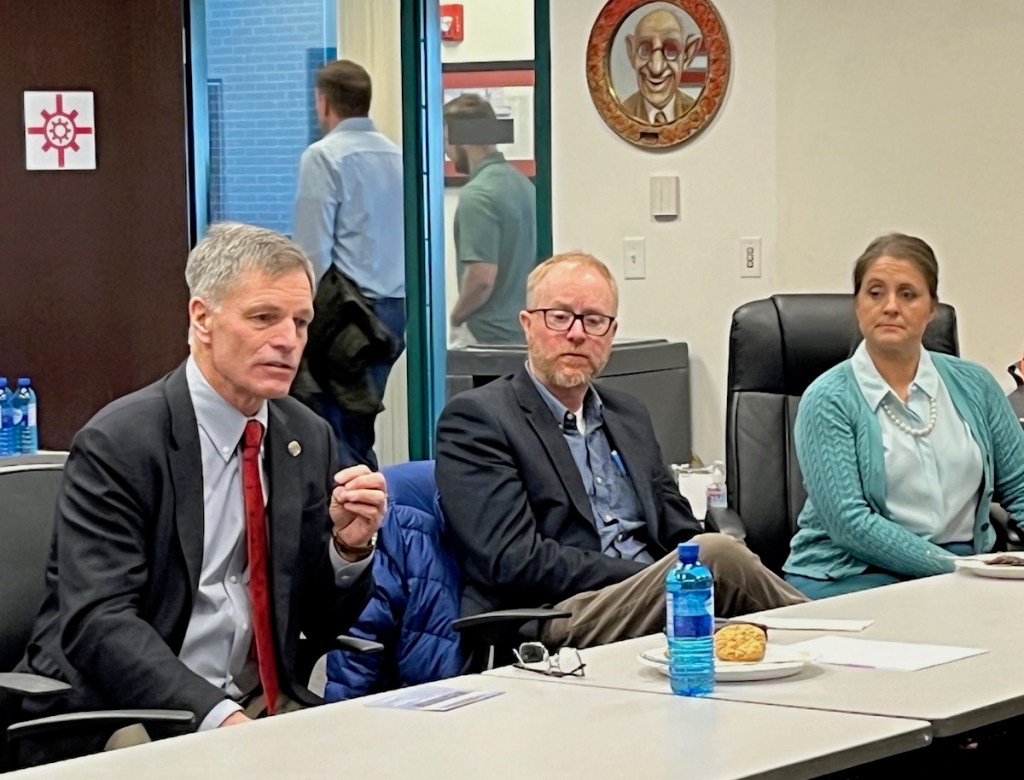
“If we can extend the life of these coal plants [by retrofitting them to capture carbon] for a period of time, we can meet that gap,” Gordon told members of Advance Casper, the city’s business and economic development group.
Gordon has been aggressively sharing his energy vision of late. He spoke last fall at Harvard University, which drew a strong rebuke from Wyoming’s far right. He also appeared on “60 Minutes,” where the governor discussed making the state carbon-negative.
One challenge, Gordon explained to members of Advance Casper, is that states that are demanding low-carbon or carbon-free electricity are not fairly distributing those costs, which include the loss of viewsheds and wildlife habitat from wind and solar farms in Wyoming. At the same time, those states don’t want to help pay to capture carbon at Wyoming coal plants, despite their own carbon policies that push costs onto Wyoming ratepayers.
“We need to be able to have the grid pay for the desire to reduce carbon emissions — that’s consumers across” the West, Gordon said.
To that end, Gordon has been lobbying his counterparts in the Western Governors Association. Gordon was elected WGA president last summer, and he established “Decarbonizing the West” as his signature initiative during his one-year tenure.
The initiative spans an all-of-the-above energy strategy, from nuclear and geothermal power to smarter siting of wind and solar development. Bringing some of those western state leaders onboard with his ideas for adding carbon capture to fossil fuels is still a challenge, Gordon said.
Meantime, the Biden administration — although it’s onboard with Wyoming’s carbon capture research efforts — continues to present existential threats to the state’s struggling fossil fuel industries through restrictive rulemakings to cut carbon emissions, the governor maintains.
State of the state’s energy
In his State of the State address on Monday at the Capitol, Gordon said the Legislature’s task of crafting a state budget for the next two years is particularly challenging under the weight of federal policies that the Biden administration continues to pile on fossil fuels — an industry that has “anchored our economy for over a century,” Gordon said.
The weight of Wyoming’s fossil fuel economic anchor has varied greatly in recent years, and it’s the largest factor in setting the state’s budget — in boom times and in bust. Although revenue from Wyoming’s carbon-based energy industries rebounded after the economic shock of the pandemic, markets have begun to settle back into broader trends that point to a continued decline in Wyoming coal consumption and the potential for even more volatility for oil and natural gas.

What looked to be an extra $50.3 million in extra discretionary budget spending, according to Wyoming’s revenue forecast in August, was dialed back in January to $37 million.
Biden administration policies — such as oil and gas leasing reforms, methane emission reduction rules, coal power plant emissions and a restrictive proposal for energy development in the Bureau of Land Management’s Rock Springs Resource Management Plan — are a significant driver of forecasted revenues and cause for a conservative approach to the state’s budget, according to Gordon.
They also represent a federal policy agenda that is “misguided,” “warped” and “unwise” — and, borrowing from a phrase by Gulf War military leader Gen. Norman Schwarzkopf, they amount to “pure, unadulterated ‘bovine scatology,'” Gordon declared.
“Wyoming people know how these policies have left our nation more vulnerable to put our economy — our very way of life — at risk,” Gordon said.



Carbon capture defies physics and thermodynamics. It can’t cost less energy to recapture carbon than one gets from burning an unsaturated carbon-based fuel. And coal is the MOST unsaturated carbon-based fuel.
Remember when a certain oil company was fined $6 million for underpaying royalties, and then the gov gave them $6 million. This is the same Gov that rejected money to feed children.
It seems precious Wyoming will be more and more at the center of so many changes to come. Let’s hope the carbon capture research is at the forefront and they win big enough to prosper and wisely manage, even lead the nation.