


PINEDALE—Mike Schmid told Wyoming Game and Fish commissioners that pronghorn populations remained in good shape throughout the intensive-drilling era 20 years ago in the Green River Basin’s “mega fields” — some of the largest natural gas fields the industry has ever known.
And for that reason, the industryman could not get behind the idea of classifying 2.8 million acres of the region as a designated migration corridor for the Sublette Pronghorn Herd.
“As somebody that’s been in the business my entire life, it’s hard for me to support this,” said Schmid, who was ousted from his post on the commission he addressed three years ago. “I just don’t see the need for it.”

Several others tied to industry urged inaction, or adding contingencies, at the Tuesday meeting in Pinedale. Colin McKee, with the Petroleum Association of Wyoming, expressed worries that if the state moves forward with designating the route, it could lead to more rigid protections — and more rigid regulations — from the federal government.
“Then it gets to a place where we don’t have as much control,” McKee told commissioners over Zoom.
But on Tuesday, Wyoming officials broke from a long track record of heeding industry concerns. Five years after the state agency slammed the brakes on designating the Sublette Pronghorn Herd migration path, it reversed course. In a 7-0 vote, the Wyoming Game and Fish Commission opted to pursue establishing protections that could help hold the line of a migratory pronghorn population biologist say is at “high risk” of being lost.

“Today’s an exciting day,” Jill Randall, Game and Fish’s big game migration coordinator, said at the onset of the discussion.
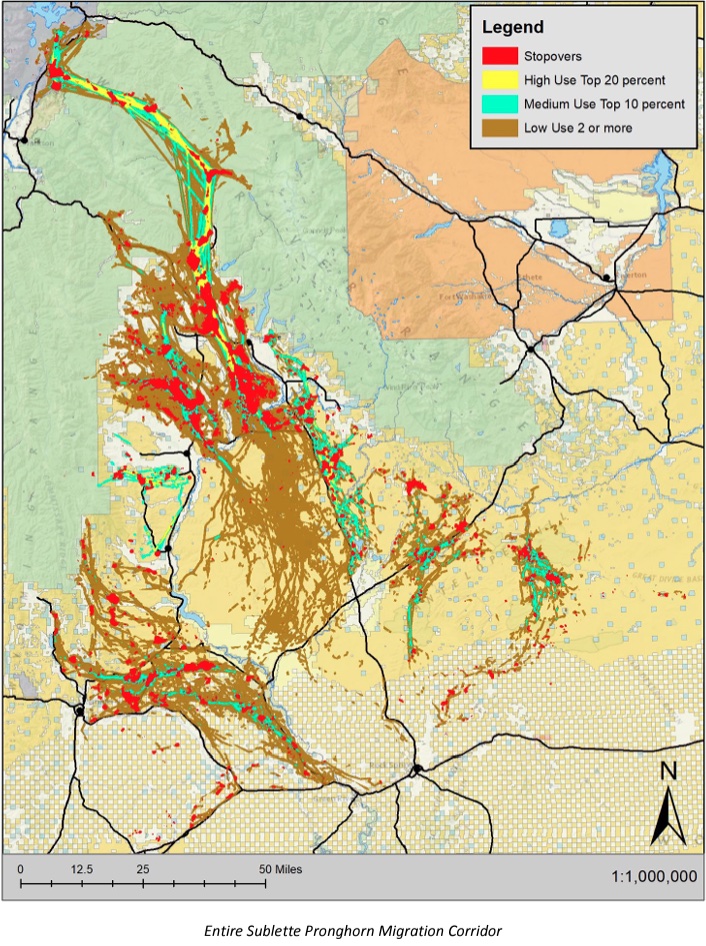
Randall outlined how 415 GPS-collared animals studied over 20 years helped inform the agency’s recommendation to designate the Sublette Pronghorn Herd’s web of migrations, which tread from Interstate 80 to Jackson Hole and have gained national notoriety since the long-distance passageway was discovered more than a quarter century ago. She presented a map that showed huge gashes in the landscape where subdivisions, energy development and other human activities have fragmented the sagebrush sea the pronghorn need to travel through to survive.
“For example, last winter, it was very apparent to us that those individuals that had the ability to move south … had a higher likelihood of survival,” Randall said. “Connectivity to get them to those crucial winter ranges in severe winters is really essential.”
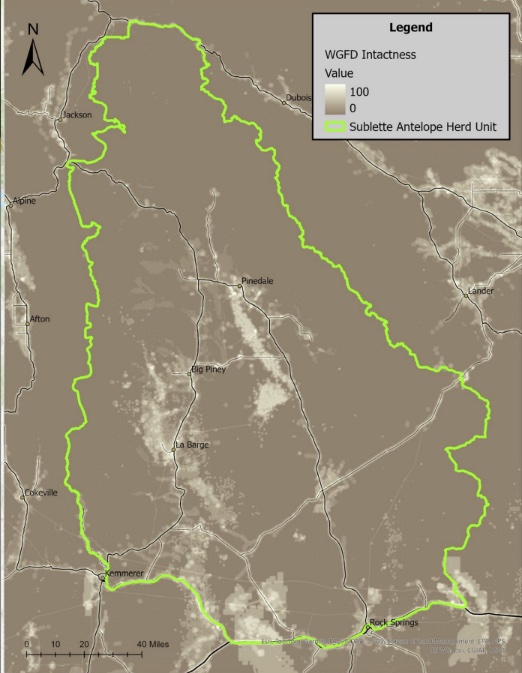
Game and Fish staff’s recommendation to move forward also engendered a chorus of support. Some 90% of the 300-plus comments that state agencies received advocated for protecting the pronghorn herd.
“Overwhelmingly, the public sentiment was in support of moving this process forward,” said Doug Brimeyer, Game and Fish’s deputy chief of wildlife.
Countering reluctant industry representatives, conservationists came out in support of the state agency.
“It’s a lot easier to maintain habitat integrity than it is to try to restore something after it’s been degraded,” said the Wyoming Outdoor Council’s Meghan Riley.
Nick Dobric, with the Wilderness Society, applauded the proposal: “We have something really special here,” he said. “A lot of other states, a lot of other communities really envy what we have for wildlife in Wyoming and this process will help us keep that.”
State officials didn’t dismiss industry’s concerns about the federal government meddling in migration issues.
“What if we don’t move the corridor forward? What does that say to our federal partners?” Game and Fish Deputy Director Angi Bruce said. “There’s a risk there, too. If we don’t do anything, the risk may be that they need to step in.”
The federal government, she said, “wants to have a piece of migration.”
Much of the consternation from industry reps who spoke stemmed from the Bureau of Land Management’s hot-button resource management plan for its Rock Springs region, which proposes “no surface occupancy” in the entirety of designated migration corridors — plus future corridors — as the “preferred” course of action. Wyoming officials, including Gov. Mark Gordon, have pressured the federal agency to defer to the state’s policy, which is much more permissive of development, especially outside of the most-constricted “bottleneck” areas.

Nevertheless, Wyoming’s policy is seen as one of the most robust actions by a western state to conserve wildlife migration.
Pursuing the Path of the Pronghorn designation will be the first time state officials take the policy for a spin since it was revamped nearly five years ago and put under the jurisdiction of the governor. A good deal of bureaucratic process — and several decision-making junctures — wait ahead.
“Does that allow us to pump the brakes? It looks like it does,” Game and Fish Commissioner Rusty Bell said about the process.
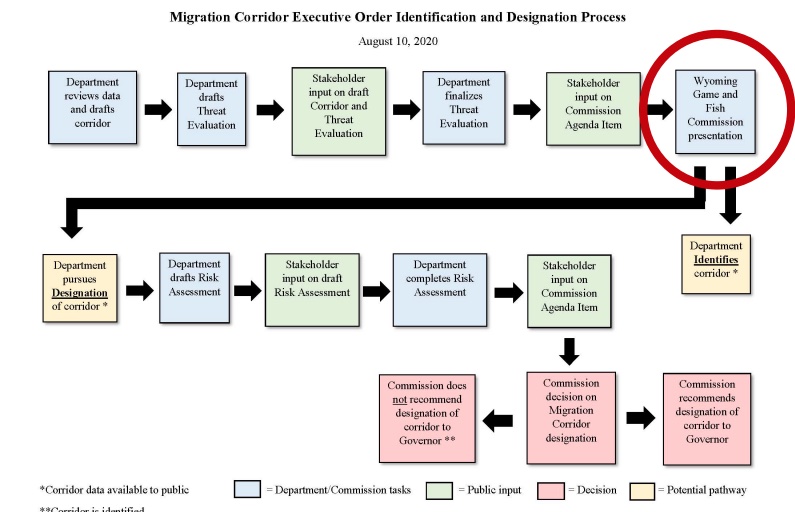
Game and Fish’s next step is to prepare a “biological risk assessment.” That document should be out to the public by late 2024, Brimeyer said. Gordon will also assemble a stakeholder group that will work over the state’s proposal. At the end of the process, which could drag for another year or more, Gordon will make the final decision.

I really hope that this ancient path is preserved. What kind of people are we? Industry pressure indeed. How dull, boring and single-mindedly selfish not to.
GAME AND FISH’S BEST AVAILABLE SCIENCE MUST BE INCORPORATED INTO THE ROCK SPRINGS RMP REVISION: Just a reminder to everyone that the scientific data Game and Fish has methodically generated over the past 50 years will be and already has been – submitted to the BLM for inclusion in the RMP revision – this is nothing new its standard procedure. However, when overwhelming evidence is submitted to the BLM it certainly encourages them to seriously consider migration corridor designations in the preferred alternative. The migration information also verifies the considerable use of the BLM lands in SW Wyoming by antelope, elk and deer particularly during winter. With that it mind, BLM basically has to allocate the available forage/grass between cattle, sheep, wild horses, antelope, elk, deer and desert sheep – something has to give. Over use of the range by wild horses is the obvious use which should be reduced; however, Game and Fish’s migration best available science could result in changes to grazing allocations based on the BAS. Of prime importance of course is whether or not Game and Fish’s migration BAS is an actual recommendation by the Game and Fish Department to BLM – a recommendation which would support designation of migration corridors on BLM surface – a designation which could lead to no surface occupancy inclusions in the Final RMP. This weeks decision by the Game and Fish Commission certainly could have an impact on the Final RMP – we’ll just have to wait and see what the revised Draft and Final RMP looks like. I have a hunch that BLM now has enough BAS in hand coupled with public sentiment and the Commissions decision this week to include designated NSO corridors – but I may be wrong again – what do you think – should BLM include designated NSO migration corridors in the Final RMP???
I find it sad in a way that this topic has taken 25 years to begin to move forward. Unfortunately it is a reminder that all wild life, fish and native Americans have one thing in common. At some point all of them were or are a threat to the financial well being of a few individuals, developers and corporations. Remember history is written by the winners, but it does not mean it is the truth.
If the oil and gas industry is not, as they claim, having a negative impact on pronghorn populations, why then are they fighting this proposal? Shouldn’t the industry be supporting the effort if their claims are true?
GAME AND FISH MUST TAKE THE LEAD!!!! Yesterday’s decision and vote by the Commission signals that Game and Fish is now ready to take the lead which will precipitate action on the migration corridors. Game and Fish has the best available science on migration corridors. I worked on a few hot springs protection issues here in Hot Springs County – and when the County Commissioners took a firm stance on a hot springs protection issue – which we did – everyone else fell in right behind us including State Parks. Call it providing political cover or CYA – most agencies appreciate someone else going first. With respect to the migration corridors, the BLM will really take notice of yesterday’s decision by the Game and Fish Commission; and, hopefully, the Sublette County Commissioners will firmly support migration protection issues. Which brings us to Cheyenne – the governor and his staff. They were caught on the wrong side of the Marton Ranch acquisition and on the Kelly school section issue – could they possibly ignore public opinion and the Game and Fish Departments recommendations concerning migration corridors??? After making extremely poor judgements on the previous two issues it concerns me that they might get it wrong again down there in the Governor’s Office. Its about time they listen to the people and the Game and Fish Commission and fully support protection of migration corridors in the Green River basin and drainage. And, its about time for Game and Fish to start purchasing easements for migration corridors in the bottle neck areas of high use – the private landowners must be compensated for giving up the future development rights on portions of their surface estate. The Hoback migration corridors would be a good place for purchasing of easements – and, there are many partners who can now join Game and Fish in their efforts to purchase easements across private land. Hopefully, yesterday’s Game and Fish decision and vote will now get the ball rolling but Game and Fish absolutely must take the lead and provide the leadership which migration corridors need. Step forward and lead ladies and gentlemen.
Many thanks to the Wyoming Game and Fish Commissioners and the staff of the Wyoming Game and Fish in working to protect the migration corridor for the Sublette Pronghorn Herd. Pronghorn are a delight to behold and are a Wyoming resource that make Wyoming attractive to visitors and Wyoming residents alike, as well as representing a vital part of nature we need to help preserve. These actions make Wyoming stronger and better for all. It is my hope that Governor Gordon will concur to help make this happen.
Obviously Governor Gordon will make the final decision to protect that migration corridor for the antelope among other game animals . After the winter of 2022 and 2023 they deserve a break . That migration route is essential for their survival . I hope the governor will protect them .
Big money has killed so much of life on this planet, can you at least let this unique and fascinating species have a life????