

Whether a state lawmaker must live in the legislative district where they were elected is the biggest no-brainer in Wyoming politics.
Opinion
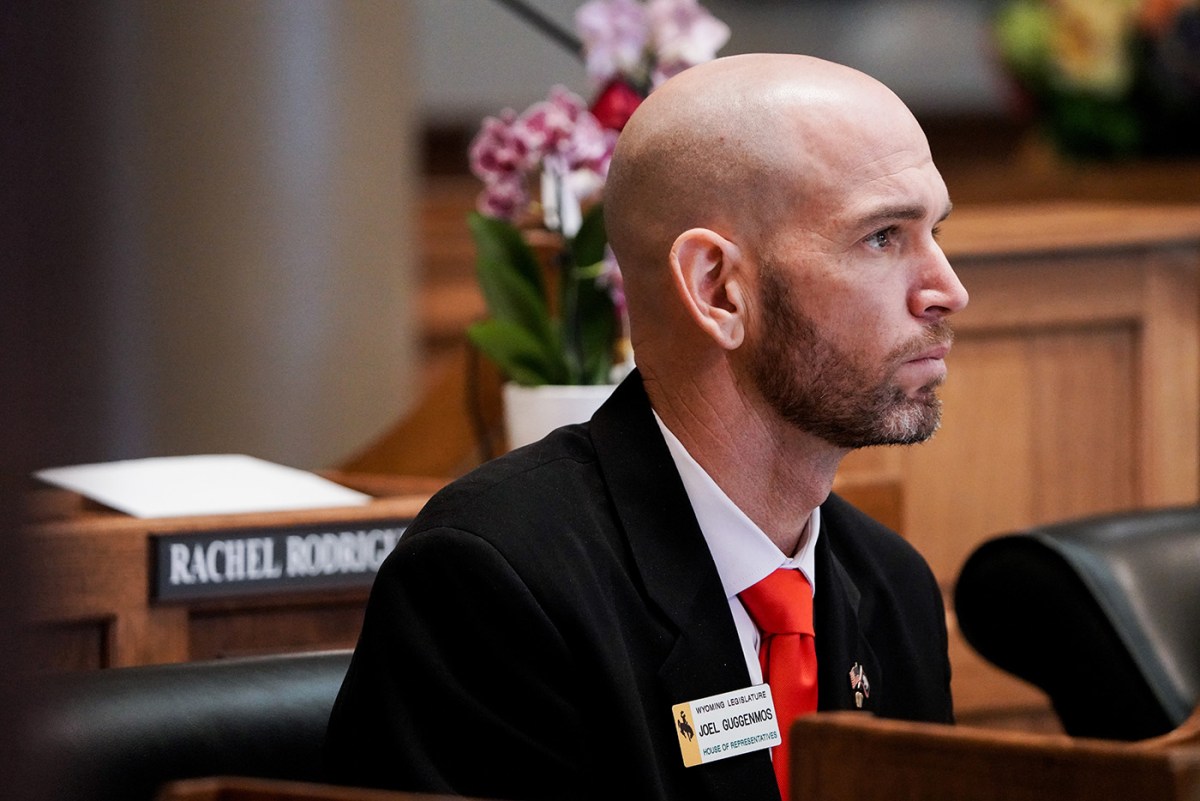
Everyone can get behind that concept, even Rep. Joel Guggenmos, R-Riverton, who is under investigation for living outside his district for several months while serving in the Legislature. He told WyoFile last week he thinks a residency requirement should be in the Wyoming Constitution.
“It’s only right that people live in and around the people that they represent,” Guggenmos said. “That’s my belief.”
Mine too. In fact, it might be the only issue the freshman Freedom Caucus legislator and I will ever agree upon. Still, that’s at least proof that polar political opposites can find some common ground. Can we get an “amen” for bipartisanship?
Not from me. Like all disputes over legislative residency that have transpired in Wyoming over the years, the hole Guggenmos dug for himself comes with its own special set of circumstances that are difficult to equate.
Coupled with the challenge of matching constitutional requirements with evolving state laws, it’s no wonder that the saga of Guggenmos’ house District 55 residency, and what happens next is as clear as mud.
Guggenmos, elected to the House in 2024, was living with his wife in a log cabin in his Riverton district until last September, when he said his landlord shocked him by raising the rent by six times the amount his family had been paying.
Anyone would be stressed by that unbelievable situation. Guggenmos said the immediate answer was moving his family to live in an RV parked at a relative’s place in neighboring House District 33, where Rep. Ivan Posey, D-Riverton, is the elected representative.
Guggenmos told WyoFile that before he moved to HD-33, he asked the Legislative Service Office for advice. The LSO confirmed it gave him a copy of the agency’s memo based on historical and legal precedent, including a dispute in 2022 when the Wyoming Republican Party charged that a moderate GOP House member, Dan Zwonitzer, was living outside his Cheyenne district.
The House voted to not form a committee to investigate the Zwonitzer case, but the hoopla surrounding the incident took its toll on the legislator, who lost his 2024 primary bid for an 11th term.
LSO’s memo explained the reasoning behind what it shared with Guggenmos: “The Wyoming Constitution does not require a member to continue to reside in his district after his election for purposes of being qualified to continue to serve in the House of Representatives.”
Just when I think Wyoming politics can’t get any stranger, a story like this darkens our skies. In addition to being disheartening because of its conclusion, the memo is counterintuitive to everything we learned in civics class about how the democratic process is supposed to work.
Guggenmos said based on the LSO memo, he believed his move to the RV outside of his district did not create a vacancy. He also said he submitted a “routine” ethics disclosure form to the Secretary of State’s Office at the end of December, listing the RV location as his residence. The Guggenmos family didn’t move back to HD-55 until last month, when they rented a different house.
The window to file as a candidate for office is May 14-29.
Guggenmos’ departure from HD-55 raises several questions. If he filed paperwork with the Secretary of State’s Office detailing exactly where he lived, doesn’t the office have a responsibility to check if that address is in a legislator’s district?
I’m confident that the vast majority of Wyomingites would say we can fix this hole in our election laws, but it’s not going to be easy — and it may indeed be impossible. Think “Catch-22” to infinity.
The Legislature thought it worked this residency problem out in a straightforward way in 2003. It passed a law that reads: “A vacancy shall occur in the office of a member of the state Legislature when the person fails to reside in the legislative district from which he is elected.”
Under this law, the fate of Guggenmos’ term would be obvious: He left his district, creating a vacancy that must be promptly filled. The Fremont County GOP’s precinct committee women and men would need to seek and review applications for a new representative, interview the candidates and send three nominees to Fremont County commissioners for the final selection.
It’s so obvious, in fact, that when Fremont County Clerk Julie Freese received a complaint from a HD-55 resident, she decided it had merit and forwarded it to the Fremont County Sheriff’s Office, the secretary of state and attorney general. The sheriff is investigating, and the other two officials did not respond to WyoFile’s inquiries.
Freese did exactly what she should have under that law. However, in 2004, a year after the vacancy statute went into effect, the Wyoming Supreme Court ruled that the state’s statutorily imposed term limits are unconstitutional.
What does that have to do with this controversy? On the surface, nothing, but it had an important impact nonetheless. The justices ruled that the qualifications to be a legislative candidate are precisely what the state Constitution spells out, and nothing more.
It’s a fairly short list: U.S. citizenship, at least 25 years old, and a resident of the district you want to represent for at least a year. The state is prohibited from passing other laws limiting who can run for the Legislature.
Or put another way: The Wyoming Constitution requires lawmakers to live in their district when they’re elected, but it doesn’t mandate they continue residing there for their entire term.
Why are there no guidelines for how long a lawmaker is “away from home” for any reason before voters can reasonably expect him or her to return to the job of representing them? Why doesn’t the Wyoming Constitution establish that lawmakers must continue to live in their district after being elected?
Is this any way to run a state legislature? I’ll answer that one: No, it’s crazy.
Amending what the state’s founders included in the constitution is an incredibly high bar.
First, the House and Senate must both approve putting the amendment on the next general election ballot by a two-thirds majority. It may be a common sense change, but special interests might fight it regardless.
Guggenmos raised the spectre of people playing political games with the issue. So did the Wyoming Republican Party, which recently voted to ignore state election laws and endorse primary candidates.
“Somebody’s coming after me now to try to discredit me. And that’s fine. I didn’t do anything,” Guggenmos told WyoFile. “My conscience is clear.”
Ginger Bennett, chair of the Fremont County Republican Party, issued a statement strongly supporting Guggenmos. She told Cowboy State Daily he has built a “strong conservative record” in the Legislature and shown “principled and unwavering commitment to conservative ideals.”
Bennett praised Guggenmos for “his honesty throughout this matter” and “demonstrating the integrity that defines true public service.”
Guggenmos would earn those compliments if he skipped this year’s election, reestablished his residential requirements in HD-55, and got back on the ballot in 2028. He likely will not need to do that, because the courts determined in Zwonitzer’s case that if there’s a question about a candidate’s residential status, it’s up to the House to decide whether to have a special committee further investigate. I doubt the Freedom Caucus-led House would pursue such an inquiry.
In my view, Guggenmos no longer meets the requirement to have spent the past year in his district before the Aug. 18 GOP primary. Instead of resolving the issue in a way that would earn him voters’ respect, Guggenmos is making excuses that what he did wasn’t a big deal because he was living “just outside [my] district.” But it doesn’t matter whether it’s a mile or 100 miles. He wasn’t living where his constituents expected him to be.

The law seems to be pretty clear on this, at least based on what I’ve read thus far, Mr. Guggenmos doesn’t have to resign his seat, but neither is he eligible to run for reelection this year. Knowing Julie Freese, I expect that if Mr. Guggenos does file for reelection, she will faithfully follow the law and deny him access to the ballot. Having to move outside the district temporarily – although it is a bit of a stretch to believe that he couldn’t find ANY place to live within the district for 9 months – is unfortunate, in the long run it is an even bigger stretch to suggest that any harm was done by Mr. Guggenmos’ absence and he shouldn’t be pressured to resign his seat. But he is NOT eligible to run for reelection. We will soon see if he is a man of principle or if he really is one of the tinfoil Stetson wearing Free Dumb caucus weasels who are convinced that rules only apply to their opponents.
Had the Guggenmos house burned down, would this be an issue? They moved (obviously temporarily, the new “home” was an RV on a relatives place) until they could find a new place that met their requirements and was in his district.
I agree with Kerry Drake?! Weird.
In the case of Dan Zwonitzer, he did not move back to his district, his district moved to include his new home in redistricting. And yes, the Wyoming Caucus wasn’t going to form a committee to investigate.
In fact, the legislature as a whole is loathe overturn a vote of the people for their representatives. I suppose that residency only really matters with the voters… or not.
There is a long history of residence infractions. Easy to do when you have homes in various states and counties. And easier to deny allegations.
When Hank Coe wasn’t living in Teton county or in Arizona, he was in his district. Hank was good friends with the Arizona Senator Rich Crandell. They spent a good amount of social time in Arizona and had the chairmanship of the education committee. Hank had it in Wyoming, and Rich had it in Arizona. When Rich Crandall resigned from the AZ legislature, he announced in the paper that he had found his new dream job. This was about a week after the passage of SF-104. Lo and Behold, he shows up for work as the director of the Wyoming Dept. of Ed. Of course, he had contracts with the department of Ed for about a year before his arrival.
Good old boys and residency means that the lines of residency are dotted.
Bob Nicholas’ wife says in an online magazine that she lives with her husband in Lander.
I can’t even tell if Megan Degenfelder lives in Laramie or Laramie County. I know that nobody works on the second floor of the Herschler East building, they must be exercising their residency. Except for the lovely lady that is always in to work at about 5AM.
Is Zoom a residential address?
Does it even matter? Residency is defined differently for elected office than it is for UW, than it is for a fishing license… Didn’t Liz Cheney get fined for fishing in Wyoming as a Virginia resident whilst running for Congress?
https://billingsgazette.com/news/state-and-regional/wyoming/liz-cheney-jumped-the-gun-on-wyo-fishing-license/article_3302576a-3443-54d9-b483-aa08fd6850de.html
In the cowboy state, it isn’t hard to see the cowboys roam.
The only certain residency is in Rawlins, unless there is an escape.
There is no need to change the law or the Constitution. We just need to elect people who do what’s right not what they can get away with. The statutes and the Constitution always tell you what’s legal, they don’t always tell you what is right. If Rep. Guggenmos is truly a man of honesty and integrity he will do what is right, not just what he can get away with. The right thing to do is resign, it really is that simple.
A very interesting and informative piece.
However, you failed to remember that the country is operating on the Trump rule
Two wrongs make a right and if that’s not right, it’s three wrongs make a right and until someone challenges it you get away with it.
Trump rules have really been adopted by the free dumb carcasses. So, it’s not wrong until someone calls you on it.
I’m glad you were calling them out on it.
It is my hope that the people of Wyoming will wake up, get out and vote in the primary and get the wackos out of the state legislature. If not, we’re in for a very long haul.
Greetings. As a longtime reader and Wyoming resident, I thank and applaud your continued dedication to rigorously supported research and informing the people. Again, many thanks.
I have had the privilege of both following Kerry Drake’s work and knowing him personally for many years. I consider him a friend, trusted and talented writer and a voice our state has always desperately needed. Thank you, Kerry.
Warmest regards.